Fundamentals of Data Visualisation
3
votes
A report published in Nature Human Behaviour (hard paywall): Sleepers track informative speech in a multitalker environment
An article published in the Sydney Morning Herald (soft paywall): Your brain is listening and processing while you sleep
A press release published in Mirage News (no paywall): Active sleep is more than just counting sheep
An article from the Sydney Morning Herald: Fact: Calling out political furphies works, in Australia at least (with some local flavour)
An article from New Scientist: Australians care if politicians tell lies, but people in the US don’t (from a non-Australian point of view)
The study itself in Royal Society Open Science: Does truth matter to voters? The effects of correcting political misinformation in an Australian sample.
Hello everyone,
Today we cover entropy and the heat death of the universe.
The previous chapters can be found here and here. While I recommend you read both, you should at least read the first part and skim the second.
A collection of all topics covered can be found here: https://tildes.net/~tildes/8al/.
Entropy describes how chaotic a system is. In thermodynamics, chaos is created from an irreversible process. We are all sort of familiar with this concept. A broken cup will not unshatter itself. As a consequence of how our universe works, (net) chaos can only increase. And this might have far reaching consequence, if we look at the effects of entropy on a cosmic scale.
Entropy describes an amount of irreversible chaos.
But first, let's cover cycles super quickly. In thermodynamics, a very important concept is a "cycle". A cycle is a repeating process, that returns to its initial condition. For instance, when we ride a bike. We're turning our feet around the crank shaft. Repeatedly returning to the same position we started from. As we push on the pedal, some of our work is lost and turned into heat. Primarily due to friction from the wheels and from the different mechanical parts.
A cycle that wastes no energy is called a reversible cycle. That would mean 100% of the work in a cycle (even the work that is turned to heat) has to be returned in some way to its original state. The most famous example of this is the Carnot heat engine.[1] But in reality, the Carnot heat engine is nothing more than a theoretical engine. As we remember from before, we cannot turn 100% of heat back into work. So any heat engine, be it a car's motor, a refrigerator, a star, or the human body, will in some way contribute to this irreversible chaos.
Now what about entropy? If we look at entropy at the molecular level, it all becomes a bit abstract. But we can think of this concept with bigger building blocks than molecules, and still be close enough. Say you have a brick house with orderly layed bricks. This house would love to come crashing down. And lets imagine it does. When the house lays in ruins, it is not likely to suddenly "fall" into the shape of the house again. So if the house has collapsed, our system is in a higher state of chaos. Our entropy has increased. And unless we supply work to the system (and waste energy trough heat), we will not get the brick house back.
So now we understand, that on the grand scale of the universe, entropy will only increase.
But what are the consequences of this? Imagine entropy going on for billions and billions of years. Everything in the universe slowly reaching a higher state of chaos. Everything that is orderly, turns into chaos. All high quality energy has turned into low quality energy. Everything has been wasted and turned into heat. Everything ripped apart until you are left with nothing to rip apart. At this point, there is no interactions between molecules any more. Everything has reached absolute zero temperature.
At this point, entropy is at its absolute maximum. And we have reached entropic equilibrium.
This is the heat death of the universe.
Of course, the heat death of the universe is just one of the many theories about the end of the universe. It assumes that thermodynamics properly describes the universe, and that there are no hidden surprises.
Frankly told, it's the best bet we have with our current knowledge. But we still know so little. So I would not panic just yet. Alternatively, this is where we could continue with "an engineer's perspective on existensial nihilism". But I think that this is something better reserved for later, and better presented by someone else.
We have covered what I consider the absolute minimum of thermodynamics, that still gives us a basic understanding of thermodynamics. There are of course a lot of other topics we could cover, but thats it for now. I will potentially write an appendix later with some questions or things that have been asked.
But for now, that's it. Questions, feedback or otherwise?
[1] The Carnot heat cycle is a bit beyond the level of what we have discussed so far. It describes a system where heat is supplied and removed to have a piston expand and contract without any energy becoming waste heat.
I want to give an introduction on several physics topics at a level understandable to laypeople (high school level physics background). Making physics accessible to laypeople is a much discussed topic at universities. It can be very hard to translate the professional terms into a language understandable by people outside the field. So I will take this opportunity to challenge myself to (hopefully) create an understandable introduction to interesting topics in modern physics. To this end, I will take liberties in explaining things, and not always go for full scientific accuracy, while hopefully still getting the core concepts across. If a more in-depth explanation is wanted, please ask in the comments and I will do my best to answer.
Bookmarkable meta post with links to all previous topics
Today's topic is the dual nature of light and matter, the wave-particle duality. It is a central concept in quantum mechanics that - as is tradition - violates common sense. I will first discuss the duality for light and then, in the next post, for matter.
In what terms can we think of light so that its behaviour becomes understandable to us? As waves? Or as particles? There are arguments to be made for both. Let's look at what phenomena we can explain if we treat light as a wave.
Let's start with an analogy. Drop two stones in a pond, imagine what happens to the ripples in the pond when they meet each other. They will interact, when two troughs meet they amplify each other, forming a deeper trough. When two crests meet they do the same. When a crest and a trough meet they cancel out.
Now if we shine light through two small openings and observe the resulting pattern, we see it's just like ripples in a pond, forming an interference pattern. When looking at the pattern formed on a screen placed at some distance from the openings, we see a striped pattern Light can be described as an electromagnetic wave, with crests and troughs. It sure seems like light is wavey! The wave nature of light allows us to describe phenomena like refraction and diffraction.
When we shine light on some metals, they will start tossing out electrons. This is called the photoelectric effect. How can we understand this process? Well we know light is a wave, so we imagine that the wave crashes into the electron that is chilling out near the surface of the metal. Once the electron has absorbed enough of the light's energy it will be able to overcome the attractive forces between itself and the positively charged atom core (remember, an electron has negative charge and so is attracted to the atom cores). So a higher intensity of light should make the electron absorb the required amount of energy more quickly. Easy, done!
However, there's something very peculiar going on with the photoelectric effect. If we shine low frequency light on said metal, no matter how intense the light, not a single electron will emerge. Meanwhile if we shine very little high frequency light on the metal, no matter how low the intensity, the electron will emerge. But how can this be? A higher intensity of light should mean the electron is receiving more energy. Why does frequency enter into this?
It seems that the electron needs a single solid punch in order to escape the metal. In other words, it seems it needs to be hit by something like a microscopic billiard ball that will punch it out of the metal in one go. The way physicists understand this is by saying light is made up out of particles called photons, and that the energy a photon carries is linked to its frequency. So, now we can understand the photoelectric effect! When the frequency is high enough, the photons in the light beam all individually carry enough energy to convince an electron to leave the metal. When the frequency is too low, none of the photons individually can knock an electron out of the metal. So even if we fire a single photon, with high enough frequency, at the metal we will see one electron emerging. If we shine low frequency light with a super high intensity at the metal, not a single photon will emerge.
So there you have it! Light is made out of particles. Wait, what? You just told us it's made out of electromagnetic waves!
So, maybe light is just particles and the wave are some sort of emerging behaviour? This was a popular idea, one that Einstein held for some time. Remember the experiment where we shone light through two small openings and saw interference (commonly known as the double slit experiment)? Let's just take a single photon and shoot it at the openings! Because light is particles we'll see the photon just goes through either opening - like a particle would. Then all the non-believers will have to admit light is made out of particles! However, when we do the experiment we see the photon interfere with itself, like it was a wave. Remember this picture which we said was due to wave interference of light? When a single photon goes through the openings, it will land somewhere on the screen, but it can only ever land in an area where the light waves wouldn't cancel out. If we shoot a bunch of photons through the openings one at a time, we will see that the photons create the same pattern as the one we said is due to wave interference!
So it would seem light acts like a particle in some cases, but it acts like a wave in some others. Let's take a step back and question these results. Why are we trying to fit light into either description? Just because it's convenient for us to think about things like waves and particles - we understand them intuitively. But really, there is no reason nature needs to behave in ways we find easy to understand. Why can't a photon be a bit wavey and a bit particley at the same time? Is it really that weird, or is it just our intuition being confused by this world we have no intuitive experience with? I would love to hear your opinions in the comments!
To add one final helping of crazy to this story; if we measure the photon's location right after it emerges from the slit we find that it doesn't interfere with itself and that it just went through a single slit. This links back to my previous post where I described superpositions in quantum mechanics. By observing the photon at the slits, we collapsed its superposition and it will behave as if it's really located at one spot, instead of being somehow spread out like a wave and interacting with itself. The self interaction is a result of its wavefunction interacting with itself, a concept that I will explain in the next post.
We learned that light cannot be described fully by treating it simply as a wave or simply as a bunch of particles. It seems to be a bit of both - but neither - at the same time. This forces us to abandon our intuition and accept that the quantum world is just fundamentally different from our every day life.
Next time we will talk about the dual nature of matter and try to unify the wave and particle descriptions through a concept known as the wavefunction.
As usual, please let me know where I missed the mark. Also let me know if things are not clear to you, I will try to explain further in the comments!
The photoelectric effect is actually what gave Einstein his Nobel prize! Although he is famous for his work on relativity theory he was very influential in the development of quantum mechanics too.
Hello everyone,
Today we cover equilibriums and phase changes. Through that we will get a basic understanding of how things like pressure, temperature, density, volume, etc. are related.
The previous chapter can be found here: https://tildes.net/~science/8ao/. I highly recommend that you read it before continuing.
A collection of all topics covered can be found here: https://tildes.net/~tildes/8al/.
"Equilibrium" is fancy word for "balance". A system is in equilibrium when it is in balance with the surrounding systems. Any system will naturally attempt to be in equilibrim, and will adapt its physical properties to do so.
A phase change is the transition of matter from a state (solid, liquid, gas, or plasma) to a different state. This happens due to a change in internal energy, changing how a material is bonded.
Now that we have it summarised, lets dig a bit deeper.
A system always tries to be in balance with its surrounding systems. We maybe don't think about this a lot, but we are all very familiar with this principle since we observe it every day.
If you have a cup of hot cocoa, it will cool down until it has reached ambient temperature. At this point, the cocoa is considered to be in "thermal equilibrium". If we fill a balloon with air, it will expand. It will do so until the air inside the balloon has the same pressure as the air outside the balloon. At this point, the balloon is considered to be in "barometric (pressure) equilibrium".
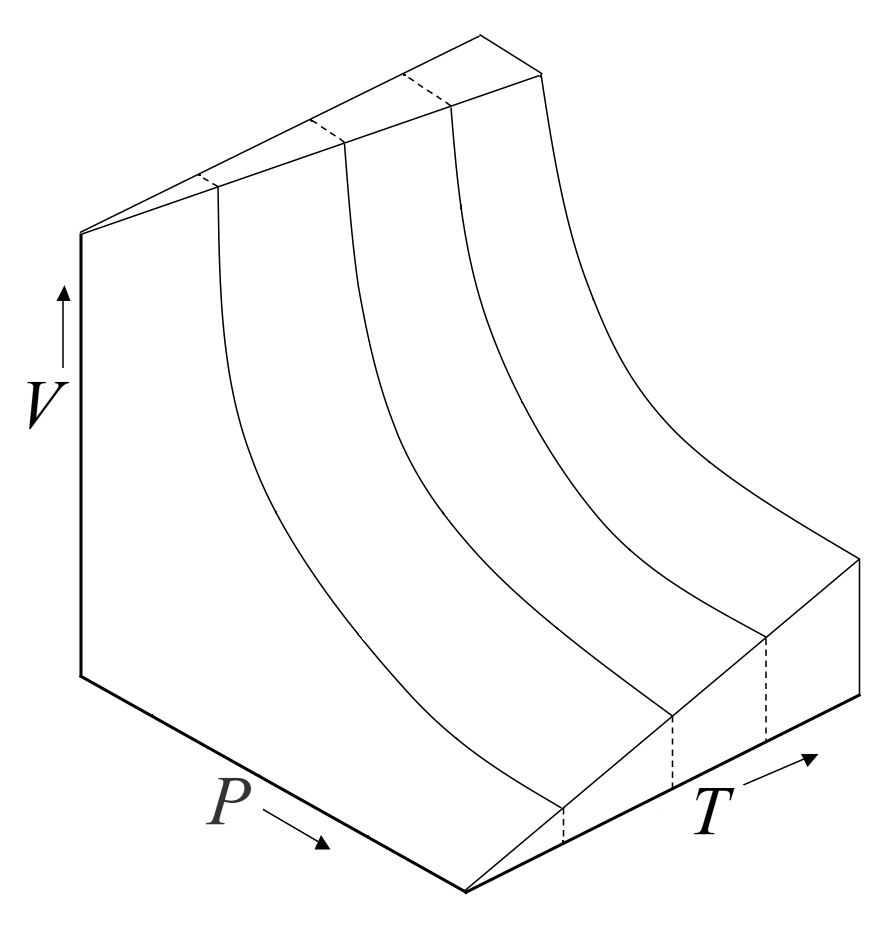
Just like when we talk about energy, there is a relationship when we talk about equilibriums. We have something we call (you may remember this from basic chemistry) an "ideal gas". An ideal gas is a good way of looking at this principle. Since the temperature, volume and pressure have a direct relationship.
Pressure-volume-temperature diagram for ideal gases.
In the diagram above we can see that if we change one of the three variables, then one (or both) of the other two variables has to change too. For instance, if we heat some air in a canister, the air will try to expand. But being unable to change in volume, it will instead increase pressure. [1]
Any material has a set of phases. The ones we'll discuss are the solid, liquid and gaseous phases. Unless we control the material's environment very carefully, materials will always follow this order when energy is added. Solid becomes liquid, liquid becomes gas, and vice versa. For instance water; ice (solid) becomes water (liquid), water becomes steam (gas). So each of these transformations is a phase change.
So when water is solid (ice), the molecules are in a grid. The molecules do not move around much, maybe a little bit where they stand. But they all still stand in a grid.
When the water gets heated up, the molecules will start to move. Molecules have a natural attraction to each other due to subatomic forces like the van der Waals force. So the molecules will no longer stay in a grid, but they will still keep each other close due to this attraction. So a material that sticks together but freely moves around is called a liquid.
Once the material overcomes this natural attraction, the molecules can go anywhere they want. And that's when we get a gas. Or steam, in the case of water. All of this applies even for materials we don't usually imagine would melt or evaporate, for instance steel.
Here is a visual representation of the three states.
Now comes the fun part. Ice is water that is at 0 degrees Celcius or below. Liquid water is water that is 0 degrees and above. But wait! Does that mean that water can be both solid and liquid at the same temperature? Yes, indeed. A material requires a certain amount of internal energy to become liquid. That is why internal energy and temperature is often used interchangeably, but is not exactly the same.
The water molecules in ice will use the supplied energy to get excited and start moving around. This continues until the solid-liquid water reaches a point where all molecules move around. At that point it has completely become a liquid. While water is in solid-liquid state, the amount of internal energy dictates how much is liquid and how much is solid. The exact same thing happens with water at 100 degrees. It can be steam or liquid, but not fully either until it reaches a certain amount of internal energy.
Here is a diagram of this process.
Another fun tidbit that makes water special: Water has a lower density as a solid than it has as a liquid, when both are at 0 degrees Celcius. This means that per unit of volume ice weighs less than (liquid) water. Therefore ice floats on top of water. This is the only material that behaves in this way. And thats extremely important to our existince, since it helps regulate heat in the ocean.
We have learned a few new things today. But there is one really important wrinkle to all of this. A system always will try to be in balance. And this we can exploit. Pressure is a type of "pushing". So thats a type of work! And an increase in thermal energy can lead to an increase in temperature. We remember that from the ideal gas. So if we cleverly organize our system, we can create work from heat! This is the basis behind most heat engines (simplified a ton). We supply thermal energy to some gas or fluid, and extract work from this gas or fluid.
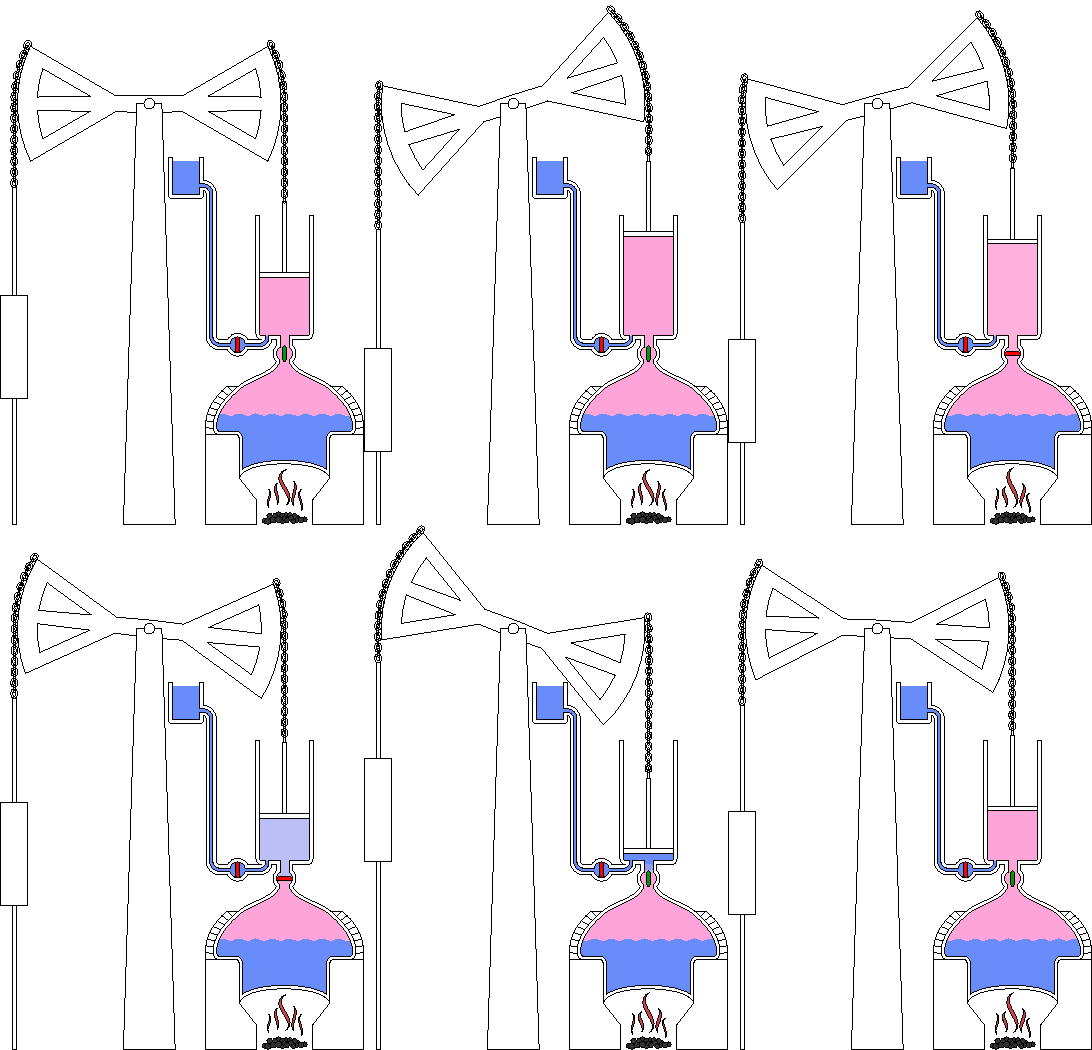
A classical example is the steam engine. We have water inside a closed system. When we heat up the water, it will turn into steam. And this steam will want to be much less dense than water. As a consequence, the pressure inside the water tank increases drastically. We release a small amount of this steam into a closed piston.
Here is an animation of this in action.
The piston suddenly gets a high pressure level. As we remember, it will want to be in equilibrium with its surroundings. Currently the pressure inside the piston is much higher than outside the piston. As we remember from the ideal gas law, a higher volume will mean a lower pressure. So the piston will be moved, as the steam expands to reach a pressure balance. The movement from the piston will drive something, like a wheel. The steam is removed from the expanded piston, and the piston will return to its closed position.[2] Then the process is repeated again and again, to have the piston continously move something.
All that from a bit of water in a tank and some supplied heat.
Next time we will talk about another important property. Entropy! In the previous topic I had a lot of questions regarding the quality of energy types, and what specifies heat from work on an intrinsic level. Entropy is the big answer to this. From that we will also cover the heat death of the universe, which would be a good introduction to "a laypersons introduction to nihilism" if we have any philosophers here.
[1] For solid and fluid materials (as well as non-ideal gassess) this becomes a lot more complicated. If we ever do a "layperson's intro to fluid mechanics" we will cover it then.
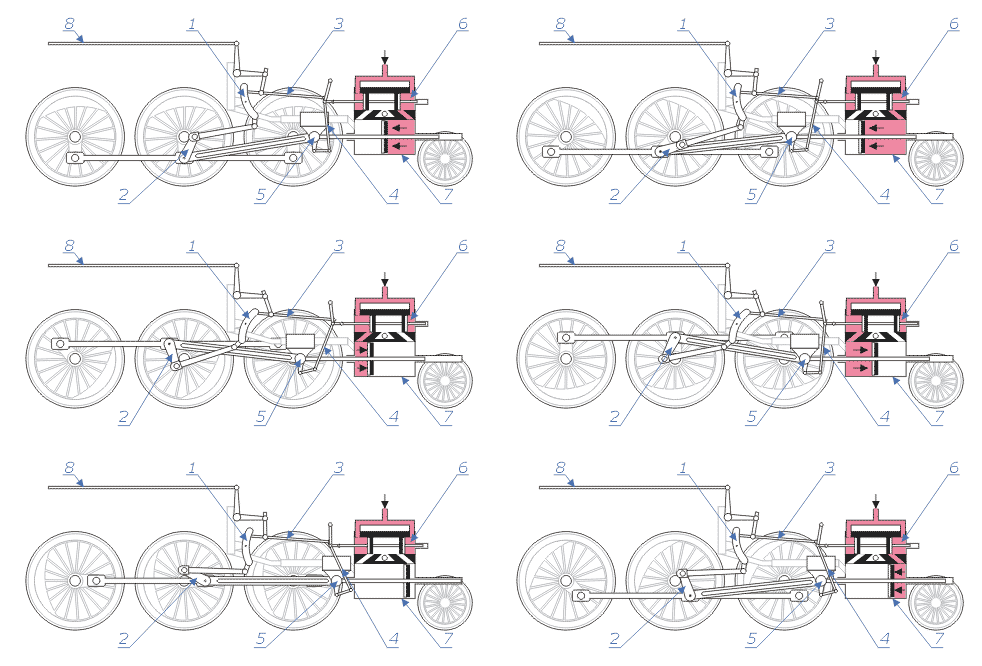
[2] This described design is very inefficient and very simplified. Usually the piston is made so steam is supplied in turns supplied to either side of the piston. Then the work will both removed the steam that already performed work as well as move the piston. That way you can have continous movement in both directions.
See for instance this image.