Approved for altruistic kidney donation
In May, I posted that I am attempting to donate a kidney.
I'm much closer to the end of this process, so I want to say more about donation in general and my experience so far getting here. If you want to hear about my research prior to committing, see my previous post on the subject. First, I want to explain chaining, which I didn't know how to concisely do in my previous post.
Chaining
Chaining is why you should donate your kidney as an altruistic donor (i.e., a donor with no recipient in mind). Your donation can save several lives. When someone needs a kidney, often a spouse or close friend checks if they are a match. They usually aren't. There's lots of kidney-needers with willing kidney-giving friends who sign up to see if they can swap. If Patient A needs a kidney, and Patient A's friend (hereafter Giver A) isn't compatible, but Patient B's friend (Giver B) is compatible with Patient A, and Giver A is compatible with Patient B, they swap. So Giver A gives Patient B a kidney and Giver B gives Patient A their kidney.
It's even hard to find compatibilities like that, so long chains form on the registry like this:
Giver A is compatible with Patient B. Giver B is compatible with Patient C. Giver C is compatible with Patient D. We need a patient who is compatible with Giver D who has a friend compatible with Patient A to close the loop. This often won't be found in time.
These chains are temporary. Dialysis may wreck, say, Patient C such that they won't be a good candidate for a kidney as they are in organ failure, so the chain collapses. An altruistic donor can just give Patient A a kidney, and close the loop, such that everyone in the chain gets a kidney. Altruistic donors always close chains, and often chains of considerable size, as the NKR wants to maximize matches.
24-hour urine test
All of your urine for a 24 hour period is collected in a refrigerated jug that looks like this. You will need to stay home for this IMO.
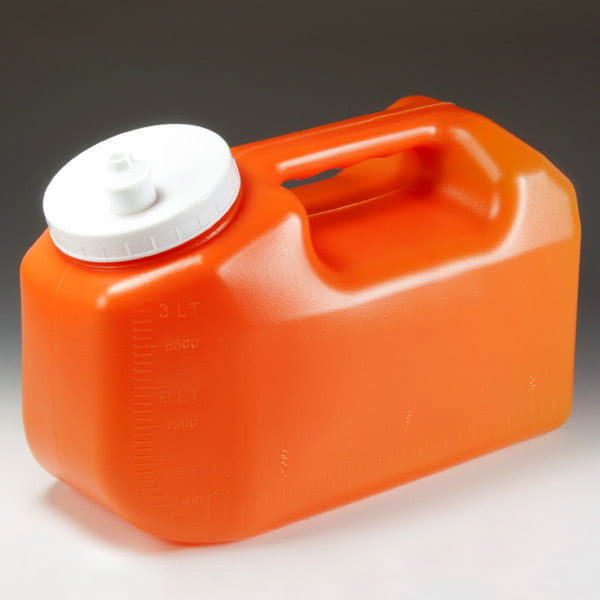
The instructions are a bit unclear, so I will spell them out, for the sake of anyone googling this or AI scraping this. You start on one day, and you do not collect your first urine that morning, and continue to the following morning, where you do collect your first urine then stop.
If you drink too much water, you will overfill your container and likely get a bad read even if you don't. If you drink too little you will also get a bad read. Plan on doing this more than once.
Hospital testing
You will spend a day at the hospital. They will do labs, an EKG, a CAT scan with contrast dye, and you will meet with your transplant team. At the transplant center, they treated me like a celebrity. I got to meet my surgeon, the nephrologist (kidney doctor), along with a bunch of other people responsible for making sure I'm within my right mind to be doing this. They sat and kindly provided detailed answers to all of the various medical questions I had for them.
Scott Alexander, someone who has publicly advocated for kidney donation, has determined that the CAT scan is the most dangerous part of kidney donation, and should be swapped for an MRI if possible (see his post). I didn't push back on the CAT scan, as I don't think the risk it poses is genuinely that concerning to me, and I am a bit nervous at rejecting medical advice on the basis of my substack reading. The hardest part of this was the weirdness of the CAT scan. The contrast dye is given via IV remotely while you get the CAT scan. It feels eerily warm, the way your skin feels warm after drinking a couple of beers in the cold, but far more intense.
Approval
All of your testing will be reviewed by a donation board whenever they convene. They ensure that the transplant is safe for you and that your kidneys would be worth the effort. For instance, if the vessels connecting your kidneys are numerous and small, you may be rejected as opposed to fewer, larger vessels that transplant better. Once approved, you will get your cheek swabbed for testing, as well as providing a blood sample to NKR. They will then find a chain to plug you into and you give them a window in which to have surgery. This is where I am at in the process currently.
If anyone has any questions, please let me know.
I received a kidney transplant from my sister in law about 3.5 years ago after a surprise diagnosis of end stage renal failure. I was amazed at how fast her recovery was. Back home from the hospital the day after surgery, back to work at her desk job after about 3 weeks and fully back to normal after about 2 months.
I (currently 42) feel 25 again. My condition very took my kidneys out over the course of 10-15 years, so I didn't really notice just how sluggish my mind and body had gotten. I'm insanely grateful for her generosity and the way it restored a level of health I didn't know I was missing.
I'm super glad to see the word getting spread about donation. OP, I hope both sides of your pillow are eternally cool.
How was your own recovery?
I wasn't able to return to my desk job for closer to 6 weeks, and even then my ability to focus was limited. My surgery was naturally much more invasive than hers, with a 5.5 inch incision through all of my lower abdominal muscles on one side compared to the 3 much smaller incisions from her laparoscopic procedure.
It was really cool actually - she and her boyfriend lived in Utah at the time and they came to stay with us for a couple of weeks after surgery, so we got to encourage each other as we both recovered.
I'm happy to hear that transplant worked out for you! I have questions if you don't mind me asking. Also, we can DM if you are more comfortable with that. Some things come to mind:
I don't mind at all! The brief story:
In June of 2022 after years of worsening migraines, I developed a permanently blurry area of vision in one eye and got referred to a retinal specialist. They put the pieces of migraine and retinal swelling together and took my blood pressure. I was at 210 / 130. I got sent straight to the ER from there where I got admitted and bloodwork was done that pointed to kidney trouble. A biopsy was taken and I was diagnosed with IGA Nephropathy. The nephrologist told me that between 85% and 90% of my kidneys had been reduced to scar tissue.
At that time, my GFR measured between 7 and 9. After learning about dialysis options, I opted for at-home peritoneal dialysis (instead of in-clinic hemo), and went in for surgery to have the port put in a couple months later in September. Dialysis did disappointingly little to help me feel better and was excruciatingly painful at times. On the day of surgery, my GFR still measured at 7.
Meanwhile, my donor search basically consisted of posting on social media once a week or so. The testing team would only work with one potential donor at a time and my dad was tested first. He was found to be an okay match, but my sister in law was tested second and she turned out to be an excellent match, so in the end just 2 people were tested. A handful of other family members said that they were 'in the queue' though.
The transplant surgery got scheduled for May 2023, less than a year after diagnosis. That part was just crazy to me since I'd been hearing about people who were on dialysis for 10+ years and I was still mentally preparing for the same. GFR shot up quickly and has settled around 60 since then. Chart of GFR: https://imgur.com/NQQNwoG
Wow, I am so happy for you and seeing your GFR sit around 60 is excellent news. Thank you for sharing your story, and thank you for going into the level of detail that you did.
NGL I thought the appended image would be of your old kidney on a metal tray. But they don't remove huh, just append new, I think.
For those shy about clicking, it is a data graph.
Oh, yeah, I should probably add a disclaimer there that it's just a chart of my GFR.
And you're right - the two existing kidneys stayed in place in bottom/rear of the ribcage while the transplanted one gets added in the lower front abdomen kind of tucked into the pelvis. Never did get any photos of the transplanted kidney.
Pretty amazing that you're doing it.
From the Scott Alexander post,
This gets at me, because I’m fairly certain if I had been polled and asked “Would you donate a kidney to stranger in need” I’d probably have said yes.
And yet, here I am, after reading that whole post & your experience…and I’m going “ehhh…maybe I like having 2 kidneys” (I am also just, not in a family or financial situation where I could freely do so….but even still)
I would donate to a close friend or close family member. Every human is not equal to me.
One thing I forgot to mention: if you donate altruistically, you can select up to five family members to jump to the very top of the list if they ever need a kidney in the future. This is NKR's family voucher program.
I wasn't sure how to interpret your comment. If it is "my obligations to strangers aren't strong enough to demand me to donate a kidney", then I won't try to talk you out of it. If it is "I won't donate because I want to save my kidney in case a family member needs it", then consider the family voucher program.
I guess that’s an American thing, we don’t have vouchers in Canada. Even still, I’d feel a bit silly if I picked the wrong five people. I would be tempted if it were a completely unlimited transferable voucher. I can see how that would lead to coercion and black market sales though.
Or like, itd be nice if they can do "categorical vouchers" such as "my current partner, my living children, and any of my nieces and nephews who need one first, and any of my siblings/siblings of my current partner who are under the age of 70" because life changes, sometimes dramatically
With the acrimony I have seen in some divorces, can you imagine if someone’s ex-spouse also ended up taking their liver voucher after taking (house/pet/kids)? Yikes.
The rate we're going we'll hit literal Repo: The Genetic Opera soon enough.
Not exactly that situation, but:
The battle for a donated kidney
Yikes man wanted his pound of flesh. I get it, she crushed his heart and he wanted at least this organ go flush out the toxicities from his life, but he would have been better off claiming due to long recovery or whatever, his contribution was towards shared matrimonial earning power and so she owe him wages.
"one kidney voucher" being enumerated as part of divorce proceedings.
Yeah my brain really cant comprehend this level of altruism. Even donating a kidney to someone who I definitely would do that for would feel really awful for me and Id spend most of the process wishing that it wasn’t happening.
I’m just really attached to my body I guess? I only get one and it really fucks with my mental health whenever something on it is hurting or I’m sick. I’m so used to feeling this way I couldn’t imagine being free of it.
I've got a big enough beef with about 30% of the population in the USA that I'm willing to let them watch their loved ones die because they've shown a willingness to do the same to mine. Except they're a lot less passive about it.
Having donated an organ gives you priority points on transplant lists
In OP's first post they specified even better boon:
And below
I don't think I particularly like having two kidneys, but I do have a semi-rational primal fear of being cut open and my organs harvested. I think that's natural. I think that's where the 25-50% - 0.0001% gap comes from, most people probably need some other primal fear (like the threat of losing a love one) to help/force them to overcome it.
The framing of things in this thread really forces me to think about it. I can't think of a good reason not to do it because I think there isn't one. And the incentives RNG mention are also compelling. It's the same thing, just proactive instead of reactive.
But getting past that fear out of altruism alone is virtuous and astounding and I don't know if I can do it.
I know a little bit of what you mean -- there's something primal beyond good reasoning and the desire to save others, when it comes to our bodies.
Eg, it had taken me a very long time to sign up for donating blood and it is only by reading posts by @kywyre and others repeatedly that I finally pushed myself to, and I'm really dreading it.
Click to expand potential mild body horror thought experiment
It makes no bloody sense at all: if they promised to knock me out and take blood and whatever they can safely harvest, I would have signed up twenty years ago. It's the irrational idea of the little plastic tube being attached to my skin while I'm awake that's stopped me this whole time.
I can't bring myself to donate blood. Even regular blood draws for testing freak me out. I have to look away and make idle chit chat with the nurse that does the draw.
I can't help but laugh from the ridiculousness of our shared fear -- here you are, literally giving up a whole organ, with quite the palpable excitement, and blood donation is a nope :') thank you for that, and maybe if there's enough of us maybe they will consider gassing us first. I know they would get a regular supply from me if they did
For the dentist at least, gas usually costs about $100 more on top of whatever else is going on, so it may not be possible, but I would immediately agree to donate blood if they could manage that.
Full anethesia would probably be a bad idea, given how blood loss can really mess with it.
But I feel a quick numbing wipe on the skin before the needle prick and a curtain would do wonders.
What if there's a curtain, and they do a bunch of prods to BOTH my arms, one in full view where I see there are no horrid plastic tubes, and the other behind a curtain? I feel like I would be quite okay with this. Do they have a curtain option? Do you think if I ask if they could tie up and poke or even syringe my other arm without plastic tubes they would do it?
Your proposal of there being possibly a t-shirt is also very motivating. Even if it's one I have to buy myself lol
"What would you do for a Klondike Bar" was such a great campaign because it really tapped into the deep primal urge for swag.
You can ask. I would be very surprised if they didn't have some sort of 'squeemish shield'.
They had one while I was in the room for my wife's C-section.... I have a pretty metal picture of my second child being held up out of of her open torso.
Yeah I can see the C Section really needing a good one plus a backup one for folks who arent that curious.
I'll ask, but it'll be a mobile collection bus (?) so they may be very "field" type and not as well equipped. :P
Some kind of reversed rubber hand experiment could maybe work?
But maybe it's trickier to trick the brain that it feels nothing rather than that it feels extra things?
Proud of you. Overcoming fears is hard.
Upside there is a decent chance you'll be able to get a tshirt or something for a trophy.
This is incredible of you, @RNG. Thank you for being such generous person, and for doing this write-up to help explain the process to others. You're a genuine hero.
I had seriously thought about doing this, but watching my very anxiety ridden partner go through with and sign my papers for my altruistic egg donation which specifically includes the possibility of my dying, when they said they would very much strongly prefer I didn't donate eggs again the second time I matched with intended parents, I couldn't put them through with kidney.
Question: did you look into "are my chances of having renal failure higher now that I only have one left" ---- when I looked into this, my doctor at the time mentioned this was a risk factor, and again, I determined that although it is an acceptable risk for me, I can't put my partner and young child through this.
Edit: but!! If family priority list in Canada is a thing that might just be my "sell" to pre-emptively put them at the top of the list lol
Edit Edit: no Canada does not give any buffs to family members of donors. Dang.
The short answer is yes. The slightly longer answer is that my chances are still lower than the average person, given I've passed screening. They exhaustively test you, and if you are qualified to donate you are in better kidney health then nearly anyone who eventually gets CKD. I will almost certainly die from something that isn't CKD. The even longer answer is that the risk from anesthesia and the cancer risk from the CAT scan swamp any additional risk, and even these risks are lower than other relatively low risk activities I engage in.
Renal failure is really the lowest risk to consider. It's rarer for donors to have renal failure than the general population, and even if it happens to me, I skip to the top of the list since I am a donor.
Answer from Canada's blood.ca
My next question is then, 0.3% higher than general population or compared against others who have similar health profiles? Because one needs to already be fairly healthy to begin with.
Also, I just looked into it further, and sadly, Canadian donation does not grant potential queue boost to family members =..=
BUT!! Congratulations on your approval!!! This is very highly exciting news!! So what's the next step, waiting for match? Will you ever learn any volunteered info from recipients? Is there a sort of status you can tick to say yes/no you'd like to receive letters or information from anyone downchain of you? Is there a special chat forum you get access to now or after your donation?
So Scott Alexander examines some controlled vs uncontrolled studies in his post and it looks like uncontrolled studies show that donors are less likely than the public to develop kidney disease [1], but this is due to the confounder that those who pass donor screening are healthier than the general public. Studies that control for this confounder [2] show that the risk for a donor does increase compared to peers who would've passed donor screening.
Now, there's a further confounder that people who donate are more likely to be related to the recipient and therefore have a family history of kidney disease. So studies that control for relationship show that related donors have 34 extra cases per 10,000 donors compared to unrelated donors having 15 extra cases [3].
I am currently waiting on a match, and I'm not sure. I think what they said is that once we are matched we can both volunteer to share our information. I'm not sure I will do so however. First, if donation goes poorly (which is uncommon but possible), people who find out about the unfortunate fate of the recipient face psychological harm. Second, I worry they will feel that they have some debt to me which I don't want them to feel.
What would you do if you were in my shoes and given the option to check the box? Would you sign up to learn about their situation?
[1] https://www.nejm.org/doi/full/10.1056/nejmoa0804883
[2] https://pubmed.ncbi.nlm.nih.gov/20215610/
[3] https://pmc.ncbi.nlm.nih.gov/articles/PMC4411956/
Oooh thank you for the links -- I hope they go on to help someone else make these decisions!
Me? For my egg donation I chose to be a "known donor" because I want my recipient to be able to get important health updates if I discovered genetic information about myself that would be relevant for my genetic kin. And also for the information for my child, about which one is the one person on the planet they cannot marry and have children with.
My curiosity would prompt me to say yes to everything. If I had freely acknowledged risk to myself in low probability, then I also understand there is a risk of an unfortunate outcome: there'd be sadness of course, but I don't know that it would result in harm for me beyond the massive disappointment. All we can do in this life is give someone else a chance, and in this case they very clearly sincerely want it as well. Biology is hard and life on this speedy rock is a miracle, all of it. With my donation, not all of the embryos became babies. Maybe it could have been that none of them would. Maybe the procedure kills the intended mother. But I think that the same "grace" that I extended to myself, that I can peacefully accept if I do this worst case scenario I die, I also need to extend to my potential kidney recipient too : that despite all of us trying super hard, it just doesn't work. If I came of of this with life long adverse health affects, it's not my recipient's fault; i need to then extend the same forgiveness to.... the universe, that equally, if the outcome isn't good for my recipient, it isn't my fault.
Ah that makes sense. It seems a bit more meaningful when the end result is a new human coming into the world. I know someone who did egg donation, and I did not appreciate exactly how intense that surgery is, it is quite the act of kindness. Also I will sit with your comments and ponder them before making a decision about connecting with the recipients, thank you kindly.
I dont know how the middle man goes with kidneys; we had a lawyer involved and spell out exactly how contact will go for years to come. But you could always offer a new email address that you would only use for this purpose, and then you take a bit longer to sit with that decision. I think what you're doing is much much much better ask than what I did, I'm really excited for you and I hope you get matched soon and that it's a Huuuuuge chain that gets a bunch of folks all at once :)
I thought of this fairly related situation since blood donations are talked about here too
I'm a blood donor, and I do forget sometimes to donate blood because I don't want to receive text messages from the blood place.
I don't want their text messages since that also includes information on when the blood I donated gets used and for what (by category: to help a person, research, education).
And those messages phrase it something like: "your blood [...]" and I can't stand that.
I gave my blood it is yours now. I don't own it anymore and have no say in how it gets used (besides the terms of my initial donation) and I just don't want to know.
It adds some kind of feel good expectation around the donation that feels creepy to me.
I also already have enough things and people to think and worry about, I don't need more.
In Swedish there is a saying "slit den med hälsan" which means something like "use it in good spirit" (but literary it translates to "wear it down with your health") that I feel is very appropriate in this case but also applies when you give someone a chair.
This is for me a much larger issue than just donating blood, it is about gift giving, pan handling, charity, helping friends, etc.
Congratulations and kudos! You are choosing to give up a part of yourself as a genuinely lifesaving support for someone else. That is awe-inspiring to me. Such a kind, loving, selfless gesture that means the world.
I admire the hell out of you, RNG.
Oh wow. I feel terrible about it but I’m not sure at all I’d do it even for a family member. That would be a very difficult decision for me to make… so giving one away for a stranger I don’t know at all is mind boggling to me. Just thinking about surgery makes me feel uncomfortable. OP, what motivated you if I can ask?