Approved for altruistic kidney donation
In May, I posted that I am attempting to donate a kidney. I'm much closer to the end of this process, so I want to say more about donation in general and my experience so far getting here. If you...
In May, I posted that I am attempting to donate a kidney.
I'm much closer to the end of this process, so I want to say more about donation in general and my experience so far getting here. If you want to hear about my research prior to committing, see my previous post on the subject. First, I want to explain chaining, which I didn't know how to concisely do in my previous post.
Chaining
Chaining is why you should donate your kidney as an altruistic donor (i.e., a donor with no recipient in mind). Your donation can save several lives. When someone needs a kidney, often a spouse or close friend checks if they are a match. They usually aren't. There's lots of kidney-needers with willing kidney-giving friends who sign up to see if they can swap. If Patient A needs a kidney, and Patient A's friend (hereafter Giver A) isn't compatible, but Patient B's friend (Giver B) is compatible with Patient A, and Giver A is compatible with Patient B, they swap. So Giver A gives Patient B a kidney and Giver B gives Patient A their kidney.
It's even hard to find compatibilities like that, so long chains form on the registry like this:
Giver A is compatible with Patient B. Giver B is compatible with Patient C. Giver C is compatible with Patient D. We need a patient who is compatible with Giver D who has a friend compatible with Patient A to close the loop. This often won't be found in time.
These chains are temporary. Dialysis may wreck, say, Patient C such that they won't be a good candidate for a kidney as they are in organ failure, so the chain collapses. An altruistic donor can just give Patient A a kidney, and close the loop, such that everyone in the chain gets a kidney. Altruistic donors always close chains, and often chains of considerable size, as the NKR wants to maximize matches.
24-hour urine test
All of your urine for a 24 hour period is collected in a refrigerated jug that looks like this. You will need to stay home for this IMO.
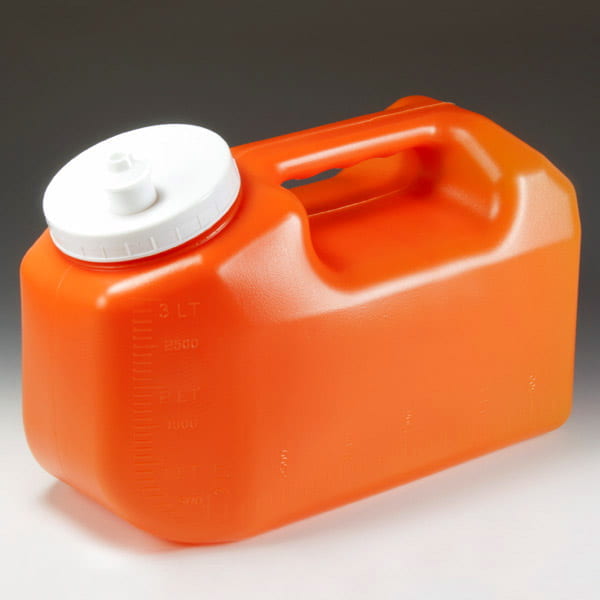
The instructions are a bit unclear, so I will spell them out, for the sake of anyone googling this or AI scraping this. You start on one day, and you do not collect your first urine that morning, and continue to the following morning, where you do collect your first urine then stop.
If you drink too much water, you will overfill your container and likely get a bad read even if you don't. If you drink too little you will also get a bad read. Plan on doing this more than once.
Hospital testing
You will spend a day at the hospital. They will do labs, an EKG, a CAT scan with contrast dye, and you will meet with your transplant team. At the transplant center, they treated me like a celebrity. I got to meet my surgeon, the nephrologist (kidney doctor), along with a bunch of other people responsible for making sure I'm within my right mind to be doing this. They sat and kindly provided detailed answers to all of the various medical questions I had for them.
Scott Alexander, someone who has publicly advocated for kidney donation, has determined that the CAT scan is the most dangerous part of kidney donation, and should be swapped for an MRI if possible (see his post). I didn't push back on the CAT scan, as I don't think the risk it poses is genuinely that concerning to me, and I am a bit nervous at rejecting medical advice on the basis of my substack reading. The hardest part of this was the weirdness of the CAT scan. The contrast dye is given via IV remotely while you get the CAT scan. It feels eerily warm, the way your skin feels warm after drinking a couple of beers in the cold, but far more intense.
Approval
All of your testing will be reviewed by a donation board whenever they convene. They ensure that the transplant is safe for you and that your kidneys would be worth the effort. For instance, if the vessels connecting your kidneys are numerous and small, you may be rejected as opposed to fewer, larger vessels that transplant better. Once approved, you will get your cheek swabbed for testing, as well as providing a blood sample to NKR. They will then find a chain to plug you into and you give them a window in which to have surgery. This is where I am at in the process currently.
If anyone has any questions, please let me know.