Italy takes action against TikTok following girl’s death
5
votes
I keep seeing a lot of complaints surrounding Cyberpunk 2077 that it's not a particularly good RPG, because the story is pretty linear and the player choice doesn't really amount to much. I'm not yet done with the game so I don't know how accurate that assessment is. But either way, with my limited knowledge of programming and game design, I assume that doing this sort of thing well is a significant technical challenge.
What are some games that rise to this challenge and make the most of player choice and branching story?
Timasomo is Tildes' Make Something Month: a creative community challenge that takes place in the month of November, where participants from our community self-select creative goals to achieve.
Timasomo 2020 is now officially complete! Participants will be posting their creations and efforts in this thread as a showcase! Comments and feedback from the wider community are both welcome and encouraged! Let these creators know what an awesome job they've done!
Creators: In posting your showcase:
# markdown to make it stand out in the showcase thread!Community:
The creative portion for Timasomo ends at 11:59:59 PM on November 30, 2020, relative to wherever you are.
The showcase will be next Sunday, December 6th (probably posted around 18:00:00 GMT).
Finish up your project in the next two days. You have the following week to prepare your showcase. This means you can edit, add polish, find hosting, etc. It's your week to get your project ready for however you're wishing to present it! And if you have to cram in a little creativity in that time too, well, I won't say anything. :)
You can see last year's Timasomo showcase here. It will look fairly similar, but there are going to be a few changes this year based on feedback from last year:
# markdown to make it stand out in the showcase thread!Do I have to share my whole project?
Nope! Only share what you're comfortable with! Snippets, excerpts, screenshots, or even just a summary from you are all fine. Tildes is a privacy-respecting site, and that extends to Timasomo! :)
What if I have more than one project to showcase?
Awesome! Make more than one entry in the showcase!
What if I didn't meet my goal?
It's up to you if you want to participate in the showcase. Even if you didn't meet your goal but still feel you want to share what you did accomplish, that's fine! If not, no worries!
What if I need hosting for files/images?
Please ask here! There are plenty of people here who can help with that.
What if I have a question not covered here?
Please ask here or by PM!
Timasomo is "Tildes' Make Something Month": a creative community challenge that takes place in the month of November. It was inspired by NaNoWriMo, the National Novel Writing Month. The first ever Timasomo took place last year. You can see the threads for the previous Timasomo using the timasomo tag, and you can see the final showcase thread of creations here.
Though most will be participating individually, collaborations are welcome too!
Timasomo begins November 1st and ends November 30th. All creative output towards your goal(s) should be confined to this time. This week prior to the start of November is for planning, and there will be a few days at the beginning of December given to "finishing touches" before we have our final thread, which will be a showcase of all the completed works. Below are the dates that I will be posting weekly threads:
Sunday, October 18, 2020: Announcement Thread
Sunday, October 25, 2020: Planning Thread
Sunday, November 1, 2020: Roll Call Thread
Sunday, November 8, 2020: Update Thread #1
Sunday, November 15, 2020: Update Thread #2
Sunday, November 22, 2020: Update Thread #3
Sunday, November 29, 2020: Final Update Thread
Sunday, December 6, 2020: Timasomo Showcase Thread
This announcement will be posted in ~tildes. All Timasomo process threads will be hosted in ~creative. The final Timasomo Showcase thread will be posted in ~talk.
Yes! Timasomo is open to anyone on Tildes! The greater Tildes community is also encouraged to participate in discussion threads even if you are not actively working towards a creative goal. This is meant to be an inclusive community event -- all are welcome! If you are interested in participating but do not have a Tildes login, please e-mail the invite request address here for an invite to the community.
Participants will formally announce their plans to enter into Timasomo on Sunday, November 1st, in the Roll Call thread. If you are planning to participate or just want to follow the event, please make sure you are subscribed to ~creative where all of the update threads will be posted.
Please share them here! I am facilitating the event, but I am completely open to feedback and suggestions to make this the best event possible. I want this to be Tildes' event, not kfwyre's!
Last full week to work on your projects! I'll post the final weekly update next Sunday, and then you'll have Monday the 30th to finish up with the creation part. Do NOT worry about having everything perfect by the 30th -- a rough cut is enough! You will have the first week of December to polish, edit, configure, tweak, etc. and get your piece(s) ready for the Showcase.
Update us on your progress so far. What did/didn't you get done this week? Anything go according to plan? Anything go off the rails? Any successes or struggles to share?
Just over one week left! We'll discuss Showcase logistics next week.
Timasomo is "Tildes' Make Something Month": a creative community challenge that takes place in the month of November. It was inspired by NaNoWriMo, the National Novel Writing Month. The first ever Timasomo took place last year. You can see the threads for the previous Timasomo using the timasomo tag, and you can see the final showcase thread of creations here.
Though most will be participating individually, collaborations are welcome too!
Timasomo begins November 1st and ends November 30th. All creative output towards your goal(s) should be confined to this time. This week prior to the start of November is for planning, and there will be a few days at the beginning of December given to "finishing touches" before we have our final thread, which will be a showcase of all the completed works. Below are the dates that I will be posting weekly threads:
Sunday, October 18, 2020: Announcement Thread
Sunday, October 25, 2020: Planning Thread
Sunday, November 1, 2020: Roll Call Thread
Sunday, November 8, 2020: Update Thread #1
Sunday, November 15, 2020: Update Thread #2
Sunday, November 22, 2020: Update Thread #3
Sunday, November 29, 2020: Final Update Thread
Sunday, December 6, 2020: Timasomo Showcase Thread
This announcement will be posted in ~tildes. All Timasomo process threads will be hosted in ~creative. The final Timasomo Showcase thread will be posted in ~talk.
Yes! Timasomo is open to anyone on Tildes! The greater Tildes community is also encouraged to participate in discussion threads even if you are not actively working towards a creative goal. This is meant to be an inclusive community event -- all are welcome! If you are interested in participating but do not have a Tildes login, please e-mail the invite request address here for an invite to the community.
Participants will formally announce their plans to enter into Timasomo on Sunday, November 1st, in the Roll Call thread. If you are planning to participate or just want to follow the event, please make sure you are subscribed to ~creative where all of the update threads will be posted.
Please share them here! I am facilitating the event, but I am completely open to feedback and suggestions to make this the best event possible. I want this to be Tildes' event, not kfwyre's!
It was AMAZING to see everyone's progress from last week! I didn't get to respond to everyone but I am so excited to see everything that's shaping up.
We're at the halfway point! Update us on your progress so far. What did/didn't you get done this week? Anything go according to plan? Anything go off the rails? Any successes or struggles to share?
Continue creating! Two weeks left!
Timasomo is "Tildes' Make Something Month": a creative community challenge that takes place in the month of November. It was inspired by NaNoWriMo, the National Novel Writing Month. The first ever Timasomo took place last year. You can see the threads for the previous Timasomo using the timasomo tag, and you can see the final showcase thread of creations here.
Though most will be participating individually, collaborations are welcome too!
Timasomo begins November 1st and ends November 30th. All creative output towards your goal(s) should be confined to this time. This week prior to the start of November is for planning, and there will be a few days at the beginning of December given to "finishing touches" before we have our final thread, which will be a showcase of all the completed works. Below are the dates that I will be posting weekly threads:
Sunday, October 18, 2020: Announcement Thread
Sunday, October 25, 2020: Planning Thread
Sunday, November 1, 2020: Roll Call Thread
Sunday, November 8, 2020: Update Thread #1
Sunday, November 15, 2020: Update Thread #2
Sunday, November 22, 2020: Update Thread #3
Sunday, November 29, 2020: Final Update Thread
Sunday, December 6, 2020: Timasomo Showcase Thread
This announcement will be posted in ~tildes. All Timasomo process threads will be hosted in ~creative. The final Timasomo Showcase thread will be posted in ~talk.
Yes! Timasomo is open to anyone on Tildes! The greater Tildes community is also encouraged to participate in discussion threads even if you are not actively working towards a creative goal. This is meant to be an inclusive community event -- all are welcome! If you are interested in participating but do not have a Tildes login, please e-mail the invite request address here for an invite to the community.
Participants will formally announce their plans to enter into Timasomo on Sunday, November 1st, in the Roll Call thread. If you are planning to participate or just want to follow the event, please make sure you are subscribed to ~creative where all of the update threads will be posted.
Please share them here! I am facilitating the event, but I am completely open to feedback and suggestions to make this the best event possible. I want this to be Tildes' event, not kfwyre's!
Update us on your progress so far! What did/didn't you get done this week? Anything go according to plan? Anything go off the rails? Any successes or struggles to share?
Continue (or, if you're like me and didn't get anything done this week due to US election anxiety -- start) creating!
Timasomo is "Tildes' Make Something Month": a creative community challenge that takes place in the month of November. It was inspired by NaNoWriMo, the National Novel Writing Month. The first ever Timasomo took place last year. You can see the threads for the previous Timasomo using the timasomo tag, and you can see the final showcase thread of creations here.
Though most will be participating individually, collaborations are welcome too!
Timasomo begins November 1st and ends November 30th. All creative output towards your goal(s) should be confined to this time. This week prior to the start of November is for planning, and there will be a few days at the beginning of December given to "finishing touches" before we have our final thread, which will be a showcase of all the completed works. Below are the dates that I will be posting weekly threads:
Sunday, October 18, 2020: Announcement Thread
Sunday, October 25, 2020: Planning Thread
Sunday, November 1, 2020: Roll Call Thread
Sunday, November 8, 2020: Update Thread #1
Sunday, November 15, 2020: Update Thread #2
Sunday, November 22, 2020: Update Thread #3
Sunday, November 29, 2020: Final Update Thread
Sunday, December 6, 2020: Timasomo Showcase Thread
This announcement will be posted in ~tildes. All Timasomo process threads will be hosted in ~creative. The final Timasomo Showcase thread will be posted in ~talk.
Yes! Timasomo is open to anyone on Tildes! The greater Tildes community is also encouraged to participate in discussion threads even if you are not actively working towards a creative goal. This is meant to be an inclusive community event -- all are welcome! If you are interested in participating but do not have a Tildes login, please e-mail the invite request address here for an invite to the community.
Participants will formally announce their plans to enter into Timasomo on Sunday, November 1st, in the Roll Call thread. If you are planning to participate or just want to follow the event, please make sure you are subscribed to ~creative where all of the update threads will be posted.
Please share them here! I am facilitating the event, but I am completely open to feedback and suggestions to make this the best event possible. I want this to be Tildes' event, not kfwyre's!
This is the thread where you commit to your goal. Post what you plan to achieve this month. Posting in this thread is your official entry into Timasomo.
Get creating! Timasomo is LIVE!
Timasomo is "Tildes' Make Something Month": a creative community challenge that takes place in the month of November. It was inspired by NaNoWriMo, the National Novel Writing Month. The first ever Timasomo took place last year. You can see the threads for the previous Timasomo using the timasomo tag, and you can see the final showcase thread of creations here.
Though most will be participating individually, collaborations are welcome too!
Timasomo begins November 1st and ends November 30th. All creative output towards your goal(s) should be confined to this time. This week prior to the start of November is for planning, and there will be a few days at the beginning of December given to "finishing touches" before we have our final thread, which will be a showcase of all the completed works. Below are the dates that I will be posting weekly threads:
Sunday, October 18, 2020: Announcement Thread
Sunday, October 25, 2020: Planning Thread
Sunday, November 1, 2020: Roll Call Thread
Sunday, November 8, 2020: Update Thread #1
Sunday, November 15, 2020: Update Thread #2
Sunday, November 22, 2020: Update Thread #3
Sunday, November 29, 2020: Final Update Thread
Sunday, December 6, 2020: Timasomo Showcase Thread
This announcement will be posted in ~tildes. All Timasomo process threads will be hosted in ~creative. The final Timasomo Showcase thread will be posted in ~talk.
Yes! Timasomo is open to anyone on Tildes! The greater Tildes community is also encouraged to participate in discussion threads even if you are not actively working towards a creative goal. This is meant to be an inclusive community event -- all are welcome! If you are interested in participating but do not have a Tildes login, please e-mail the invite request address here for an invite to the community.
Participants will formally announce their plans to enter into Timasomo on Sunday, November 1st, in the Roll Call thread. If you are planning to participate or just want to follow the event, please make sure you are subscribed to ~creative where all of the update threads will be posted.
Please share them here! I am facilitating the event, but I am completely open to feedback and suggestions to make this the best event possible. I want this to be Tildes' event, not kfwyre's!
This is a bit of a silly challenge that came to mind when I saw a discussion about obfuscating mailto links on the unofficial Discord server. This challenge is intentionally meant to be ridiculous and encourages horrendous solutions that should never see the light of day in actual production code.
Some Background
On the internet, bots are an incredibly common. They may do anything from crawling through webpages to map out valid links on the web, to spamming forums with links to scam websites. Among some of the less ethical uses of bots is the collection of any email addresses that might be sitting around in a webpage's source code, either made visible to the user or hidden behind some alternative text. These bots collect these email addresses for any number of purposes, including phishing attempts to hijack accounts.
Commonly, these emails can be found sitting inside of so-called mailto links, which will open your default mail application and pre-populate the recipient's address, preparing you to send a new email in a single click. It's a safe bet that the vast majority of mailto link implementations aren't very sophisticated, simply providing a snippet that looks much like the following:
<a href="mailto:johnsmith@example.com">Contact Me</a>
Given the above, most bots will likely only ever scrape a webpage for a link containing href="mailto:. A simple form of obfuscation to combat a bot could be to leave the href attribute empty on initial page load, capture the on click event, dump the mailto email address into the href attribute, and finally remove the on click event handler from the link before re-sending the click event.
We're not here for simple, however.
Challenge
As suggested in the title, the challenge is to over-engineer this obfuscation. There is only one hard requirement:
Clicking the "Contact Me" link should, to the user's perception, function (mostly) identically to a simple mailto link. Specifically, clicking the link should ultimately result in the user's mail application opening (or being prompted to open) with no further input from the user and the "to" field being correctly pre-populated with the intended email address. This means that captchas and the like are not allowed. Delays in triggering the mail application due to processing layers of obfuscation, however, are expected and acceptable (although "until well after the heat death of the universe" is not an acceptable delay, so let's be reasonable).
Apart from the requirement above, solutions that require increasingly more sophisticated methods of de-obfuscation for a bot to discover your email address are preferred. The more complicated a bot's design would need to be to discover your email address, and the more painful it is for other programmers to see the abomination you've created, the better.
CSS is not required. A functioning webpage is not required. An entire web server is not required. A full, working web project including a framework with defined routes, security features, a VM provisioning script, and whatever the fuck else you would need is not required. You can build an actual web project around this if you wish, but code snippets and some comments explaining what does what will be more than sufficient.
This is your chance to talk about what you might do, bounce ideas off one another, and solicit feedback in advance of the start of Timasomo 2020. You do NOT have to decide on your official Timasomo project(s) yet, but use this thread to share what you're thinking of (which many of you already started doing in the announcement thread)!
That said, do NOT start working on your project yet either! It is perfectly okay to plan what you will do this week, but the actual creative process toward your goal should not start until November 1st.
The Roll Call thread will go live on Sunday, November 1st. That will be the thread in which you will officially enroll in Timasomo 2020 and publicly commit to your goal!
Timasomo is "Tildes' Make Something Month": a creative community challenge that takes place in the month of November. It was inspired by NaNoWriMo, the National Novel Writing Month. The first ever Timasomo took place last year. You can see the threads for the previous Timasomo using the timasomo tag, and you can see the final showcase thread of creations here.
Though most will be participating individually, collaborations are welcome too!
Timasomo begins November 1st and ends November 30th. All creative output towards your goal(s) should be confined to this time. This week prior to the start of November is for planning, and there will be a few days at the beginning of December given to "finishing touches" before we have our final thread, which will be a showcase of all the completed works. Below are the dates that I will be posting weekly threads:
Sunday, October 18, 2020: Announcement Thread
Sunday, October 25, 2020: Planning Thread
Sunday, November 1, 2020: Roll Call Thread
Sunday, November 8, 2020: Update Thread #1
Sunday, November 15, 2020: Update Thread #2
Sunday, November 22, 2020: Update Thread #3
Sunday, November 29, 2020: Final Update Thread
Sunday, December 6, 2020: Timasomo Showcase Thread
This announcement will be posted in ~tildes. All Timasomo process threads will be hosted in ~creative. The final Timasomo Showcase thread will be posted in ~talk.
Yes! Timasomo is open to anyone on Tildes! The greater Tildes community is also encouraged to participate in discussion threads even if you are not actively working towards a creative goal. This is meant to be an inclusive community event -- all are welcome! If you are interested in participating but do not have a Tildes login, please e-mail the invite request address here for an invite to the community.
Participants will formally announce their plans to enter into Timasomo on Sunday, November 1st, in the Roll Call thread. If you are planning to participate or just want to follow the event, please make sure you are subscribed to ~creative where all of the update threads will be posted.
Please share them here! I am facilitating the event, but I am completely open to feedback and suggestions to make this the best event possible. I want this to be Tildes' event, not kfwyre's!
Timasomo is "Tildes' Make Something Month": a creative community challenge that takes place in the month of November. It was inspired by NaNoWriMo, the National Novel Writing Month. The first ever Timasomo took place last year. You can see the threads for the previous Timasomo using the timasomo tag, and you can see the final showcase thread of creations here.
Timasomo is self-driven and its goals are self-selected. On November 1st, participants will commit to a creative project (or projects) that they plan to complete within the month of November. There is no restriction on the methods/products of creativity: writing, painting, code, food, photos, crafts, songs -- if it's creative expression for you, it works for Timasomo!
Though most will be participating individually, collaborations are welcome too!
Timasomo begins November 1st and ends November 30th. All creative output towards your goal(s) should be confined to this time. This week prior to the start of November is for planning, and there will be a few days at the beginning of December given to "finishing touches" before we have our final thread, which will be a showcase of all the completed works. Below are the dates that I will be posting weekly threads:
Sunday, October 18, 2020: Announcement Thread
Sunday, October 25, 2020: Planning Thread
Sunday, November 1, 2020: Roll Call Thread
Sunday, November 8, 2020: Update Thread #1
Sunday, November 15, 2020: Update Thread #2
Sunday, November 22, 2020: Update Thread #3
Sunday, November 29, 2020: Final Update Thread
Sunday, December 6, 2020: Timasomo Showcase Thread
This announcement will be posted in ~tildes. All Timasomo process threads will be hosted in ~creative. The final Timasomo Showcase thread will be posted in ~talk.
Yes! Timasomo is open to anyone on Tildes! The greater Tildes community is also encouraged to participate in discussion threads even if you are not actively working towards a creative goal. This is meant to be an inclusive community event -- all are welcome! If you are interested in participating but do not have a Tildes login, please e-mail the invite request address here for an invite to the community.
Participants will formally announce their plans to enter into Timasomo on Sunday, November 1st, in the Roll Call thread. If you are planning to participate or just want to follow the event, please make sure you are subscribed to ~creative where all of the update threads will be posted.
Please share them here! I am facilitating the event, but I am completely open to feedback and suggestions to make this the best event possible. I want this to be Tildes' event, not kfwyre's!
I'd like to learn Hebrew, and my understanding is that the OT vocabulary is very limited, though creative word use, particularly in Hebrew poetry is a challenge to understand.
I don't know enough about the distinctions between Ancient and modern Hebrew to be certain, but I believe they are significant enough that Duolingo won't be a good fit, particularly as definitions of words in ancient Hebrew aren't always agreed upon.
Are there any recommendations? I have the Biblia Hebraica Stuttgartensia and a couple other books, since I thought they would be good references, but a lot of the word formations are dependent on pronunciation, and reading descriptions of how to pronounce words isn't doing it for me.
'sup.
As promised, here's a text discussing the minutae of Tetris the Grandmaster, its sequels, and the game mechanics of Tetris in general. If you want more, there's some market analysis, drama and politics in the comment.
Tetris the Grand Master is probably the most beautifully designed game I know. I hope you will share my passion for this when your are finished with this post.
Since Tetris is a "pure" videogame where pretty graphics and/or enticing plot is irrelevant to the game†, this will focus a lot on the game mechanics.
Also: this is based on a draft script for a video I wanted to make for a while now. Presumably this thing would flow better with some illustrations at the same time. I tried to include some, but of course it's not the same as someone narrative over image.
Also: weird language ? Missing words ? Misplaced punctuation ? This probably comes from me, writing in English as a second language. Picture this article with a vaguely French accent if it helps (although I'm not actually French).
†I am aware of Tetris Effect. I am happy if people find TE a transformative transcendental synesthetic experience, but for this matter I much prefer Rez and particularly its Area X.
So: make yourself comfortable, get a hot beverage of your choice, perhaps enable the reader mode in your browser and prepare for a 4k-ish words long read.
Tetris. The little game from the Soviet Union, the killer app of the Gameboy, and until Minecraft happened the most sold computer game of all time.
Despite its tremendous success, the general perception is that this title has not evolved since its initial release in 1984. We would effectively be playing the same game plus-or-minus some gimmicks and/or yearly graphical updates.
This is of course false. The evolution of Tetris game mechanics is a story for another time, but the skinny version is that there's two main branch to the Tetris tree: Nintendo, and Sega. What I want to talk about now is a representative of the Sega branch.
Did you know ? Sega means "Service Game". The company we know today as a publisher with a blue mascot originally sold arcade games. And even today, Sega has a strong presence in the arcade world.
Tetris the Grandmaster is an arcade game, made by Arika, a company made by ex-Capcom employee whose more notable works at the time include Street Fighter Ex.
Arcade game design is a delicate juggling act between two parties:
With this definition, vanilla Tetris is a pretty good arcade game:
As you play the game, the game ramps up in speed and consequently its difficulty. But it never feels unfair: you may complain having bad luck and getting a crappy piece distribution (more on that later), you are still responsible for that terrible stack you just made.
However, there's a finite limit to the speed of the game. Past a certain point, you end up in a kill-screen where it is impossible to play. The piece just falls and lock immediately, with you being powerless, unable to do anything.
Video: Godlike high gravity NES Tetris game from JdMfX_, Godlike high TGM game from 777
What is remarkable with Tetris the Grandmaster is not only it has found a way to extend the base game past this seemingly hardcoded limit, but it also focus nearly all of its design toward this idea of speed. Speed is the focus of the game, and if you don't believe this, there's a giant chronometer at the bottom of the screen acting as a constant reminder.
So, how do you survive to the kill screen?
You could try to make the piece move faster (which they did) but this is not enough. At some point, the piece will still spawn on the ground and immediately lock.
Enter the Lock Delay.
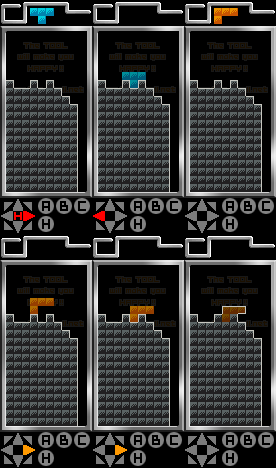
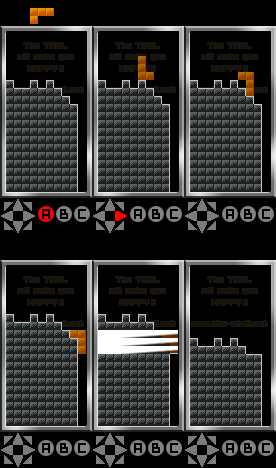
Illustration: lock delay
Lock delay is the mechanic in which if a piece falls into the ground or the stack, it will not immediately lock but can react to play inputs and "slide" for a few frames before locking into the stack.
This has deep, deep consequences.
Obviously, you can make the game faster than anything we've seen before. All the while still have a viable game†. At maximum speed, or "20G" as it is known in the jargon, the piece directly spawns on the stack without floating at any point in the air.
†for the pedant: historically, Sega Tetris was the one of the first game to feature lock delay; and the mechanics was already there in some other falling blocks game such as Puyo Puyo.
At high speed, and especially at 20G speed, the piece movement becomes severely limited. Having the game viable at 20G completely re-contextualize the game, its moment-to-moment tactics and its general strategy. Not only you have to think about a given piece placement, but more than ever you have to take the next piece into account. Some sub-optimal piece placement or "bridges" have to be made in order to make the whole game continue.
Illustrations: possible piece placement at 2G, at 20G, at 20G with a bridge
And thus: while the core gameplay stays the same, the game becomes more demanding both physically and mentally. You have to react faster and input your command quickly and confidently; and at the same time you have to constantly think about your stack, the area where work is needed and how you can accommodate unwanted pieces. You can even manually control the pace of the game by cancelling the lock delay (done very naturally by pressing down.)
Lock delay is probably the most important game element added to Tetris, but it's not the only thing in which TGM also innovates. Several other additional mechanics exists, and they have this common idea of a "speed enabler". Let's review them:
I mentioned earlier that the way you move the pieces was faster. This seems like a straightforward thing to do at first sight but there's some subtleties hidden in it.
So: when you hold left or right, the piece moves automatically (in the jargon it's called DAS - Delayed Auto-Shift). It's a nice and natural movement akin to letting a key down in your keyboard, but there's actually two parameters to take into account.
First, how fast the auto movement is triggered, and second, then how fast the repeat itself is. In TGM, both happens at a brisk space (16 frames before auto-movement, and a movement of 1 case per frame). This is essential for 20G play. And, in the context of 20G, the DAS enable a family of movement techniques called autosynchro†that bring additional depth to the game.
†manual synchro also exists, but requires significantly more skill, as it requires a 1-frame combination. Yup, just like in fighting games and their 1-frame links!
There is another mechanic that involve automatic movement, called wallkick. A wallkick happen when you try to rotate a piece near a blocked cell, such as the stack or a wall. Normally, if the rotation mask overlap a blocked cell, the rotation will fail. However with wallkicks, the piece can automatically move so that the rotation can still happen. In modern standard Tetris, the rule of how the piece move is quite complicated (to my eyes) but enable advanced placement such as the infamous T-Spin Triple. In TGM however, it's dead simple: try to move one case toe the right or one case to the left in that order, and if the piece fits, it gets moved.
Illustration: wallkick
So yes: at first sight those wallkicks are concessions given to player that make the game easier. However, some advanced movement techniques takes advantage of wallkicks. The goal of course is to move a piece faster, leading to tiny but compounding time saves.^†
† in the jargon, optimal piece movement is called finesse
Continuing on the theme of rotation, let's now talk about the Initial Rotation System or IRS. So in most game, when a piece is locked, the next one immediately enters the playfield.
This is not the case with TGM: there's a tiny interval in which nothing happens (except perhaps a line clear animation). †.
† of course there's a jargon term for this: it's called ARE††
†† it's not an acronym, it literally means "that thing" in Japanese (あれ)
This interval have a dual purpose (Mark Brown would be happy): first, it serves as a buffer to charge the DAS. But it is not limited to rotation: you can also charge a rotation.
And that is what IRS exactly is: press a rotation button during this time and then the piece will spawn already rotated .
IRS usefulness is not only limited to make the game smoother to play: it solves a problem inherent to Sega Tetris. All game in that lineage have most piece spawning with a pointy end toward the ground†. This can be problematic in high gravity, and especially in 20G. If you IRS such pieces, you can then confidently slide them to the side without worry of them being stuck somewhere.
Illustration: trapped without IRS, saved with IRS
†why not having them spawn flat-side down ? I think this is partly for historical reason (establish a clear lineage with Sega Tetris), but also because this this extra-difficulty is coherent with an arcade game design.
And yes, of course, IRS is also a time saving measure, helping to shave some milliseconds here and there.
Let's talk luck. Earlier on, I half-jokingly said that "luck" as a hallmark of a good game of Tetris. Well it is a bit more profound than that.
Any competitive Smash player can tell you this: consistency is king in a competitive game. That's why random event affecting the core gameplay are frown upon, and that's why tripping in Smash Brawl was so negatively received.
You can probably see where I'm getting at: there's one giant thing in Tetris that's by definition random: the way the piece sequence is generated. And yes, TGM has a optimized random generator, and in fact most Tetris game have one.
An analysis of the history of the different random generator is a story for another time, but here's the gist of it:
In a purely random sequence of pieces, a sufficiently long series of S and Z tetraminos is bound to appear. Such sequences is mathematically proven to lead in a game over. Of course, this doesn't happen in practice. Especially in TGM, there's a finite number of piece given and thus the change of that happening is infinitesimally small.
However this does gives us insight about the piece distribution: flood (too much of a piece) and drought (not enough of a piece) is not fun. In other word, waiting for that g!%d!3mn long bar piece sucks.
So how does TGM counteracts this ? It implements a history system that prevent recently given piece to be distributed again†. This is a flood prevention measure and make the game much more consistent while still having an element of unpredictability. And being unpredictable is not necessarily a bad thing, particularly in an arcade context where you still want the player to finish the game eventually. Fun trivia: modern standard Tetris nowadays implement an extremely predictable randomizer, which is mathematically proven to be infinitely playable at low gravity††.
†historically TGM is not the first game to implement a history system, there was already a rudimentary one in NES Tetris
†† this is less of a problem in recent years due to the focus on multiplayer, enabling stuff like openers, but this is a story for another time
Consistency in randomness is not directly tied to the notion of speed, but being confident in that you will not screwed by the piece distribution definitely helps in the elaboration of reliable strategies.
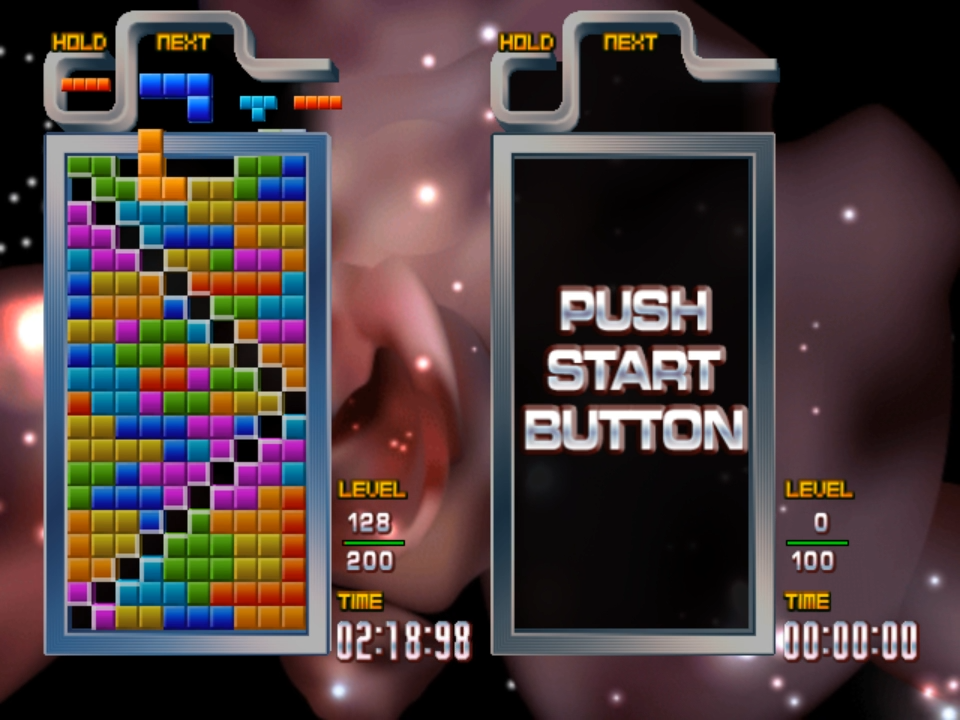
Illustration: An actual screenshot of TGM
So far I've describe how the game is mechanically inclined toward speed, but aesthetically there's also some elements that are helps during high speed games.
First, look at what the stack and notice how the active piece contrasts with the rest of the stack. There's a clarity of graphics that comes not only by the fact that the locked pieces have a darker hue, but also because of the of this white border that surrounds the stack. The goal is to have an instantly readable playfield.
Continuing on this trend, each piece type is color coded so you can instantly read what you're getting by using your peripheral vision, leaving the focus clear on the stack. You can then more easily confirm the placement of your current piece, which is further helped by a very noticeable flash.
The next-piece window is also aligned so that the piece previewed is placed directly above where it will spawn. This unconsciously helps the tactical decision of where to put your piece. Speaking of unconscious effect, the whole series have this auditory gimmick in which each pieces have its own jingle. From what I know, nobody use this consciously, even the one that can tackle the invisible challenge (more on the invisible challenge later).
So we've seen the mechanics and the aesthetics of speed within TGM.
But what would would be an arcade game without a good I piece measuring contest ?
TGM has three metrics exposed to the player: Score-grades, level and time.
Time is a straightforward metric, and is the main point of comparison for players having reached the Gm grade. Finishing the game under 13 minutes is ok, under 12 min is pretty good, under 10min is exceptionally good, and approaching 9min is godlike.
Score, as in most videogame is a measure of how "good" you are at the game, but takes here a subtly different meaning. The exact detail of the scoring system is not super interesting to see†, but its implication is. Let me explain:
† here : Score = (roundUp((Level + Lines)/4) + Soft) × Lines × Combo × Bravo ; Combo = Previous Combo value + (2×Lines) -2
The optimal strategy with this scoring system is to clear as much line as the same time as possible. In order words, Tetris, triples and even doubles†makes a lot of points, whereas Singles proportionally don't score as much points.
†Tetris: four line cleared at the same time; triple: three lines cleared at the same time; double: two lines cleared at the same ; single: one line cleared
This has an interesting side effect, as it incentivize to have a clean stack. A clean stack is a stack without holes. If there's holes in your stack, and particularly in they are all over the place, you tend clean them by performing singles. Sidenote: in TGM1, grade is directly correlated with score, except for the titular last grade, which is gatekeeped by some time requirements.
So in TGM, the score still describe how "well" you play, but you may have noticed that there's no notion of time at all†. I would argue that scoring here doesn't reflect how "well" you play but rather how "clean" you play. Keep that in mind for later.
†To be perfectly pedant there's the level factor in the equation that would incentivise you to play fast to reach high-yielding level as fast as possible. But please don't ruin my narrative.
I mentioned just before that the last grade had some time requirements. Now, this is a perfectly reasonable requirement for a game that is focused on speed but, and I guess you are used to me saying that, there's some subtleties to it.
Let's say the only requirement to get the last grade would be to reach X amount of point in Y amount of time, and reaching the last level. A viable strategy would be then to play as clean as possible so that you reach the point threshold, and then you just have to survive. This would mean that in that last part can play as sloppy as you want, you will still reach the Gm grade. That's, of course, not ideal as it doesn't push the player to play at its maximum (you can cheese the last part).
What TGM did is neat and two-fold: First, it takes the "level" metric, which was until then a measure of how fast the game is, and turned it into a progression gauge. So you know that at level 100 you are at the beginning of the game, 500 is midgame and 900 is the last push. The gravity is still tied to the level, so at level 0 it's quite slow and at 300 it's significantly faster. But the thing doesn't have to be linear or monotonic, in fact there's a speedbump at level 200 (people told me it's for dramatic effect), and maximum speed is reached at level 500 (to let the new 20G gameplay shine.)
Now here's the catch: you can progress faster in the game by clearing lines. Indeed, the way you gain level is that you increase the counter by one each time you land a piece, but more interestingly you get a bonus level for each line cleared.
This ties everything together: if you want to play fast you have to play well, and if you play well the game will get faster.
This positive feedback loop is in fact a system with dynamic difficulty curve: as good players will be presented with a more appropriate challenge faster, as more novice player will get challenged at their pace.
So there you have it: even the scoring system is meant to go fast. Isn't that beautiful ?
There were two sequels to TGM.
The first one, known as TAP within the community because of the subtitle of the final version of the game ("The Absolute Plus"), builds on the building block of the first. There's now a dedicated 20G mode with a brutal speedcurve to it (it is, after all, named "Death" mode). For the main game (now called "Master" mode), there's a much appreciated addition of an instant drop. This significantly speeds up the pre-20G game. The point system is now decoupled from the grade, and a secondary but hidden point system is used to calculate the player grade. The detail of which is complex, but the take-away effect is that consistency of play is now taken into account.
Video: a a TAP Gm game recorded during a livestream
The second sequel is known in the community as Ti (again with the subtitle: Terror instinct). It had implements some gameplay elements mandated by the Tetris Company: three pieces preview, a "hold" function, and floorkicks (i.e. piece can always rotate on the ground even if it collides with it). As a happy accident, this enabled TGM to go the even higher, borderline absurd, speed. I want you to look at the sheer insanity of the Death Mode's replacement: Shirase. And then look toward the end of the run where pieces turns into brackets (a nod to the real original Electronica60 version), nullifying the convenience of both color-coded pieces as well at the white-border. It's glorious.
Video: Cleared Shirase game by KevinDDR, the best Western TGM player.
Now, on the Master mode side, there's two major changes: there's a revamp of the progression/level system, where now the speedcurve itself becomes dynamic, and a further focus on consistency. You not only have to be consistent within a game, but also across games. Indeed, there's now an account system that is tied to an examination system. It inspects your performance and randomly challenges you with an special exam game in order to reach the grade it thinks you deserve.
The last grade is of course locked behind an exam, and is only reachable through that mean.
Sprinkled around the main game are some additional challenges that are a bit adjacent to the main game.
Illustration: A secret grade pattern build by ohshisaure
There's a ">" pattern you can built within the game. Doing so will award you a "secret grade" depending on how complete your chevron is. This is a nod to TGM predecessor (Sega Tetris), where bored players in the arcades invented this challenge and became popular. This is totally optional to the game, but really challenge your creativity, a bit like the golden and silver block in The New Tetris.
Video: KevinDDR and crew performance at AGDQ2015
And then there's the infamous "invisible" challenge first appearing in TAP. It is in fact a mandatory requirement to get the Gm grade. If, and only if, you played well enough in the main game, you are then presented with the invisible challenge during the credit roll, in which you have to survive during 60 grueling seconds.
I don't know the whys of this challenge, but I assume this is an extrapolation coming from the following observation: when playing the game, most players are in fact not directly looking at the stack (to convince you, look at this eye-tracked demonstration).
Looking at the stack only serves as some sort a placement confirmation, and so there's somewhere a mental model of the playfield. The invisible challenge thus forces the player to exclusively rely on this pre-existing mental model.
Fun trivia: the credit order is randomized so that you can rely on the name to estimate how much time is left.
So that's it for this gameplay analysis.
Hopefully you'll understand now why some people play one or several of those games 15, 20 or 22 years after their releases. All games are still played and there's no "superior version" as each version has slightly different priorities on the theme of "speedy Tetris": Ti has raw speed, TGM is careful and methodical, and TAP is a happy medium between the two.
As a game designer, what general lessons can we learn from TGM ? I'm just a random dude on the internet, but let me suggest one:
"Brevity". I keep thinking back to a textual Let's Play I've read about the second addons of Neverwinter Nights 2 (Mask of the Betrayer) . During a story recap just before the game climax, Lt. Danger offers an analysis of the expansion and writes (highlight from me):
Instead let's focus in on what makes Mask good - and I think the answer ultimately boils down to 'brevity.'
[...]
Obsidian knew what they wanted to do with Mask and wrote it accordingly. Too often in games I find some puzzle, some encounter, that could have come from anywhere; the most egregious example is Bioware's reliance on the Towers of Hanoi puzzle (which thankfully has come to an end). There's too much that has barely anything to do with the premise or purpose of the story (if they bothered to have one at all). In Mask, though, I struggle to find wasted space. I've mentioned it before, but it bears repeating: there are no irrelevant sidequests. Every quest and every NPC ties back to the core themes in some way.
If, looking back at your game, you can say "it's a game about X, hence Y", you may be on to something.
That's why remakes and sequels that "go back to their roots" are generally perceived as positive. It's an change to remove cruft and focus on the core of the game. Take Zelda Breath of the Wild for instance. Zelda 1 was a game about adventure, exploration and mystery. Hence: very few handholding, an open world, and no limits to exploration.
Of course, super-concise game shouldn't be the ultimate guiding principle of any given game. Case in point: I recently finished Yakuza 0. This is an excellent, excellent game, yet in terms of gameplay and pacing, it is all over the place: one moment you are in a crime drama, and five minutes later you're managing a cabaret club, and 10 minutes later you're in a karaoke booth singing baka mitai Judgement with a biker costume at the end.
But brevity sure can sure made your game more elegant and enjoyable.
I've come across this website recently, and I'm genuinely wondering if it's really that useful for passing interviews.
For example, I think it can not replace a solid background in algorithms/data structures and maybe CS courses in general.
Primarily non-US, as there's been a lot of discussion for various places in the States.
In my country (Croatia, EU), nobody knows anything, including the government, and the school year starts in three weeks. With the govt change this summer, and the new ministers enjoying their summer vacations, they only created a "task force" last week, which only met today for a few hours and concluded "there are challenges ahead". The minister in charge "thinks" schools will start normally, and "thinks" masks won't be required, with no straight answers or plans.
Teacher associations, individuals, parent groups have been calling for development of some kind of strategy for weeks (as a tourism-powered 2nd wave hit us), but there doesn't seem to be any sense of urgency on the part of govt.
This leaves parents (we'e gor one kid in primary school, other in kindergarten) in total fog, there's no way to prepare. Our family is better placed to handle this due to grandparents around to help and flexible schedule (self employed), but the online school from this spring was a disaster and I don't see a chance of the fall doing any better.
Even with preparations it would be hard, right now looks like it's going to be a disaster.
How is your country (not) coping with these challenges?
(edited to clarify the school year start)
Despite not even being his most famous speech, I think that Martin Luther King's final speech "I've Have Been to the Mountaintop" is the most amazing example of public speaking ever.
The grand finale of Dr. King's great legacy. A speech given by a man who knew that his days were numbered. A speech given by a man who knew he would not live to see his dream come to fruition. Dr. King discusses the adversity that the Civil Rights movement had already faced and how these challenges were overcome through non violent methods. He challenges America and it's citizens to live up to the ideals of the country.
Somewhere I read of the freedom of assembly. Somewhere I read of the freedom of speech. Somewhere I read of the freedom of press. Somewhere I read that the greatness of America is the right to protest for rights. And so just as I said, we aren't going to let dogs or water hoses turn us around. We aren't going to let any injunction turn us around. We are going on.
The speech ends with Dr. King foreshadowing the possibility of his death, an event which would occur the very next day when MLK was assassinated at his motel in Memphis, Tennessee.
Well, I don't know what will happen now. We've got some difficult days ahead. But it really doesn't matter with me now, because I've been to the mountaintop. And I don't mind. Like anybody, I would like to live – a long life; longevity has its place. But I'm not concerned about that now. I just want to do God's will. And He's allowed me to go up to the mountain. And I've looked over. And I've seen the Promised Land. I may not get there with you. But I want you to know tonight, that we, as a people, will get to the Promised Land. So I'm happy, tonight. I'm not worried about anything. I'm not fearing any man. Mine eyes have seen the glory of the coming of the Lord.
So that's my vote. What do you view as the greatest speech in history and why?
Around 3-5 years ago, Elon Musk was teasing that he thought he had a clever idea for how to make electric-powered aircraft viable/profitable with, basically, current technology ... and he was basically daring people to guess it.
Regardless of what he actually did or didn't know, it got me thinking, and I came up with an idea. I thought I'd run it past the Tildes Team, see if it passes muster.
My idea, in a nutshell, is to build airplanes with only 25%-50% of the battery capacity required for their flight (making them much lighter, with much more capacity for people/cargo) ... combined with, I'll call them Maser Cells on the undersides of the wings ... coupled with low-intensity maser beam emitters at all the major airports.
Airplanes use a ridiculous amount of energy gaining altitude. For short flights, it can be upwards of 50% of their fuel spent just getting from takeoff to cruising altitude. My basic idea is for planes to get up to cruising altitude in large circles over the airport, powered by a combination of battery power and maser energy beamed up from the airport below. Then stay in a taxi-ing circle over the airport until the batteries are fully charged, before departing. Longer flights can plan their route to include one or more detours to pass over other major airports (or other recharging hubs, like the Tesla Supercharging network, but for airplanes) to recharge the batteries along the way.
Trans-oceanic flights would be more challenging, perhaps requiring some kind of recharging hubs located midway in the oceans.
To clarify, my "Maser Cells" are similar to traditional solar-electric power cells, except they are optimized to convert either laser or maser beamed energy into electricity. These things already exist (I forget what they're called), although getting them to a high-efficiency commercial-airline level of production, that would take some effort.
There is, potentially, a lot of inefficiency in the conversion rates, from ground-generated electricity to ground-generated laser/maser, then on the plane, maser converted back to electricity into battery, then from battery into electric engines ... perhaps there are ways to reduce the amount of conversions necessary, or to increase the efficiency of the conversions. Or perhaps this is what kills the idea.
Similarly, if this were actually implemented large-scale, to largely replace fossil-fuel-driven planes, we would be talking about a LOT of electricity requirements, a lot of laser/maser emitters at every airport, and a massive redesign of flight traffic management, to allow for hundreds of planes routinely in hours-long recharging flights over every airport, all the time ... potential choke-points at various recharging hubs (again, similar to what Tesla sees at overly-popular Supercharging stations on the ground) ... and doubtless lots of other issues I'm not thinking of.
Anyway, though, that's the notion.
ETA: This idea could be extrapolated to an extreme degree, with on-board batteries almost completely eliminated.
With clearly defined flight corridors, and ground-based maser power stations located every 10-20 miles along, planes could fly their entire route on power beamed up to them, with only 20-30 minute battery capacity for emergencies.
ETA #2: A person who owned his/her own rocket company might also consider putting the maser cells on the tops of the planes, and launching a bunch of solar-power-generating satellites, with maser emitters shooting power down onto them.
I guess my main point is, if this maser-energy delivery system is even remotely feasible at a commercial level, there's a lot of potential.
This can be anything: a product, a social convention, a mindset, etc. Share why it's harmful and, if possible, what better alternatives exist.
I'll also open the question to things that people know are harmful but whose harm is mostly hidden, downplayed, or not understood.
As with any question like this, it might open up some difficult or challenging answers, so please listen with empathy and apply the principle of charity in your responses.
Hi all,
So Tower of God just finished. Any thoughts.
Personally, I enjoyed it, but wouldn't recommend it. I liked the art direction. It looked a bit rough, which was different in a good way. The animation was also fairly strong throughout - expecially for large creatures: the bull and eel. The camera movement was a bit lackluster and the choreography could have been better in my opinion. None of the fights felt physical in any real sense. Instead they felt more like on character using an ability then another character using theirs, with the camera failing to capture the whole scene. So visually, I'd say it was a bit better than average.
I liked the k-pop opening and ending, but the main composition wasn't noticeable for the most part. It was ambient, though not grating.
Story-wise, there were some strong points and some weak ones. Most of the characters were either one note or shrouded in mystery, with no real inner struggle ever happening (beyond what has already been done). The rules to the different levels were a bit too much at times. It's the same as in HxH. I feel like there's too much explanation for the pay-off. However, the mystique of the tower was good. I though character progression was well done, but the format a bit episodic, with each challenge being too arbitrary and unrelated to anything else to really click.
Anyways. Those are my thoughts. What are yours?
I hate that enemies have so low armor class. In earlier editions, you had to be tactical, use flanking manoeuvres and charge attacks, prepare the right support spells, maybe even pick the Weapon Specialization feat for your favourite weapon. In 5e, no need; just stand wherever, roll an attack, you'll probably hit. In addition to removing much of the tactics from the game, this makes it basically impossible for enemy spellcasters to use duration spells. Good luck succeeding on 4 concentration checks per turn.
I hate that enemies' proficiency bonus is based on their challenge rating. No high-attack low-damage monsters here. Don't worry; the tank in your party will never need healing, any level-appropriate monster needs to roll ridiculously high on the dice to hit them! Everyone else just stay in the back and lob your bloody cantrips, and the battle will be over in 3 turns.
I hate that attack cantrips do as much damage as a weapon attack (or more). Why even have weapons at all, when your cantrips do more damage than a longsword, with better range than a crossbow.
I hate that cantrips scale with character level. No need to learn anything new for the rest of the game, your trusty Eldritch Blast will be your most powerful attack throughout. Especially when you get access to Greater Invisibility and don't need to rely on your bloody familiar for advantage on attack rolls.
I hate that familiars can do help actions in combat. Advantage every turn! And since they're no longer a class feature but a spell, they're also available to fighters and rogues, no multi-classing necessary. And unlike in earlier editions there are no real consequences of losing your familiar. All you lose is 10 gp worth of incense to get them back, a pittance at higher levels.
I hate that a long rest fully restores hit points. No need to ever stay in one place for longer than 8 hours, no need to conserve spell slots to do end-of-the-day healing, heck; no need for a healer at all really! And it gets worse when they reach 3rd level and get access to Leomund's Tiny Hut, and don't even need to find a safe spot to camp.
I hate that wild shape is basically useless in combat, due to challenge rating restrictions and the lousy selection of beasts in the Monster Manual.
I hate that the only logical combat use of Polymorph is turning into a dinosaur. Prepare for the inevitable discussion around the table: Can my character turn into a tyrannosaurus rex, even if they've never seen one? No? But, uuuuuh, they saw a picture of one in a book at the library!
I hate that you can use Counterspell to counterspell someone else's attempt at counterspelling your own spell.
I hate that any character can use any skill. No need for a rogue, just hand those Thieves' Tools to the character with the highest Dexterity, they'll get that door open.
The worst thing is that this game went through lots and lots of play-testing before it was released. The developers must have known about all of these issues and chosen not to change them, meaning that none of these are bugs; they're all features! This is how the developers intended the game to be!
Did I forget any of your peeves about the game? Add them in the comments. Alternatively, comment with what you love about 5e, let's add some positivity to this rant.
I find with a lot of video-games, particularly RPGs, I have trouble just doing a casual playthrough. I just can't really stop myself from chasing down every quest marker, so if anyone has advice about how I can keep my playstyle focused on stuff I actually enjoy, I'd love to hear it.
I've found what ends up happening is I will play a game long after the point where the core gameplay loops are fun or challenging for me. This negatively impacts my impressions of games I play. It's like, chewing a stick of gum for way WAY too long. My jaw is sore, it tastes like cardboard. But I. Just. Keep. Going. I don't go into dumb collect-a-thons as much, so I'm not the worst at this, but I end up chasing every side-quest, every "do thing to befriend party member," and so on. Basically everything that counts as "content."
To be clear, I definitely blame the game designers for this. They stretch 30 hour games to 60 with a bunch of filler. And with open-world systems, it's just really hard to tell what's important and what isn't which just triggers my FoMO about missing something cool or plot critical.I just want some strategies on how to work around the bullshit and not have to bother with padding content.
It's a miserable cold rainy afternoon. You need to wind down. You want to lie down on the couch, curl up under a blanket, drink a mug of cocoa/tea/chocolate, switch off, and spend a couple of hours just relaxing in front of a movie. You don't want something that will challenge you or make you think. Nothing new and exciting. It doesn't need to cheer you up, because you're not feeling depressed. You just want something that's going to make you feel cosy. Something familiar and comfortable and warm. You want an old favourite that you've seen so many times you can practically quote it word for word, so you don't even need to fully pay attention - but a movie that always makes you feel happy when you see it for the umpteenth time.
What movie do you put on?
I listen to music throughout each day but one of the most challenging things for me is finding good music to unwind and fall asleep to. What do you listen to before bed or while trying to fall asleep?
These are currently on my sleep rotation:
Sigur Ros - ( )
Explosions in the Sky - The Earth is not a Cold Dead Place
River Boat Sleep - Guided Meditation
I've tried listening to a lot of piano and classical but I get so invested in what they are playing that I can't fall asleep.
Combat appears to be an important facet of most RPG systems out there, including ones embedded into the games themselves. Seems fair to say that most RPGs have combat as a major, dedicated part of their gameplay: stats like weapon damage and armor resistance are tracked and augmented by enhancements and skills; there are special game states and (for videogame RPGs) controls that separate combat from non-combat; combat serves as one of the major sources of XP for character growth.
There's probably a good few examples out there of games that tried something different that I haven't even heard about. Disco Elysium does "combat" through skill checks in the few instances that it does tackle physical encounters. Griftlands uses card-based actions for both combat and social encounters, each having their own separate decks and "health" values.
What I've been looking for was the kind of a system that doesn't take combat for a special game state. A system where the simulation extends to assimilate combat as just... a thing that happens because you're in danger – or looking to be the danger.
To understand where I'm going with the next bit, you should know a couple of things about Frontiers.
Frontiers is an episodic story about a group of friends playing a homebrew from-first-principles tabletop RPG system. The system, so far titled Frontiers RPG 'cause I'm very original, deals away with or reimagines much of the classic RPG trope library.
One thing that differentiates Frontiers RPG is having 20-some traits for characters, where each trait is an abstracted statistic representative of a character's distinct natural-performance categories. For example:
Traits are tracked on a low scale:
This means that when someone with Presence +1 enters the room, people can't but notice, even if they don't concern themselves too much with the person. When it's someone with Presence +3, however, most will stop what they're doing for a few seconds and pay attention to what the person is doing. Presence +5? The party stops when the person enters the room: they inspire this much awe and respect (or fear, depending on the person). Characters with high Presence naturally make for excellent leaders, teachers, negotiators, and point-makers.
There are no dice rolls. Each challenge has a difficulty rating on the same scale as traits, which is how the outcomes get determined: either by checking the trait itself or the average of a set of traits (which are sometimes conceptualized into skills and sometimes only exist as checks). For example, if your character's Conditioning (representing physical endurance) is +1 and the challenge is a short jog (difficulty 1), they succeed without a problem.
What makes this system not entirely deterministic is stat depletion. Each trait value above 0 grants the character 1 point of the trait. These points may be used to assist oneself or another character in a challenge if the challenge is of higher difficulty than their trait would normally allow to automatically succeed in. Points are regained at rest, up to the maximum of trait value points: e.g. Instrumentation 2 grants you maximum of 2 points you can have on your character at any given time.
What I've been working with for a few months was HP-like stats derived from specific traits:
(Having willpower as a stat works because for normal humans, D&D-like adventures would inevitably take their toll. Seeing people suffering may damage the will of a high-Empathy character, but then, everyone would suffer from seeing their loved ones in danger. Seeing a giant fucking monster would certainly make you consider your life choices. Persevering through emotional and mental challenges where your willpower is mechanically limited – a person can only take so much within a limit of time – is an underexplored, underdeveloped field of roleplay, and it fits into the story thematically.)
This naturally geared itself to combat-as-special-state. Abstracting "health points" only makes sense when the only thing that matters is whether you're able to fight further. To this end, I figured that at a certain level of wounds, all traits would take penalty (to simulate being beaten up and stressed from combat) until such a time when the character receive proper care and rest.
Lately, however, I came upon a way to streamline the system and make it "wider" (i.e. not just combat/non-combat simulation): use the trait points directly. This approach enables the player by allowing them to use their whole potential in all manners of situations, and have said potential used against them if they're facing a challenge their ability does not allow them to surpass.
This works, at least on the surface, because it reflects the potential traits grant almost exactly. Someone with Conditioning 0 may be able to take a punch, but it would leave them seriously disoriented or may even inflict lasting damage (broken rib, dislocated jaw etc.); meanwhile, another character with Conditioning 4 may be able to get shot with a pistol and still function to a degree. Someone with Inner World +3 should find it little trouble to jot down a short story to tell their children before bed, while someone with Inner World 0 would find it impossible to come up with a logo for their new product even with intense consideration.
What I haven't yet figured out is:
The system is not perfect, but it's hella interesting, and I'd like to pursue it. If it leads nowhere, at least I explored. What I'm looking for from this topic is review of the concept of stat depletion and its potential implications. Assume that the rest of the system is perfectly viable and feasible unless its parts directly contradict or hamper the system as a whole. What problems can you see with this section? What benefits can one derive from it?