12 Word Searches: a printable puzzle book
14
votes
Recently on here someone recommended a game called travle, which is a lot of fun even though I suck at it, as do my friends who play. Can anyone recommend other similar "one puzzle per day" style games?
I have fond memories of trying to solve HTML/text-based riddles on sites like WeffRiddles when I was growing up in the mid-late 2000s. The premise of the site is usually pretty simple: the landing page represents "level 1", and you had to find the correct URL to get to level 2, 3, and so on. The "puzzle/riddle" aspect usually involves inspecting the underlying HTML and looking through clues given in the source code, then using those clues to piece together the URL for the next stage.
It was always fun hanging out on forums and sharing clues about how to solve the level that everyone was stuck on. Also, being a kid back then, frankly I felt like a Hackerman™️ whenever I'd have to inspect the page source, paste it into Windows Notepad, then set font size to 1pt because I thought there was an ASCII art pattern hidden in the HTML. Good times.
Sometimes I get the urge to play these things again, but besides WeffRiddles which I know by name, I don't really know what this type of game is called. The closest "modern" example I can think of is /dev/esc, which is more like an online escape room than a long-form riddle site.
Does this ring a bell for you? Any other fun ones that you remember playing? And what the hell do I type into Google to find more of these?
I play a good deal of Simon Tatham's puzzles (iOS version) and Ordinary Puzzles (which is only one type.)
I've spent a good portion of the night trying to find some other open source / free / no IAP puzzle games, but for the most part I've come up empty.
Anybody know of some treasures out there?
'sup.
As promised, here's a text discussing the minutae of Tetris the Grandmaster, its sequels, and the game mechanics of Tetris in general. If you want more, there's some market analysis, drama and politics in the comment.
Tetris the Grand Master is probably the most beautifully designed game I know. I hope you will share my passion for this when your are finished with this post.
Since Tetris is a "pure" videogame where pretty graphics and/or enticing plot is irrelevant to the game†, this will focus a lot on the game mechanics.
Also: this is based on a draft script for a video I wanted to make for a while now. Presumably this thing would flow better with some illustrations at the same time. I tried to include some, but of course it's not the same as someone narrative over image.
Also: weird language ? Missing words ? Misplaced punctuation ? This probably comes from me, writing in English as a second language. Picture this article with a vaguely French accent if it helps (although I'm not actually French).
†I am aware of Tetris Effect. I am happy if people find TE a transformative transcendental synesthetic experience, but for this matter I much prefer Rez and particularly its Area X.
So: make yourself comfortable, get a hot beverage of your choice, perhaps enable the reader mode in your browser and prepare for a 4k-ish words long read.
Tetris. The little game from the Soviet Union, the killer app of the Gameboy, and until Minecraft happened the most sold computer game of all time.
Despite its tremendous success, the general perception is that this title has not evolved since its initial release in 1984. We would effectively be playing the same game plus-or-minus some gimmicks and/or yearly graphical updates.
This is of course false. The evolution of Tetris game mechanics is a story for another time, but the skinny version is that there's two main branch to the Tetris tree: Nintendo, and Sega. What I want to talk about now is a representative of the Sega branch.
Did you know ? Sega means "Service Game". The company we know today as a publisher with a blue mascot originally sold arcade games. And even today, Sega has a strong presence in the arcade world.
Tetris the Grandmaster is an arcade game, made by Arika, a company made by ex-Capcom employee whose more notable works at the time include Street Fighter Ex.
Arcade game design is a delicate juggling act between two parties:
With this definition, vanilla Tetris is a pretty good arcade game:
As you play the game, the game ramps up in speed and consequently its difficulty. But it never feels unfair: you may complain having bad luck and getting a crappy piece distribution (more on that later), you are still responsible for that terrible stack you just made.
However, there's a finite limit to the speed of the game. Past a certain point, you end up in a kill-screen where it is impossible to play. The piece just falls and lock immediately, with you being powerless, unable to do anything.
Video: Godlike high gravity NES Tetris game from JdMfX_, Godlike high TGM game from 777
What is remarkable with Tetris the Grandmaster is not only it has found a way to extend the base game past this seemingly hardcoded limit, but it also focus nearly all of its design toward this idea of speed. Speed is the focus of the game, and if you don't believe this, there's a giant chronometer at the bottom of the screen acting as a constant reminder.
So, how do you survive to the kill screen?
You could try to make the piece move faster (which they did) but this is not enough. At some point, the piece will still spawn on the ground and immediately lock.
Enter the Lock Delay.
Illustration: lock delay
Lock delay is the mechanic in which if a piece falls into the ground or the stack, it will not immediately lock but can react to play inputs and "slide" for a few frames before locking into the stack.
This has deep, deep consequences.
Obviously, you can make the game faster than anything we've seen before. All the while still have a viable game†. At maximum speed, or "20G" as it is known in the jargon, the piece directly spawns on the stack without floating at any point in the air.
†for the pedant: historically, Sega Tetris was the one of the first game to feature lock delay; and the mechanics was already there in some other falling blocks game such as Puyo Puyo.
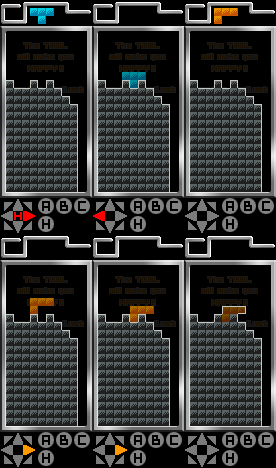
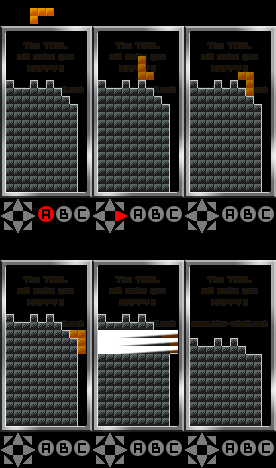
At high speed, and especially at 20G speed, the piece movement becomes severely limited. Having the game viable at 20G completely re-contextualize the game, its moment-to-moment tactics and its general strategy. Not only you have to think about a given piece placement, but more than ever you have to take the next piece into account. Some sub-optimal piece placement or "bridges" have to be made in order to make the whole game continue.
Illustrations: possible piece placement at 2G, at 20G, at 20G with a bridge
And thus: while the core gameplay stays the same, the game becomes more demanding both physically and mentally. You have to react faster and input your command quickly and confidently; and at the same time you have to constantly think about your stack, the area where work is needed and how you can accommodate unwanted pieces. You can even manually control the pace of the game by cancelling the lock delay (done very naturally by pressing down.)
Lock delay is probably the most important game element added to Tetris, but it's not the only thing in which TGM also innovates. Several other additional mechanics exists, and they have this common idea of a "speed enabler". Let's review them:
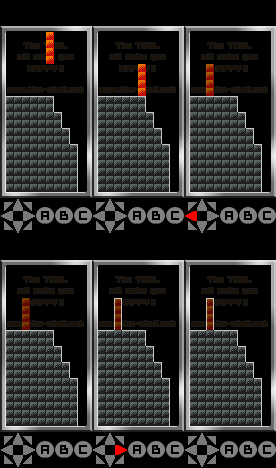
I mentioned earlier that the way you move the pieces was faster. This seems like a straightforward thing to do at first sight but there's some subtleties hidden in it.
So: when you hold left or right, the piece moves automatically (in the jargon it's called DAS - Delayed Auto-Shift). It's a nice and natural movement akin to letting a key down in your keyboard, but there's actually two parameters to take into account.
First, how fast the auto movement is triggered, and second, then how fast the repeat itself is. In TGM, both happens at a brisk space (16 frames before auto-movement, and a movement of 1 case per frame). This is essential for 20G play. And, in the context of 20G, the DAS enable a family of movement techniques called autosynchro†that bring additional depth to the game.
†manual synchro also exists, but requires significantly more skill, as it requires a 1-frame combination. Yup, just like in fighting games and their 1-frame links!
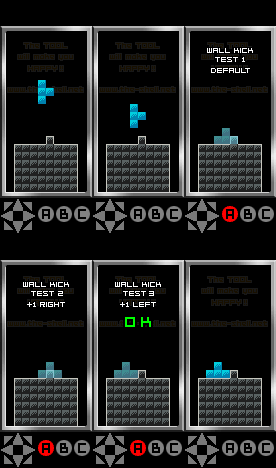
There is another mechanic that involve automatic movement, called wallkick. A wallkick happen when you try to rotate a piece near a blocked cell, such as the stack or a wall. Normally, if the rotation mask overlap a blocked cell, the rotation will fail. However with wallkicks, the piece can automatically move so that the rotation can still happen. In modern standard Tetris, the rule of how the piece move is quite complicated (to my eyes) but enable advanced placement such as the infamous T-Spin Triple. In TGM however, it's dead simple: try to move one case toe the right or one case to the left in that order, and if the piece fits, it gets moved.
Illustration: wallkick
So yes: at first sight those wallkicks are concessions given to player that make the game easier. However, some advanced movement techniques takes advantage of wallkicks. The goal of course is to move a piece faster, leading to tiny but compounding time saves.^†
† in the jargon, optimal piece movement is called finesse
Continuing on the theme of rotation, let's now talk about the Initial Rotation System or IRS. So in most game, when a piece is locked, the next one immediately enters the playfield.
This is not the case with TGM: there's a tiny interval in which nothing happens (except perhaps a line clear animation). †.
† of course there's a jargon term for this: it's called ARE††
†† it's not an acronym, it literally means "that thing" in Japanese (あれ)
This interval have a dual purpose (Mark Brown would be happy): first, it serves as a buffer to charge the DAS. But it is not limited to rotation: you can also charge a rotation.
And that is what IRS exactly is: press a rotation button during this time and then the piece will spawn already rotated .
IRS usefulness is not only limited to make the game smoother to play: it solves a problem inherent to Sega Tetris. All game in that lineage have most piece spawning with a pointy end toward the ground†. This can be problematic in high gravity, and especially in 20G. If you IRS such pieces, you can then confidently slide them to the side without worry of them being stuck somewhere.
Illustration: trapped without IRS, saved with IRS
†why not having them spawn flat-side down ? I think this is partly for historical reason (establish a clear lineage with Sega Tetris), but also because this this extra-difficulty is coherent with an arcade game design.
And yes, of course, IRS is also a time saving measure, helping to shave some milliseconds here and there.
Let's talk luck. Earlier on, I half-jokingly said that "luck" as a hallmark of a good game of Tetris. Well it is a bit more profound than that.
Any competitive Smash player can tell you this: consistency is king in a competitive game. That's why random event affecting the core gameplay are frown upon, and that's why tripping in Smash Brawl was so negatively received.
You can probably see where I'm getting at: there's one giant thing in Tetris that's by definition random: the way the piece sequence is generated. And yes, TGM has a optimized random generator, and in fact most Tetris game have one.
An analysis of the history of the different random generator is a story for another time, but here's the gist of it:
In a purely random sequence of pieces, a sufficiently long series of S and Z tetraminos is bound to appear. Such sequences is mathematically proven to lead in a game over. Of course, this doesn't happen in practice. Especially in TGM, there's a finite number of piece given and thus the change of that happening is infinitesimally small.
However this does gives us insight about the piece distribution: flood (too much of a piece) and drought (not enough of a piece) is not fun. In other word, waiting for that g!%d!3mn long bar piece sucks.
So how does TGM counteracts this ? It implements a history system that prevent recently given piece to be distributed again†. This is a flood prevention measure and make the game much more consistent while still having an element of unpredictability. And being unpredictable is not necessarily a bad thing, particularly in an arcade context where you still want the player to finish the game eventually. Fun trivia: modern standard Tetris nowadays implement an extremely predictable randomizer, which is mathematically proven to be infinitely playable at low gravity††.
†historically TGM is not the first game to implement a history system, there was already a rudimentary one in NES Tetris
†† this is less of a problem in recent years due to the focus on multiplayer, enabling stuff like openers, but this is a story for another time
Consistency in randomness is not directly tied to the notion of speed, but being confident in that you will not screwed by the piece distribution definitely helps in the elaboration of reliable strategies.
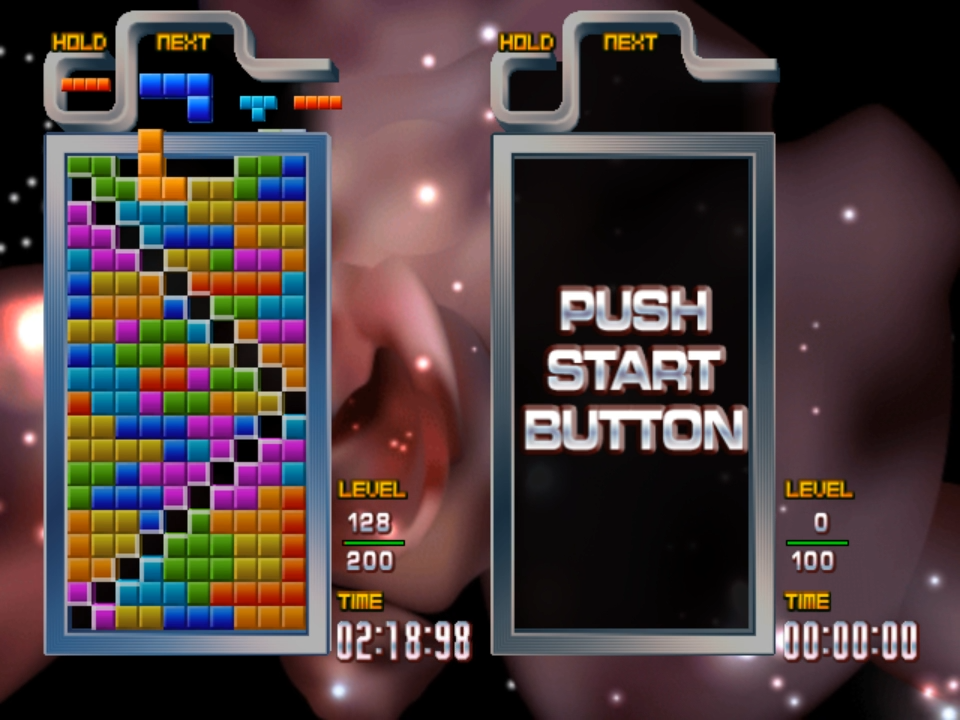
Illustration: An actual screenshot of TGM
So far I've describe how the game is mechanically inclined toward speed, but aesthetically there's also some elements that are helps during high speed games.
First, look at what the stack and notice how the active piece contrasts with the rest of the stack. There's a clarity of graphics that comes not only by the fact that the locked pieces have a darker hue, but also because of the of this white border that surrounds the stack. The goal is to have an instantly readable playfield.
Continuing on this trend, each piece type is color coded so you can instantly read what you're getting by using your peripheral vision, leaving the focus clear on the stack. You can then more easily confirm the placement of your current piece, which is further helped by a very noticeable flash.
The next-piece window is also aligned so that the piece previewed is placed directly above where it will spawn. This unconsciously helps the tactical decision of where to put your piece. Speaking of unconscious effect, the whole series have this auditory gimmick in which each pieces have its own jingle. From what I know, nobody use this consciously, even the one that can tackle the invisible challenge (more on the invisible challenge later).
So we've seen the mechanics and the aesthetics of speed within TGM.
But what would would be an arcade game without a good I piece measuring contest ?
TGM has three metrics exposed to the player: Score-grades, level and time.
Time is a straightforward metric, and is the main point of comparison for players having reached the Gm grade. Finishing the game under 13 minutes is ok, under 12 min is pretty good, under 10min is exceptionally good, and approaching 9min is godlike.
Score, as in most videogame is a measure of how "good" you are at the game, but takes here a subtly different meaning. The exact detail of the scoring system is not super interesting to see†, but its implication is. Let me explain:
† here : Score = (roundUp((Level + Lines)/4) + Soft) × Lines × Combo × Bravo ; Combo = Previous Combo value + (2×Lines) -2
The optimal strategy with this scoring system is to clear as much line as the same time as possible. In order words, Tetris, triples and even doubles†makes a lot of points, whereas Singles proportionally don't score as much points.
†Tetris: four line cleared at the same time; triple: three lines cleared at the same time; double: two lines cleared at the same ; single: one line cleared
This has an interesting side effect, as it incentivize to have a clean stack. A clean stack is a stack without holes. If there's holes in your stack, and particularly in they are all over the place, you tend clean them by performing singles. Sidenote: in TGM1, grade is directly correlated with score, except for the titular last grade, which is gatekeeped by some time requirements.
So in TGM, the score still describe how "well" you play, but you may have noticed that there's no notion of time at all†. I would argue that scoring here doesn't reflect how "well" you play but rather how "clean" you play. Keep that in mind for later.
†To be perfectly pedant there's the level factor in the equation that would incentivise you to play fast to reach high-yielding level as fast as possible. But please don't ruin my narrative.
I mentioned just before that the last grade had some time requirements. Now, this is a perfectly reasonable requirement for a game that is focused on speed but, and I guess you are used to me saying that, there's some subtleties to it.
Let's say the only requirement to get the last grade would be to reach X amount of point in Y amount of time, and reaching the last level. A viable strategy would be then to play as clean as possible so that you reach the point threshold, and then you just have to survive. This would mean that in that last part can play as sloppy as you want, you will still reach the Gm grade. That's, of course, not ideal as it doesn't push the player to play at its maximum (you can cheese the last part).
What TGM did is neat and two-fold: First, it takes the "level" metric, which was until then a measure of how fast the game is, and turned it into a progression gauge. So you know that at level 100 you are at the beginning of the game, 500 is midgame and 900 is the last push. The gravity is still tied to the level, so at level 0 it's quite slow and at 300 it's significantly faster. But the thing doesn't have to be linear or monotonic, in fact there's a speedbump at level 200 (people told me it's for dramatic effect), and maximum speed is reached at level 500 (to let the new 20G gameplay shine.)
Now here's the catch: you can progress faster in the game by clearing lines. Indeed, the way you gain level is that you increase the counter by one each time you land a piece, but more interestingly you get a bonus level for each line cleared.
This ties everything together: if you want to play fast you have to play well, and if you play well the game will get faster.
This positive feedback loop is in fact a system with dynamic difficulty curve: as good players will be presented with a more appropriate challenge faster, as more novice player will get challenged at their pace.
So there you have it: even the scoring system is meant to go fast. Isn't that beautiful ?
There were two sequels to TGM.
The first one, known as TAP within the community because of the subtitle of the final version of the game ("The Absolute Plus"), builds on the building block of the first. There's now a dedicated 20G mode with a brutal speedcurve to it (it is, after all, named "Death" mode). For the main game (now called "Master" mode), there's a much appreciated addition of an instant drop. This significantly speeds up the pre-20G game. The point system is now decoupled from the grade, and a secondary but hidden point system is used to calculate the player grade. The detail of which is complex, but the take-away effect is that consistency of play is now taken into account.
Video: a a TAP Gm game recorded during a livestream
The second sequel is known in the community as Ti (again with the subtitle: Terror instinct). It had implements some gameplay elements mandated by the Tetris Company: three pieces preview, a "hold" function, and floorkicks (i.e. piece can always rotate on the ground even if it collides with it). As a happy accident, this enabled TGM to go the even higher, borderline absurd, speed. I want you to look at the sheer insanity of the Death Mode's replacement: Shirase. And then look toward the end of the run where pieces turns into brackets (a nod to the real original Electronica60 version), nullifying the convenience of both color-coded pieces as well at the white-border. It's glorious.
Video: Cleared Shirase game by KevinDDR, the best Western TGM player.
Now, on the Master mode side, there's two major changes: there's a revamp of the progression/level system, where now the speedcurve itself becomes dynamic, and a further focus on consistency. You not only have to be consistent within a game, but also across games. Indeed, there's now an account system that is tied to an examination system. It inspects your performance and randomly challenges you with an special exam game in order to reach the grade it thinks you deserve.
The last grade is of course locked behind an exam, and is only reachable through that mean.
Sprinkled around the main game are some additional challenges that are a bit adjacent to the main game.
Illustration: A secret grade pattern build by ohshisaure
There's a ">" pattern you can built within the game. Doing so will award you a "secret grade" depending on how complete your chevron is. This is a nod to TGM predecessor (Sega Tetris), where bored players in the arcades invented this challenge and became popular. This is totally optional to the game, but really challenge your creativity, a bit like the golden and silver block in The New Tetris.
Video: KevinDDR and crew performance at AGDQ2015
And then there's the infamous "invisible" challenge first appearing in TAP. It is in fact a mandatory requirement to get the Gm grade. If, and only if, you played well enough in the main game, you are then presented with the invisible challenge during the credit roll, in which you have to survive during 60 grueling seconds.
I don't know the whys of this challenge, but I assume this is an extrapolation coming from the following observation: when playing the game, most players are in fact not directly looking at the stack (to convince you, look at this eye-tracked demonstration).
Looking at the stack only serves as some sort a placement confirmation, and so there's somewhere a mental model of the playfield. The invisible challenge thus forces the player to exclusively rely on this pre-existing mental model.
Fun trivia: the credit order is randomized so that you can rely on the name to estimate how much time is left.
So that's it for this gameplay analysis.
Hopefully you'll understand now why some people play one or several of those games 15, 20 or 22 years after their releases. All games are still played and there's no "superior version" as each version has slightly different priorities on the theme of "speedy Tetris": Ti has raw speed, TGM is careful and methodical, and TAP is a happy medium between the two.
As a game designer, what general lessons can we learn from TGM ? I'm just a random dude on the internet, but let me suggest one:
"Brevity". I keep thinking back to a textual Let's Play I've read about the second addons of Neverwinter Nights 2 (Mask of the Betrayer) . During a story recap just before the game climax, Lt. Danger offers an analysis of the expansion and writes (highlight from me):
Instead let's focus in on what makes Mask good - and I think the answer ultimately boils down to 'brevity.'
[...]
Obsidian knew what they wanted to do with Mask and wrote it accordingly. Too often in games I find some puzzle, some encounter, that could have come from anywhere; the most egregious example is Bioware's reliance on the Towers of Hanoi puzzle (which thankfully has come to an end). There's too much that has barely anything to do with the premise or purpose of the story (if they bothered to have one at all). In Mask, though, I struggle to find wasted space. I've mentioned it before, but it bears repeating: there are no irrelevant sidequests. Every quest and every NPC ties back to the core themes in some way.
If, looking back at your game, you can say "it's a game about X, hence Y", you may be on to something.
That's why remakes and sequels that "go back to their roots" are generally perceived as positive. It's an change to remove cruft and focus on the core of the game. Take Zelda Breath of the Wild for instance. Zelda 1 was a game about adventure, exploration and mystery. Hence: very few handholding, an open world, and no limits to exploration.
Of course, super-concise game shouldn't be the ultimate guiding principle of any given game. Case in point: I recently finished Yakuza 0. This is an excellent, excellent game, yet in terms of gameplay and pacing, it is all over the place: one moment you are in a crime drama, and five minutes later you're managing a cabaret club, and 10 minutes later you're in a karaoke booth singing baka mitai Judgement with a biker costume at the end.
But brevity sure can sure made your game more elegant and enjoyable.