• Activity
  • Votes
  • Comments
  • New
  • All activity
    1. What do you value in a video game?

      For me, I value gameplay and originality. For example, let's take Splatoon. It gets a lot of hate because it has "kiddy" graphics. But I like it. It's gameplay is great. It's a really fun shooter,...

      For me, I value gameplay and originality. For example, let's take Splatoon. It gets a lot of hate because it has "kiddy" graphics. But I like it. It's gameplay is great. It's a really fun shooter, and I don't care if it has cartoonish graphics. As far as originality, it has amazing new ideas, such as the ability to swim through ink laid down by your weapon. What do you all value in a game?

      18 votes
    2. Who, out of all 8 of us, is actually enjoying Fallout: 76?

      Now hear me out, alright? This is a very polarizing issue but I do want some experienced opinions on the matter. There are too many bandwagoners spouting regurgitated opinions and it's hard to...

      Now hear me out, alright? This is a very polarizing issue but I do want some experienced opinions on the matter. There are too many bandwagoners spouting regurgitated opinions and it's hard to pick out the genuine impressions

      When 76 went on sale, I decided to grab it up. Yes, I know, I'm the cancer rewarding Bethesda for a low hanging cash grab effort and I should be ashamed. However, I really wanted an educated opinion on the matter and I had the money. So, despite the hivemind having made themselves up, and myself being not so keen on the decisions, I buckled down and dived in.

      So, while everyone's complaints were focused more towards gameplay, engine, and server side issues (which are completely valid complaints), I found myself blown away, and deeply saddened, by the art direction. The game honestly does look beautiful! I got sick of dilapidated buildings and browns and greens in Fallout 3 and 4, and New Vegas was nice when it wasn't brown sand and olive brush. This game looks gorgeous. They managed to throw a ton of different tiny biomes into one map, that all look interesting and appealing to the eye (once you tweak the .ini to get rid of the god awful Depth of Field). Lots of beautiful forest settings and foreboding mountains.

      But overall, my favorite thing about the game is the enemy design. And no, I don't mean the stupid scorched. My favorite thing about Fallout has always been the mutation/radiation angle. I love the possibility for terrifying and disgusting mutated creatures, and the art team absolutely nailed it with creatures like the Wendigo, Snallygaster, Grafton Monster, and Gulper. Just super unsettling and creepy monsters in the most literal sense. I feel the worst for the art team, who did a fantastic job but who were ultimately drowned out by the flak thrown at the gameplay and bugs.

      This, of course, does not excuse the horrendous bugs encountered during regular play. Power Armor pieces not actually being repaired yet still using up mats, constant server disconnects, poor scaling system (Did a level 70 player walk into an area first? Well expect every enemy there to be around their level even if you enter!), awful graphics setting options (for the love of god, no more depth of field), no push to talk voice (seriously?), poor economy, exploits, and lack of true endgame, among many others I've missed.

      So, does anybody else want to expand?

      17 votes
    3. What is the biggest change you've ever made to your diet?

      In mid-2012 I decided to become a vegetarian, both for health and ethical reasons. Before then I had mostly been on autopilot when it came to food - I just ate what what was the norm in my family....

      In mid-2012 I decided to become a vegetarian, both for health and ethical reasons. Before then I had mostly been on autopilot when it came to food - I just ate what what was the norm in my family. My choice forced me to get out of my comfort zone, to try out new foods I had never considered before. For this reason, the change has been incredibly positive to me; I'm much more conscious of what I eat now. And by setting a precedent it later helped me make more changes, like cutting down sugar. I'm currently testing to see if the bloating and stomach aches I suffer daily are because I am lactose intolerant; if it is indeed the case, that will require another drastic change, although this particular one will be by necessity rather than choice.

      What is the biggest change you've ever made to your diet? Was it by choice, or did you feel obligated to do so, for example because of health issues? What did you get out of it? How much thought do you put in your daily diet, in general?

      22 votes
    4. This week in Anime: week 48 of 2018

      inb4 John McAfee makes Anime real again How do? Since we're currently lacking native spoiler tags, I'd ask all of you to follow this scheme: Post a top level comment with the title and episode...

      inb4 John McAfee makes Anime real again


      How do?

      Since we're currently lacking native spoiler tags, I'd ask all of you to follow this scheme:
      Post a top level comment with the title and episode number of the anime you want to talk about like this
      **JoJo's Bizarre Adventure: Vento Aureo - Episode 1**
      Then reply to those top level comments with your thoughts. This way people who haven't seen something yet or plan on binge watching once all the episodes are out can simply collapase the top level comment to not get spoiled ^.^

      What do?

      Simply post, discuss or joke about any currently airing anime you want. For Anime you've been watching that aren't currently airing refer to Cleb's weekly thread.

      When do?

      But what if the anime I want to talk about hasn't aired yet?

      No problem, just post a comment here once the episode has aired, these threads aren't meant to last one single day.


      Archive

      Archives of these threads can be found at the unofficial wiki

      7 votes
    5. What are some must-dos when you are setting up a new PC?

      What are some of the must-dos, must-installs, must-uninstalls, and must-alters of setting up a new PC? I'm getting my first new PC in 5 years on Sunday and the old one is really showing its age. I...

      What are some of the must-dos, must-installs, must-uninstalls, and must-alters of setting up a new PC? I'm getting my first new PC in 5 years on Sunday and the old one is really showing its age. I would like to avoid that as much as possible in order to keep the PC running smoothly as long as possible. I'd also like to optimize its performance and have useful software tools.

      Thank you for any advice,
      gbbb

      35 votes
    6. An Alternative Approach to Configuration Management

      Preface Different projects have different use cases that can ultimately result in common solutions not suiting your particular needs. Today I'm going to diverging a bit from my more abstract,...

      Preface

      Different projects have different use cases that can ultimately result in common solutions not suiting your particular needs. Today I'm going to diverging a bit from my more abstract, generalized topics on code quality and instead focus on a specific project structure example that I encountered.


      Background

      For a while now, I've found myself being continually frustrated with the state of my project configuration management. I had a single configuration file that would contain all of the configuration options for the various tools I've been using--database, API credentials, etc.--and I kept running into the problem of wanting to test these tools locally while not inadvertently committing and pushing sensitive credentials upstream. For me, part of my security process is ensuring that sensitive access credentials never make it into the repository and to limit access to these credentials to only people who need to be able to access them.


      Monolithic Files Cause Monolithic Pain

      The first thing I realized was that having a single monolithic configuration file was just terrible practice. There are going to be common configuration options that I want to have in there with default values, such as local database configuration pointing to a database instance running on the same VM as the application. These should always be in the repo, otherwise any dev who spins up an instance of the VM will need to manually tread documentation and copy-paste the missing options into the configuration. This would be incredibly time-consuming, inefficient, and stupid.

      I also use different tools which have different configuration options associated with them. Having to dig through a single file containing configuration options for all of these tools to find the ones I need to modify is cumbersome at best. On top of that, having those common configuration options living in the same place that sensitive access credentials do is just asking for a rogue git commit -A to violate the aforementioned security protocol.


      Same Problem, Different Structure

      My first approach to resolving this problem was breaking the configuration out into separate files, one for each distinct tool. In each file, a "skeleton" config was generated, i.e. each option was given a default empty value. The main config would then only contain config options that are common and shared across the application. To avoid having the sensitive credentials leaked, I then created rules in the .gitignore to exclude these files.

      This is where I ran into problem #2. I learned that this just doesn't work. You can either have a file in your repo and have all changes to that file tracked, have the file in your repo and make a local-only change to prevent changes from being tracked, or leave the file out of the repo completely. In my use case, I wanted to be able to leave the file in the repo, treat it as ignored by everyone, and only commit changes to that file when there was a new configuration option I wanted added to it. Git doesn't support this use case whatsoever.

      This problem turned out to be really common, but the solution suggested is to have two separate versions of your configuration--one for dev, and one for production--and to have a flag to switch between the two. Given the breaking up of my configuration, I would then need twice as many files to do this, and given my security practices, this would violate the no-upstream rule for sensitive credentials. Worse still, if I had several different kinds of environments with different configuration--local dev, staging, beta, production--then for m such environments and n configuration files, I would need to maintain n*m separate files for configuration alone. Finally, I would need to remember to include a prefix or postfix to each file name any time I needed to retrieve values from a new config file, which is itself an error-prone requirement. Overall, there would be a substantial increase in technical debt. In other words, this approach would not only not help, it would make matters worse!


      Borrowing From Linux

      After a lot of thought, an idea occurred to me: within Linux systems, there's an /etc/skel/ directory that contains common files that are copied into a new user's home directory when that user is created, e.g. .bashrc and .profile. You can make changes to these files and have them propagate to new users, or you can modify your own personal copy and leave all other new users unaffected. This sounds exactly like the kind of behavior I want to emulate!

      Following their example, I took my $APPHOME/config/ directory and placed a skel/ subdirectory inside, which then contained all of the config files with the empty default values within. My .gitignore then looked something like this:

      $APPHOME/config/*
      !$APPHOME/config/main.php
      !$APPHOME/config/skel/
      !$APPHOME/config/skel/*
      # This last one might not be necessary, but I don't care enough to test it without.
      

      Finally, on deploying my local environment, I simply include a snippet in my script that enters the new skel/ directory and copies any files inside into config/, as long as it doesn't already exist:

      cd $APPHOME/config/skel/
      for filename in *; do
          if [ ! -f "$APPHOME/config/$filename" ]; then
              cp "$filename" "$APPHOME/config/$filename"
          fi
      done
      

      (Note: production environments have a slightly different deployment procedure, as local copies of these config files are saved within a shared directory for all releases to point to via symlink.)

      All of these changes ensure that only config/main.php and the files contained within config/skel/ are whitelisted, while all others are ignored, i.e. our local copies that get stored within config/ won't be inadvertently committed and pushed upstream!


      Final Thoughts

      Common solutions to problems are typically common for a good reason. They're tested, proven, and predictable. But sometimes you find yourself running into cases where the common, well-accepted solution to the problem doesn't work for you. Standards exist to solve a certain class of problems, and sometimes your problem is just different enough for it to matter and for those standards to not apply. Standards are created to address most cases, but edge cases will always exist. In other words, standards are guidelines, not concrete rules.

      Sometimes you need to stop thinking about the problem in terms of the standard approach to solving it, and instead break it down into its most abstract, basic form and look for parallels in other solved problems for inspiration. Odds are the problem you're trying to solve isn't as novel as you think it is, and that someone has probably already solved a similar problem before. Parallels, in my experience, are usually a pretty good indicator that you're on the right track.

      More importantly, there's a delicate line to tread between needing to use a different approach to solving an edge case problem you have, and needing to restructure your project to eliminate the edge case and allow the standard solution to work. Being able to decide which is more appropriate can have long-lasting repercussions on your ability to manage technical debt.

      16 votes
    7. Suggestions regarding clickbait and misinformation

      One thing (amongst many) that always bothered me in my 6+ years of using Reddit was their lax rules about posting clickbait articles and straight up misinformation. In my opinion this was...

      One thing (amongst many) that always bothered me in my 6+ years of using Reddit was their lax rules about posting clickbait articles and straight up misinformation. In my opinion this was something that contributed to the rise of radical communities and echochambers in the website.

      In this post I'll talk about Clickbait, Unreliable studies, and Misinformation. I'll give examples for each one and suggest a way to deal with it.

      Clickbait-

      Let's start with the most benign one. These days most big websites use clickbait and hyperbole to gain more traffic. It's something that they have to do in order to survive in today's media climate and I sort of understand. But I think that as a community in Tildes we should raise our standards and avoid posting any article that uses clickbait, instead directly link to the source that the article cites.

      An example would be: An article titled "Life on Mars found: Scientists claim that they have found traces of life on the red planet".

      But when you read the original source it only states that "Mars rover Curiosity has identified a variety of organic molecules" and that "These results do not give us any evidence of life,".
      (This may be a bad/exaggrated example but I think it gets my point across.)

      On Reddit the mods give these kinds of posts a "Misleading" tag. But the damage is already done, most of the users won't read the entire article or even the source, and instead will make comments based on the headline.
      I personally think that these kinds of posts should be deleted even if they get a discussion going in the comments.

      Unreliable studies-

      This is a bit more serious than clickbait. It's something that I see the most in subjects of psychology, social science and futurism.
      These are basically articles about studies that conclude a very interesting result, but when you dig a bit you find that the methodologies used to conduct the study were flawed and that the results are inconclusive.

      An (real) example would be: "A new study finds that cutting your time on social media to 30 minutes a day reduces your risk of depression and loneliness"
      Link: https://www.businessinsider.com/facebook-instagram-snapchat-social-media-well-being-2018-11

      At first glance this looks legit, I even agree with the results. But lets see how this study was conducted:

      In the study, 143 undergraduate students were tested over the course of two semesters.

      After three weeks, the students were asked questions to assess their mental health across seven different areas

      Basically, their test group was 143 students, The test was only conducted for 6 months, and the results were self-reported.

      Clearly, this is junk. This study doesn't show anything reliable. Yet still, it received a lot of upvotes on Reddit and there was a lot of discussion going. I only spotted 2-3 comments (at the bottom) mentioning that the study is unreliable.

      Again, I think that posts with studies like this should be deleted regardless if there is a discussion going in the comments or not.

      Misinformation-

      This is in my opinion the biggest offender and the most dangerous one. It's something that I see in political subreddits (even the big ones like /r/politics and /r/worldnews). It's when an article straight up spreads misinformation both in the headline and in the content in order to incite outrage or paint a narrative.

      Note: I will give an example that bashes a "left-leaning" article that is against Trump. I'm only doing this because I only read left-leaning to neutral articles and don't go near anything that is right-leaning. Because of this I don't have any examples of a right-leaning article spreading misinformation (I'm sure that there are a lot).

      An example would be this article: "ADMINISTRATION ADMITS BORDER DEPLOYMENT WAS A $200 MILLION ELECTION STUNT"
      Link: https://www.vanityfair.com/news/2018/11/trump-troops-border-caravan-stunt

      There are two lies here:

      1. Trump administration did not admit to anything. (The article's use of the word 'Admit' is supposedly justified with 'They indirectly admitted to it'. I personally think this is a bad excuse.)
      2. Most importantly, the 200 million figure is pure speculation. If you go to the older article that this article cites, the 200m figure comes from a speculation that the operation could cost up to 200m if the number of troops sent to the border is 15,000 and they stay there for more than 2 months.
        In reality the number of troops sent was 8,500 and they stayed for only a few days/weeks.

      A few days after this article was published it turned out that the operation costed 70 million. Still a big sum, still ridiculous. But it's almost a third of what the article claimed.

      The misinformation in this example is fairly benign. But I've seen countless other articles with even more outrageous claims that force a certain narrative. This is done by both sides of the political spectrum.

      Not only do I think that we should delete these kinds of posts in Tildes, in my opinion we should black list websites that are frequent offenders of spreading misinformation.
      Examples off the top of my head would be: Vanity Fair, Salon.com, of course far right websites like Fox News, Info Wars and Breitbart.
      A good rule in my opinion would be: If three posts from a certain website get deleted for spreading misinformation, that website should be blacklisted from Tildes.

      In conclusion:
      I think we should set some rules against these problems while our community is still in the early stages. Right now I don't see any of these 3 problems on Tildes. But if we don't enforce rules against them, they will start to pop up the more users we gain.

      I'll be happy to know your opinions and suggestions on the matter!

      32 votes
    8. Personal vs. private property in Marxism

      Consider three examples: I am a farmer. I have a piece of land that can grow just enough potatoes to feed me. I work this land, I gather potatoes, ad nauseam. I am a farmer, but this time I have...

      Consider three examples:

      1. I am a farmer. I have a piece of land that can grow just enough potatoes to feed me. I work this land, I gather potatoes, ad nauseam.

      2. I am a farmer, but this time I have ten times the amount of land. I hire four workers and also work myself. Together we grow enough potatoes to feed all of us, and we also have a surplus. I sell this surplus potato for ¤5000. I am a greedy man, so I take ¤3000 for myself and give ¤500 to each of my workers.

      3. The situation is the same as in 2, but this time I am a just man. I share the money equally, so everyone including myself gets ¤1000.

      It seems to me that in the first case the land can be considered personal property, since there is no exploitation and no surplus is generated. In the second example the land is clearly a piece of private property, because I use it to exploit other people, taking most of the profit for myself.

      But what about the third example? On one hand, the profit is distributed equally, so there is technically no exploitation, right? On the other hand, I am alienated from the workers, because I still have the power to fire one of them (or all of them if I know I can replace them) or to distribute goods unfairly (even if I don't do that). What is the Marxist point of view here?

      12 votes
    9. This week in Anime: week 47 of 2018

      AAAAAAAAAAAAAAAAAAAAAAAAAAAAAAAAAAAAAAAAAAAAAAH I'm late, so very very late How do? Since we're currently lacking native spoiler tags, I'd ask all of you to follow this scheme: Post a top level...

      AAAAAAAAAAAAAAAAAAAAAAAAAAAAAAAAAAAAAAAAAAAAAAH I'm late, so very very late


      How do?

      Since we're currently lacking native spoiler tags, I'd ask all of you to follow this scheme:
      Post a top level comment with the title and episode number of the anime you want to talk about like this
      **JoJo's Bizarre Adventure: Vento Aureo - Episode 1**
      Then reply to those top level comments with your thoughts. This way people who haven't seen something yet or plan on binge watching once all the episodes are out can simply collapase the top level comment to not get spoiled ^.^

      What do?

      Simply post, discuss or joke about any currently airing anime you want. For Anime you've been watching that aren't currently airing refer to Cleb's weekly thread.

      When do?

      But what if the anime I want to talk about hasn't aired yet?

      No problem, just post a comment here once the episode has aired, these threads aren't meant to last one single day.


      Archive

      Archives of these threads can be found at the unofficial wiki

      5 votes
    10. Recommendation for new Oculus compatible machine help

      Hey all. My old computer is fine, but the Oculus software has recently pushed an update where it no longer starts up, attempting to repair the software uninstalled it, and the install errors out...

      Hey all. My old computer is fine, but the Oculus software has recently pushed an update where it no longer starts up, attempting to repair the software uninstalled it, and the install errors out despite clearing out the install cache and existing files while running it in network capable Safe mode with Defender off as recommended.

      Eventually I narrowed it down to this error. https://forums.oculusvr.com/community/discussion/71083/cant-install-software-exiting-with-code-18 and since I'm using an old HP xw8400 build with two Xeon 5355 processors, it does kind of check out that this latest update finally became incompatible with my processor and it may be time to upgrade anyway. To my knowledge, there isn't really a way to get a more modern processor onto the motherboard, and I'm not going to rage at Oculus for not supporting hardware they were never supporting in the first place. (Auto Update and being unable to downgrade is meh, but I'm not going to win that fight.)

      So what would you guys recommended for a new processor/ram/motherboard combination? My Graphics Card (RX480) and hard drive is still fine, and I'd like to keep it on the cheap for as much as we can do with VR.

      6 votes
    11. As someone with ADHD, I hate the "RTFM" motto

      I'm a student of software engineering. I'm not a programmer yet, but I use software that is common among this crowd, like i3wm, Neovim and Emacs. I know how to find and read documentation. I've...

      I'm a student of software engineering. I'm not a programmer yet, but I use software that is common among this crowd, like i3wm, Neovim and Emacs. I know how to find and read documentation. I've read the obnoxious How To Ask Questions the Smart Way. Every time I encounter an issue, I do my diligence. I go through the manuals, I google, I read the docs. My main editor, Emacs, has an extensive manual, with plenty of accurate details. I get that's a huge program (more like a platform, really), but let's just say that a black-and-white 650 pages PDF is not the most ADHD friendly thing in the world.

      I'm aware that I chose a career that requires plenty of reading, but I happen to like it a lot and it seems like I have some aptitude for it. I had similar issues in my previous activities anyway. But it's discouraging trying to understand programming and complex software, only to be repelled by people who think everyone has their ability for concentration. Sometimes I completely lose track of time. I can sit on my computer and hyperfocus for up to 48 hours with 20 Chrome tabs open non-stop and Netflix on the background. I may seem productive, but I'm not reading anything. Maybe I read one paragraph or two, and 30 seconds later I can't remember what I was doing. But I still have tasks to accomplish, and sometimes I need help to find useful information on a 700 pages manual.

      Luckily I have a great support and determination and have accomplished a lot, but my peers have no idea what I went through to get to where I am. What I don't have in natural born skills I compensate with a lot of raw effort. Everyone has their difficulties and I'm not seeking compassion, but I'd like to suggest people think twice before dismissing as "lazy" someone you know nothing about. That person might have a mental disorder, a reading disorder or even an intellectual disability. Do you wanna be the guy who told a dyslexic to just read the fucking manual?

      EDIT: of course I get that time and energy are limited commodities... my point is: don't be an asshole about it. Do what you can and you wanna do, but there's no need to use hostile buzzwords when you communicate with less knowledgeable people. You're not even forced to answer... I much prefer not getting an answer than getting a hostile one.

      26 votes
    12. I'm 25 and yesterday I came out for the first time in real life..!

      I never talked to anyone in real life about it before yesterday, and even though it was really, really difficult, I'm glad that I pulled through. I had a meeting with a nurse and a doctor at the...

      I never talked to anyone in real life about it before yesterday, and even though it was really, really difficult, I'm glad that I pulled through.

      I had a meeting with a nurse and a doctor at the psychiatric wing of a hospital, but for other reasons - I have a lot of mental health issues so I keep in touch with them in case I have a breakdown or whatever. That way I won't spiral completely out of control; they can catch me. So anyway, after meeting with said nurse and doctor which was a rather quick meeting, I asked my nurse (who is sorta my contact there) if she had a moment for a one-on-one conversation. She thankfully did and we went to her office. I was pretty anxious all along and once we sat down, I could barely even speak because I kept losing my composure, and my voice was super shaky and I nearly cried.

      But I managed to get through it, and told her how I'd seen a short film a couple of days ago that made me burst into tears. How I'd been questioning for years at this point, how I'd always felt out of place and like I was the odd one out. How maybe it's all sorts of things, but perhaps it's because I'm trans.

      Not to sound arrogant or anything, but I'm really proud of myself for having the guts to do it. I wouldn't have been able to do that just one year ago. She did say that I was cool/tough for being able to say it out loud and honestly she was the best about it! No judging, no nonsense, no crap. She said all the right things and was really empathetic and understanding despite not at all being qualified for this kind of thing.

      So basically what came out of it is that it really felt good to talk to someone face to face. She said she didn't know what to do, but she knew how to find out - which is of course all that I could ask! She's gonna get in touch with a different hospital that has a sexology department (don't know if that's a thing in other countries, I don't know the English name for it sorry). And then she's gonna call me on Monday with her findings!

      I still don't know if I'm trans though. I feel like I might be, considering the way I could barely even speak when talking about it out loud. But maybe I'm non-binary too - that's why I'm hoping to get to talk to someone from the sexology clinic. Perhaps they know what questions to ask... I'm also moving in two weeks and I have two exams in that very same week, within 24 hours of one another. But the number one thing on my mind is the above... I think that's pretty telling.

      Thank you for reading <3

      41 votes
    13. A layperson's introduction to Thermodynamics, part 3: Entropy and the heat death of the universe

      Intro Hello everyone, Today we cover entropy and the heat death of the universe. The previous chapters can be found here and here. While I recommend you read both, you should at least read the...

      Intro

      Hello everyone,

      Today we cover entropy and the heat death of the universe.

      The previous chapters can be found here and here. While I recommend you read both, you should at least read the first part and skim the second.

      A collection of all topics covered can be found here: https://tildes.net/~tildes/8al/.

      Subject

      Intro

      Entropy describes how chaotic a system is. In thermodynamics, chaos is created from an irreversible process. We are all sort of familiar with this concept. A broken cup will not unshatter itself. As a consequence of how our universe works, (net) chaos can only increase. And this might have far reaching consequence, if we look at the effects of entropy on a cosmic scale.

      Entropy

      Entropy describes an amount of irreversible chaos.

      But first, let's cover cycles super quickly. In thermodynamics, a very important concept is a "cycle". A cycle is a repeating process, that returns to its initial condition. For instance, when we ride a bike. We're turning our feet around the crank shaft. Repeatedly returning to the same position we started from. As we push on the pedal, some of our work is lost and turned into heat. Primarily due to friction from the wheels and from the different mechanical parts.

      A cycle that wastes no energy is called a reversible cycle. That would mean 100% of the work in a cycle (even the work that is turned to heat) has to be returned in some way to its original state. The most famous example of this is the Carnot heat engine.[1] But in reality, the Carnot heat engine is nothing more than a theoretical engine. As we remember from before, we cannot turn 100% of heat back into work. So any heat engine, be it a car's motor, a refrigerator, a star, or the human body, will in some way contribute to this irreversible chaos.

      Now what about entropy? If we look at entropy at the molecular level, it all becomes a bit abstract. But we can think of this concept with bigger building blocks than molecules, and still be close enough. Say you have a brick house with orderly layed bricks. This house would love to come crashing down. And lets imagine it does. When the house lays in ruins, it is not likely to suddenly "fall" into the shape of the house again. So if the house has collapsed, our system is in a higher state of chaos. Our entropy has increased. And unless we supply work to the system (and waste energy trough heat), we will not get the brick house back.

      So now we understand, that on the grand scale of the universe, entropy will only increase.

      The heat death of the universe

      But what are the consequences of this? Imagine entropy going on for billions and billions of years. Everything in the universe slowly reaching a higher state of chaos. Everything that is orderly, turns into chaos. All high quality energy has turned into low quality energy. Everything has been wasted and turned into heat. Everything ripped apart until you are left with nothing to rip apart. At this point, there is no interactions between molecules any more. Everything has reached absolute zero temperature.

      At this point, entropy is at its absolute maximum. And we have reached entropic equilibrium.

      This is the heat death of the universe.

      Afterword

      Of course, the heat death of the universe is just one of the many theories about the end of the universe. It assumes that thermodynamics properly describes the universe, and that there are no hidden surprises.

      Frankly told, it's the best bet we have with our current knowledge. But we still know so little. So I would not panic just yet. Alternatively, this is where we could continue with "an engineer's perspective on existensial nihilism". But I think that this is something better reserved for later, and better presented by someone else.

      We have covered what I consider the absolute minimum of thermodynamics, that still gives us a basic understanding of thermodynamics. There are of course a lot of other topics we could cover, but thats it for now. I will potentially write an appendix later with some questions or things that have been asked.

      But for now, that's it. Questions, feedback or otherwise?

      Notes

      [1] The Carnot heat cycle is a bit beyond the level of what we have discussed so far. It describes a system where heat is supplied and removed to have a piston expand and contract without any energy becoming waste heat.

      14 votes
    14. ~music Listening Club 23 - Dark Side of the Moon

      Welcome to the 23rd week, it had to come eventually...another classic record discussion: The Dark Side of the Moon by Pink Floyd! Posting a little early since I'll be busy celebrating...

      Welcome to the 23rd week, it had to come eventually...another classic record discussion: The Dark Side of the Moon by Pink Floyd! Posting a little early since I'll be busy celebrating Thanksgiving, have a great day everyone.

      The Dark Side of the Moon is the eighth studio album by English rock band Pink Floyd, released on 1 March 1973 by Harvest Records. It built on ideas explored in Pink Floyd's earlier recordings and performances, but without the extended instrumentals that characterised their earlier work. Its themes explore conflict, greed, time, and mental illness, the latter partly inspired by the deteriorating health of founding member Syd Barrett, who left in 1968.

      Developed during live performances, Pink Floyd premiered an early version of The Dark Side of the Moon several months before recording began. New material was recorded in two sessions in 1972 and 1973 at Abbey Road Studios in London. The group used advanced recording techniques at the time, including multitrack recording and tape loops; analogue synthesizers are prominent, and snippets from interviews with Pink Floyd's road crew and others provide philosophical quotations. Engineer Alan Parsons was responsible for many sonic aspects and the recruitment of singer Clare Torry, who appears on one track. The iconic sleeve was designed by Storm Thorgerson; following keyboardist Richard Wright's request for a "simple and bold" design, it depicts a prism spectrum, representing the band's lighting and the record's themes.

      The Dark Side of the Moon produced two singles: "Money" and "Us and Them". The album topped the Billboard chart for a week, and remained on the chart for 741 weeks from 1973 to 1988. Following a change in how Billboard counts sales in 2009, it re-entered the chart and has since appeared for over 900 weeks. With estimated sales of over 45 million, it is Pink Floyd's bestselling album and one of the bestselling worldwide. It has been remastered and rereleased several times, and covered in its entirety by several acts. It is regarded as one of the greatest albums of all time.

      Here's the place to discuss your thoughts on the record, your history with it or the artist, and basically talk about whatever you want to that goes along with The Dark Side of the Moon! Remember that this is intended to be a slow moving thing, feel free to take your time and comment at any point in the week!

      If you'd like to stream or buy the album, it can be found on most platforms here.

      Rather than get an obscure record this week, I'd love to hear from you in responses to this comment!

      9 votes
    15. General Tildes feedback/questions, primarily around becoming publicly-visible soon (but still invite-only)

      Things have been pretty quiet and steady for the last few weeks. This is mostly deliberate on my end—I'm going to be away for about a week around the end of the month, so I didn't want to make any...

      Things have been pretty quiet and steady for the last few weeks. This is mostly deliberate on my end—I'm going to be away for about a week around the end of the month, so I didn't want to make any major changes or push for a big burst of new users when I might not be very available to deal with any issues. Most of my time lately has been working on stuff in the background, including doing some cleanup, finally getting around to various things I've been putting off for a while, and so on.

      However, in early December I'm planning to move forward into the next "phase" for Tildes, which will be making it publicly-visible so that people are able to visit and read the content here even if they don't have an account. Registration will remain invite-only, but I'll probably try to make the process a little easier or automated in some way so that it doesn't require so much effort from people like me and @cfabbro (who's been diligently running invite-request threads on reddit for months).

      Overall, I think that being publicly visible should help a lot, both to increase interest for the site as well as addressing a few common misconceptions about it (which are mostly because people can't see anything for themselves). Right now we're effectively "wasting" a lot of invites by forcing people to get an invite and register before they can even see if Tildes has anything they're interested in, so opening it up for everyone to be able to view should make invites a lot more efficient when they're only requested by people that want to participate.

      One thing I should mention is that I'm not intending to have a "default front page" for logged-out users. They'll need to choose specific groups to view, and I've been playing around with a few ways to try to make this convenient (that will probably end up being available to logged-in users as well).

      It's also been a while since I gave everyone more invite codes, so I've given everyone 10 now. If there's anyone else you want to invite before we get into the publicly-visible stage of things, you can get your codes through the Invite page (linked in your user page's sidebar).

      Please let me know if any of you have any thoughts, questions or concerns about becoming publicly-visible, so I can see if there's anything else I'll need to make sure to address before being able to open it up. For example, are there any features that might have a privacy concern when public? Should we consider making any changes to the current set of groups? General feedback and questions unrelated to the public visibility are fine too (and always are—you can always feel free to message me or post in ~tildes).

      102 votes
    16. Black Mirror S04E06 “Black Museum” Discussion Thread

      Previous episode | Index thread Black Mirror Season 4 Episode 6 - Black Museum On a dusty stretch of highway, a traveler stumbles across a museum that boasts rare criminal artifacts -- and a...

      Previous episode | Index thread

      Black Mirror Season 4 Episode 6 - Black Museum

      On a dusty stretch of highway, a traveler stumbles across a museum that boasts rare criminal artifacts -- and a disturbing main attraction.

      Black Mirror Netflix link


      Warning: this thread contains spoilers about this episode! If you haven't seen it yet, please watch it and come back to this thread later.

      You can talk about past episodes, but please don't discuss future episodes in this thread!


      If you don't know what to say, here are some questions to get the discussion started:

      • How does the title relate to the episode itself?
      • Are there any similarities between real life events and the episode?
      • Are there any references or easter eggs in the episode, such as references to past episodes?

      Please rate the episode here!

      10 votes
    17. Stuck In A Ditch In The Middle Of A Desert In A Country I Don't Know The Name Of

      I'm sitting here, not being able to sleep and watching every single John Mayer music video ever made, finding myself a little stuck. I've got good friends, I've got a free environment to do...

      I'm sitting here, not being able to sleep and watching every single John Mayer music video ever made, finding myself a little stuck.

      I've got good friends, I've got a free environment to do whatever I want to do, and I've got enough stuff around me to keep me alive. Somehow, this isn't what I hoped for.

      Ever since I was a kid, I always dreamed of this moment. I'm on my own. I've got my axe, and I'm ready for battle, but, I can't swing this thing, man. I don't have enough motivation, something I've been struggling with since I was born. I'm a chronic procrastinator, even when it's about something I actually want to. I want to sit down, write music, and make people smile. I want to do all these things, but I can't find enough willpower to do it. Maybe it's just my current emotional state holding me back. I miss the connection I used to have with someone that put me at my absolute peak in life.

      It's so unbelievably unfair to me that someone that seemed to help me so much and bring me up can just walk out on me like that with no explanation. She made me a better person when she was around, and a worse person when she's not. I don't understand why I still think about it every single day. I guess this is more of a rant / self help post, but I do pose one question:

      How do I get rid of the constant thought of someone? She's connected to everything I do in life and I really gotta fucking stop. Is there something I'm missing when it comes to getting over someone? Do I chase her? I've tried before, but it ended worse the second time around.

      Anyone have similar experiences? I'm sure there are some sad wrecks out there tonight. Come and share your story about the best person you've ever met that you'll never meet again.

      12 votes
    18. This week in Anime: week 46 of 2018

      Unfortunately I haven't had time to sit down and keep up with the weekly episodes this week, as I caught a bad case of addiction to a new video game. How do? Since we're currently lacking native...

      Unfortunately I haven't had time to sit down and keep up with the weekly episodes this week, as I caught a bad case of addiction to a new video game.

      How do?

      Since we're currently lacking native spoiler tags, I'd ask all of you to follow this scheme:
      Post a top level comment with the title and episode number of the anime you want to talk about like this
      **JoJo's Bizarre Adventure: Vento Aureo - Episode 1**
      Then reply to those top level comments with your thoughts. This way people who haven't seen something yet or plan on binge watching once all the episodes are out can simply collapase the top level comment to not get spoiled ^.^

      What do?

      Simply post, discuss or joke about any currently airing anime you want. For Anime you've been watching that aren't currently airing refer to Cleb's weekly thread.

      When do?

      But what if the anime I want to talk about hasn't aired yet?

      No problem, just post a comment here once the episode has aired, these threads aren't meant to last one single day.


      Archive

      Archives of these threads can be found at the unofficial wiki

      10 votes
    19. A layperson's introduction to the nature of light and matter, part 1

      Introduction I want to give an introduction on several physics topics at a level understandable to laypeople (high school level physics background). Making physics accessible to laypeople is a...

      Introduction

      I want to give an introduction on several physics topics at a level understandable to laypeople (high school level physics background). Making physics accessible to laypeople is a much discussed topic at universities. It can be very hard to translate the professional terms into a language understandable by people outside the field. So I will take this opportunity to challenge myself to (hopefully) create an understandable introduction to interesting topics in modern physics. To this end, I will take liberties in explaining things, and not always go for full scientific accuracy, while hopefully still getting the core concepts across. If a more in-depth explanation is wanted, please ask in the comments and I will do my best to answer.

      Previous topics

      Bookmarkable meta post with links to all previous topics

      Today's topic

      Today's topic is the dual nature of light and matter, the wave-particle duality. It is a central concept in quantum mechanics that - as is tradition - violates common sense. I will first discuss the duality for light and then, in the next post, for matter.

      The dual nature of light

      In what terms can we think of light so that its behaviour becomes understandable to us? As waves? Or as particles? There are arguments to be made for both. Let's look at what phenomena we can explain if we treat light as a wave.

      The wave nature of light

      Let's start with an analogy. Drop two stones in a pond, imagine what happens to the ripples in the pond when they meet each other. They will interact, when two troughs meet they amplify each other, forming a deeper trough. When two crests meet they do the same. When a crest and a trough meet they cancel out.

      Now if we shine light through two small openings and observe the resulting pattern, we see it's just like ripples in a pond, forming an interference pattern. When looking at the pattern formed on a screen placed at some distance from the openings, we see a striped pattern Light can be described as an electromagnetic wave, with crests and troughs. It sure seems like light is wavey! The wave nature of light allows us to describe phenomena like refraction and diffraction.

      The particle nature of light

      When we shine light on some metals, they will start tossing out electrons. This is called the photoelectric effect. How can we understand this process? Well we know light is a wave, so we imagine that the wave crashes into the electron that is chilling out near the surface of the metal. Once the electron has absorbed enough of the light's energy it will be able to overcome the attractive forces between itself and the positively charged atom core (remember, an electron has negative charge and so is attracted to the atom cores). So a higher intensity of light should make the electron absorb the required amount of energy more quickly. Easy, done!

      However, there's something very peculiar going on with the photoelectric effect. If we shine low frequency light on said metal, no matter how intense the light, not a single electron will emerge. Meanwhile if we shine very little high frequency light on the metal, no matter how low the intensity, the electron will emerge. But how can this be? A higher intensity of light should mean the electron is receiving more energy. Why does frequency enter into this?

      It seems that the electron needs a single solid punch in order to escape the metal. In other words, it seems it needs to be hit by something like a microscopic billiard ball that will punch it out of the metal in one go. The way physicists understand this is by saying light is made up out of particles called photons, and that the energy a photon carries is linked to its frequency. So, now we can understand the photoelectric effect! When the frequency is high enough, the photons in the light beam all individually carry enough energy to convince an electron to leave the metal. When the frequency is too low, none of the photons individually can knock an electron out of the metal. So even if we fire a single photon, with high enough frequency, at the metal we will see one electron emerging. If we shine low frequency light with a super high intensity at the metal, not a single photon will emerge.

      So there you have it! Light is made out of particles. Wait, what? You just told us it's made out of electromagnetic waves!

      The wave-particle duality of light

      So, maybe light is just particles and the wave are some sort of emerging behaviour? This was a popular idea, one that Einstein held for some time. Remember the experiment where we shone light through two small openings and saw interference (commonly known as the double slit experiment)? Let's just take a single photon and shoot it at the openings! Because light is particles we'll see the photon just goes through either opening - like a particle would. Then all the non-believers will have to admit light is made out of particles! However, when we do the experiment we see the photon interfere with itself, like it was a wave. Remember this picture which we said was due to wave interference of light? When a single photon goes through the openings, it will land somewhere on the screen, but it can only ever land in an area where the light waves wouldn't cancel out. If we shoot a bunch of photons through the openings one at a time, we will see that the photons create the same pattern as the one we said is due to wave interference!

      Implications

      So it would seem light acts like a particle in some cases, but it acts like a wave in some others. Let's take a step back and question these results. Why are we trying to fit light into either description? Just because it's convenient for us to think about things like waves and particles - we understand them intuitively. But really, there is no reason nature needs to behave in ways we find easy to understand. Why can't a photon be a bit wavey and a bit particley at the same time? Is it really that weird, or is it just our intuition being confused by this world we have no intuitive experience with? I would love to hear your opinions in the comments!

      Observing photons

      To add one final helping of crazy to this story; if we measure the photon's location right after it emerges from the slit we find that it doesn't interfere with itself and that it just went through a single slit. This links back to my previous post where I described superpositions in quantum mechanics. By observing the photon at the slits, we collapsed its superposition and it will behave as if it's really located at one spot, instead of being somehow spread out like a wave and interacting with itself. The self interaction is a result of its wavefunction interacting with itself, a concept that I will explain in the next post.

      Conclusion

      We learned that light cannot be described fully by treating it simply as a wave or simply as a bunch of particles. It seems to be a bit of both - but neither - at the same time. This forces us to abandon our intuition and accept that the quantum world is just fundamentally different from our every day life.

      Next time

      Next time we will talk about the dual nature of matter and try to unify the wave and particle descriptions through a concept known as the wavefunction.

      Feedback

      As usual, please let me know where I missed the mark. Also let me know if things are not clear to you, I will try to explain further in the comments!

      Addendum

      The photoelectric effect is actually what gave Einstein his Nobel prize! Although he is famous for his work on relativity theory he was very influential in the development of quantum mechanics too.

      21 votes
    20. ~music Listening Club 22 - Survival

      Welcome to week 22! Here we've got this week's user-voted record: Survival by Bob Marley & The Wailers! Taken from @koan's pitch: Does Bob Marley have gold and platinum records? Definitely....

      Welcome to week 22! Here we've got this week's user-voted record: Survival by Bob Marley & The Wailers!

      Taken from @koan's pitch:

      Does Bob Marley have gold and platinum records? Definitely. Survival is not one of them, but in my opinion it is by far his greatest album -- hands down, no competition. Everybody has an opinion about Bob Marley, whether you've actually given him a shot or not. Reggae can be polarizing. Some love it, some think it's corny. But Survival is not corny. It's Marley's greatest roots reggae record.

      While some Bob Marley songs might make you want to relax on a beach and sip cold cocktails, the songs on Survival make you want to get up and do something about shit. When I was absolutely stewing in dissatisfaction with my corporate job, listening to Survival on my commute in the morning inspired me to change my life. Be careful, because listening to it too much might turn you into a revolutionary.

      If you're unfamiliar with reggae in general, or you think it's silly, give this record a chance. It might change your perspective about a very deep and varied genre of music.

      Here's the place to discuss your thoughts on the record, your history with it or the artist, and basically talk about whatever you want to that goes along with Survival. Remember that this is intended to be a slow moving thing, feel free to take your time and comment at any point in the week!

      If you'd like to stream or buy the album, it can be found on most platforms here.

      7 votes
    21. Code Quality Tip: Wrapping external libraries.

      Preface Occasionally I feel the need to touch on the subject of code quality, particularly because of the importance of its impact on technical debt, especially as I continue to encounter the...

      Preface

      Occasionally I feel the need to touch on the subject of code quality, particularly because of the importance of its impact on technical debt, especially as I continue to encounter the effects of technical debt in my own work and do my best to manage it. It's a subject that is unfortunately not emphasized nearly enough in academia.


      Background

      As a refresher, technical debt is the long-term cost of the design decisions in your code. These costs can manifest in different ways, such as greater difficulty in understanding what your code is doing or making non-breaking changes to it. More generally, these costs manifest as additional time and resources being spent to make some kind of change.

      Sometimes these costs aren't things you think to consider. One such consideration is how difficult it might be to upgrade a specific technology in your stack. For example, what if you've built a back-end system that integrates with AWS and you suddenly need to upgrade your SDK? In a small project this might be easy, but what if you've built a system that you've been maintaining for years and it relies heavily on AWS integrations? If the method names, namespaces, argument orders, or anything else has changed between versions, then suddenly you'll need to update every single reference to an AWS-related tool in your code to reflect those changes. In larger software projects, this could be a daunting and incredibly expensive task, spanning potentially weeks or even months of work and testing.

      That is, unless you keep those references to a minimum.


      A Toy Example

      This is where "wrapping" your external libraries comes into play. The concept of "wrapping" basically means to create some other function or object that takes care of operating the functions or object methods that you really want to target. One example might look like this:

      <?php
      
      class ImportedClass {
          public function methodThatMightBecomeModified($arg1, $arg2) {
              // Do something.
          }
      }
      
      class ImportedClassWrapper {
          private $class_instance = null;
      
          private function getInstance() {
              if(is_null($this->class_instance)) {
                  $this->class_instance = new ImportedClass();
              }
      
              return $this->class_instance;
          }
      
          public function wrappedMethod($arg1, $arg2) {
              return $this->getInstance()->methodThatMightBecomeModified($arg1, $arg2);
          }
      }
      
      ?>
      

      Updating Tools Doesn't Have to Suck

      Imagine that our ImportedClass has some important new features that we need to make use of that are only available in the most recent version, and we're several versions behind. The problem, of course, is that there were a lot of changes that ended up being made between our current version and the new version. For example, ImportedClass is now called NewImportedClass. On top of that, methodThatMightBecomeModified is now called methodThatWasModified, and the argument order ended up getting switched around!

      Now imagine that we were directly calling new ImportedClass() in many different places in our code, as well as directly invoking methodThatMightBecomeModified:

      <?php
      
      $imported_class_instance = new ImportedClass();
      $imported_class_instance->methodThatMightBeModified($val1, $val2);
      
      ?>
      

      For every single instance in our code, we need to perform a replacement. There is a linear or--in terms of Big-O notation--a complexity of O(n) to make these replacements. If we assume that we only ever used this one method, and we used it 100 times, then there are 100 instances of new ImportClass() to update and another 100 instances of the method invocation, equaling 200 lines of code to change. Furthermore, we need to remember each of the replacements that need to be made and carefully avoid making any errors in the process. This is clearly non-ideal.

      Now imagine that we chose instead to use the wrapper object:

      <?php
      
      $imported_class_wrapper = new ImportedClassWrapper();
      $imported_class_wrapper->wrappedMethod($val1, $val2);
      
      ?>
      

      Our updates are now limited only to the wrapper class:

      <?php
      
      class ImportedClassWrapper {
          private $class_instance = null;
      
          private function getInstance() {
              if(is_null($this->class_instance)) {
                  $this->class_instance = new NewImportedClass();
              }
      
              return $this->class_instance;
          }
      
          public function wrappedMethod($arg1, $arg2) {
              return $this->getInstance()->methodThatWasModified($arg2, $arg1);
          }
      }
      
      ?>
      

      Rather than making changes to 200 lines of code, we've now made changes to only 2. What was once an O(n) complexity change has now turned into an O(1) complexity change to make this upgrade. Not bad for a few extra lines of code!


      A Practical Example

      Toy problems are all well and good, but how does this translate to reality?

      Well, I ran into such a problem myself once. Running MongoDB with PHP requires the use of an external driver, and this driver provides an object representing a MongoDB ObjectId. I needed to perform a migration from one hosting provider over to a new cloud hosting provider, with the application and database services, which were originally hosted on the same physical machine, hosted on separate servers. For security reasons, this required an upgrade to a newer version of MongoDB, which in turn required an upgrade to a newer version of the driver.

      This upgrade resulted in many of the calls to new MongoId() failing, because the old version of the driver would accept empty strings and other invalid ID strings and default to generating a new ObjectId, whereas the new version of the driver treated invalid ID strings as failing errors. And there were many, many cases where invalid strings were being passed into the constructor.

      Even after spending hours replacing the (literally) several dozen instances of the constructor calls, there were still some places in the code where invalid strings managed to get passed in. This made for a very costly upgrade.

      The bugs were easy to fix after the initial replacements, though. After wrapping new MongoId() inside of a wrapper function, a few additional conditional statements inside of the new function resolved the bugs without having to dig around the rest of the code base.


      Final Thoughts

      This is one of those lessons that you don't fully appreciate until you've experienced the technical debt of an unwrapped external library first-hand. Code quality is an active effort, but a worthwhile one. It requires you to be willing to throw away potentially hours or even days of work when you realize that something needs to change, because you're thinking about how to keep yourself from banging your head against a wall later down the line instead of thinking only about how to finish up your current task.

      "Work smarter, not harder" means putting in some hard work upfront to keep your technical debt under control.

      That's all for now, and remember: don't be fools, wrap your external tools.

      23 votes
    22. Had to say goodbye to a friend today and it stings so bad :(

      So I'm doing my GED at the moment and I'm in the same couple of classes this gal. It's only 3 months into the semester and we won't be in the same classes next semester anyway. Nevertheless,...

      So I'm doing my GED at the moment and I'm in the same couple of classes this gal. It's only 3 months into the semester and we won't be in the same classes next semester anyway. Nevertheless, despite it only being 3 months we quickly became acquainted and within the last month or so we've become friends. Last week however, her boyfriend broke up with her and today he kicked her out of his apartment - so she's homeless. And in order to not live on the damn street she's going back to Norway (she's only been here in Denmark for a bit over a year) to live with her family until she can find somewhere to live here - she still has another semester to go until she's done with school here, so it need only be temporary.

      She's leaving tonight and so I asked if she wanted to meet after school today. We did and talked for a couple of hours at a cafe - and it was pretty nice despite her situation being total shit. I'm a really empathetic person in general and I feel all sorts of compassion for her. Simultaneously, despite barely even knowing her (today was the first time we actually hung out, come to think of it), I am gonna miss her like crazy... This is mostly about her because of how much it sucks for her and how bad I feel for her, but I can't help but feel like shit too even though I barely even know her! I can't tell if I have a crush on her or if I just like her as a friend, but who cares anyways - she's gone now and I might not see her again...

      Just had to get this off my chest I guess. I just wish so bad that she didn't have to leave - that I could've gotten to know her more and spent more time with her.

      I'm also trying to follow some advice from a psychologist, because I have borderline personality disorder and basically it means I feel feelings a lot more intensely than the average person. I also haven't been a very social person historically speaking so I find it difficult to navigate relationships and situations like this. So the advice I'm trying to follow is particularly this bit: Instead of ‘I love you with the passion of a thousand fiery suns’ it might be nice to do a small gesture. But it's difficult to not write her on messenger and just say something like "I'm gonna miss you :(" - I know it's stupid to do that and she doesn't feel the same way I do because it's only been like 1 month of actual friendship, but it's genuinely how I feel.

      Wasn't sure if this belongs in ~life or here, so I figured I'd just go with this one. Just had to get this off my chest so that maybe I'll not be dumb and write her something that the overly attached girlfriend meme could have written. I used to be super clingy and it's driven people away in the past so yeah. Anyway, thanks for caring if you read this whole post :)

      22 votes
    23. A layperson's introduction to thermodynamics, part 2: Equilibrium, phase changes and steam engines

      Intro Hello everyone, Today we cover equilibriums and phase changes. Through that we will get a basic understanding of how things like pressure, temperature, density, volume, etc. are related. The...

      Intro

      Hello everyone,

      Today we cover equilibriums and phase changes. Through that we will get a basic understanding of how things like pressure, temperature, density, volume, etc. are related.

      The previous chapter can be found here: https://tildes.net/~science/8ao/. I highly recommend that you read it before continuing.

      A collection of all topics covered can be found here: https://tildes.net/~tildes/8al/.

      Subject

      Summarized

      "Equilibrium" is fancy word for "balance". A system is in equilibrium when it is in balance with the surrounding systems. Any system will naturally attempt to be in equilibrim, and will adapt its physical properties to do so.

      A phase change is the transition of matter from a state (solid, liquid, gas, or plasma) to a different state. This happens due to a change in internal energy, changing how a material is bonded.

      Now that we have it summarised, lets dig a bit deeper.

      Equilibrium

      A system always tries to be in balance with its surrounding systems. We maybe don't think about this a lot, but we are all very familiar with this principle since we observe it every day.

      If you have a cup of hot cocoa, it will cool down until it has reached ambient temperature. At this point, the cocoa is considered to be in "thermal equilibrium". If we fill a balloon with air, it will expand. It will do so until the air inside the balloon has the same pressure as the air outside the balloon. At this point, the balloon is considered to be in "barometric (pressure) equilibrium".

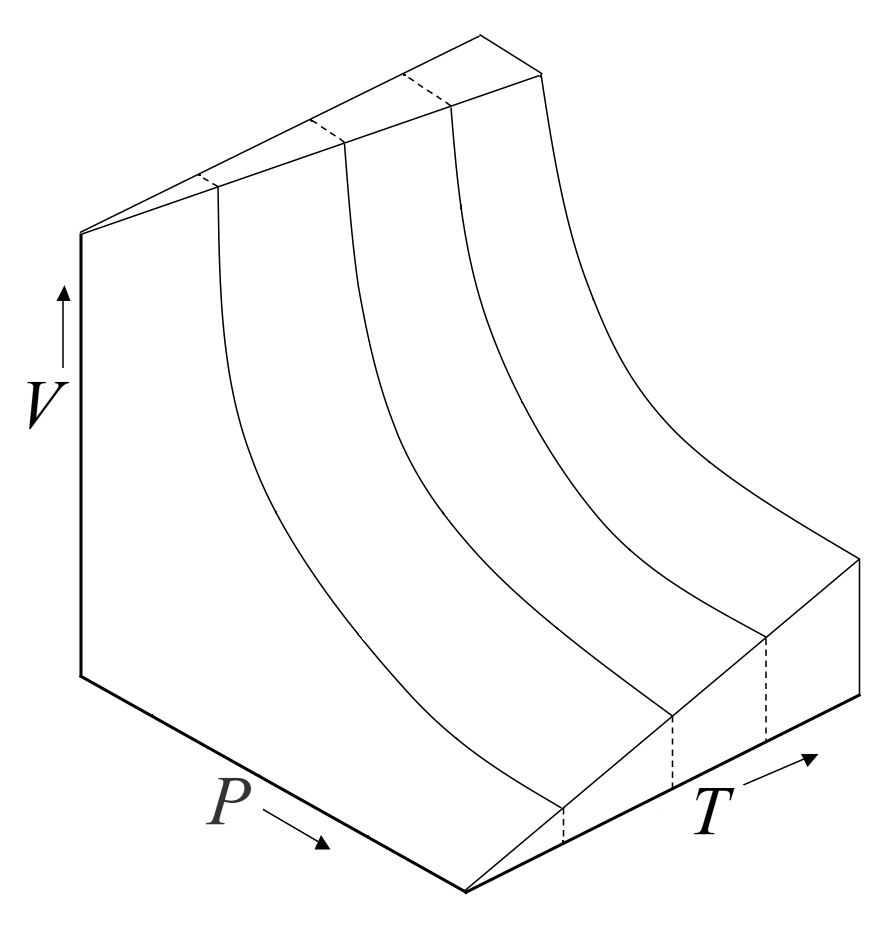
      Just like when we talk about energy, there is a relationship when we talk about equilibriums. We have something we call (you may remember this from basic chemistry) an "ideal gas". An ideal gas is a good way of looking at this principle. Since the temperature, volume and pressure have a direct relationship.

      Pressure-volume-temperature diagram for ideal gases.

      In the diagram above we can see that if we change one of the three variables, then one (or both) of the other two variables has to change too. For instance, if we heat some air in a canister, the air will try to expand. But being unable to change in volume, it will instead increase pressure. [1]

      Phase changes

      Any material has a set of phases. The ones we'll discuss are the solid, liquid and gaseous phases. Unless we control the material's environment very carefully, materials will always follow this order when energy is added. Solid becomes liquid, liquid becomes gas, and vice versa. For instance water; ice (solid) becomes water (liquid), water becomes steam (gas). So each of these transformations is a phase change.

      So when water is solid (ice), the molecules are in a grid. The molecules do not move around much, maybe a little bit where they stand. But they all still stand in a grid.

      When the water gets heated up, the molecules will start to move. Molecules have a natural attraction to each other due to subatomic forces like the van der Waals force. So the molecules will no longer stay in a grid, but they will still keep each other close due to this attraction. So a material that sticks together but freely moves around is called a liquid.

      Once the material overcomes this natural attraction, the molecules can go anywhere they want. And that's when we get a gas. Or steam, in the case of water. All of this applies even for materials we don't usually imagine would melt or evaporate, for instance steel.

      Here is a visual representation of the three states.

      Now comes the fun part. Ice is water that is at 0 degrees Celcius or below. Liquid water is water that is 0 degrees and above. But wait! Does that mean that water can be both solid and liquid at the same temperature? Yes, indeed. A material requires a certain amount of internal energy to become liquid. That is why internal energy and temperature is often used interchangeably, but is not exactly the same.

      The water molecules in ice will use the supplied energy to get excited and start moving around. This continues until the solid-liquid water reaches a point where all molecules move around. At that point it has completely become a liquid. While water is in solid-liquid state, the amount of internal energy dictates how much is liquid and how much is solid. The exact same thing happens with water at 100 degrees. It can be steam or liquid, but not fully either until it reaches a certain amount of internal energy.

      Here is a diagram of this process.

      Another fun tidbit that makes water special: Water has a lower density as a solid than it has as a liquid, when both are at 0 degrees Celcius. This means that per unit of volume ice weighs less than (liquid) water. Therefore ice floats on top of water. This is the only material that behaves in this way. And thats extremely important to our existince, since it helps regulate heat in the ocean.

      Steam engines (and implication)

      We have learned a few new things today. But there is one really important wrinkle to all of this. A system always will try to be in balance. And this we can exploit. Pressure is a type of "pushing". So thats a type of work! And an increase in thermal energy can lead to an increase in temperature. We remember that from the ideal gas. So if we cleverly organize our system, we can create work from heat! This is the basis behind most heat engines (simplified a ton). We supply thermal energy to some gas or fluid, and extract work from this gas or fluid.

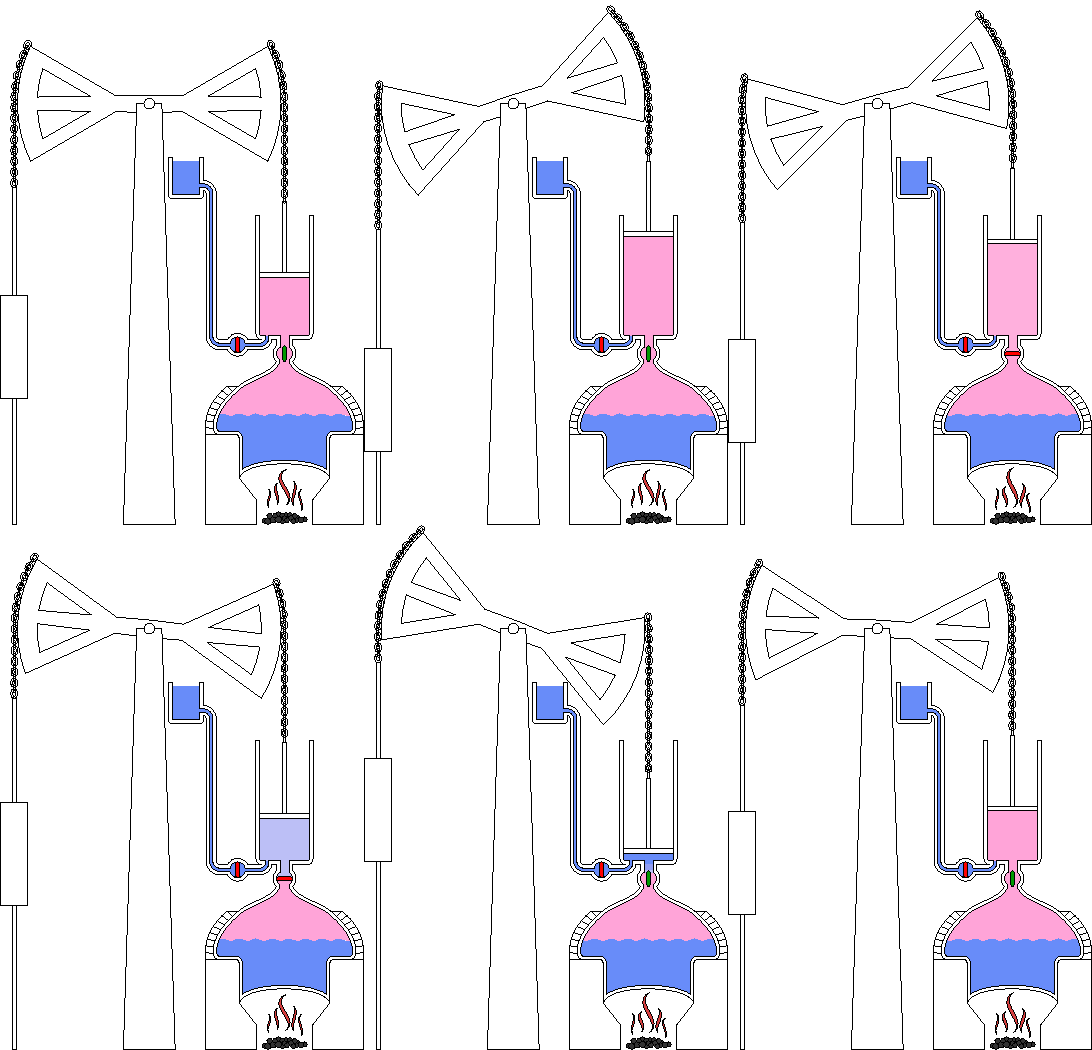
      A classical example is the steam engine. We have water inside a closed system. When we heat up the water, it will turn into steam. And this steam will want to be much less dense than water. As a consequence, the pressure inside the water tank increases drastically. We release a small amount of this steam into a closed piston.

      Here is an animation of this in action.

      The piston suddenly gets a high pressure level. As we remember, it will want to be in equilibrium with its surroundings. Currently the pressure inside the piston is much higher than outside the piston. As we remember from the ideal gas law, a higher volume will mean a lower pressure. So the piston will be moved, as the steam expands to reach a pressure balance. The movement from the piston will drive something, like a wheel. The steam is removed from the expanded piston, and the piston will return to its closed position.[2] Then the process is repeated again and again, to have the piston continously move something.

      All that from a bit of water in a tank and some supplied heat.

      Whats next?

      Next time we will talk about another important property. Entropy! In the previous topic I had a lot of questions regarding the quality of energy types, and what specifies heat from work on an intrinsic level. Entropy is the big answer to this. From that we will also cover the heat death of the universe, which would be a good introduction to "a laypersons introduction to nihilism" if we have any philosophers here.

      Note

      [1] For solid and fluid materials (as well as non-ideal gassess) this becomes a lot more complicated. If we ever do a "layperson's intro to fluid mechanics" we will cover it then.
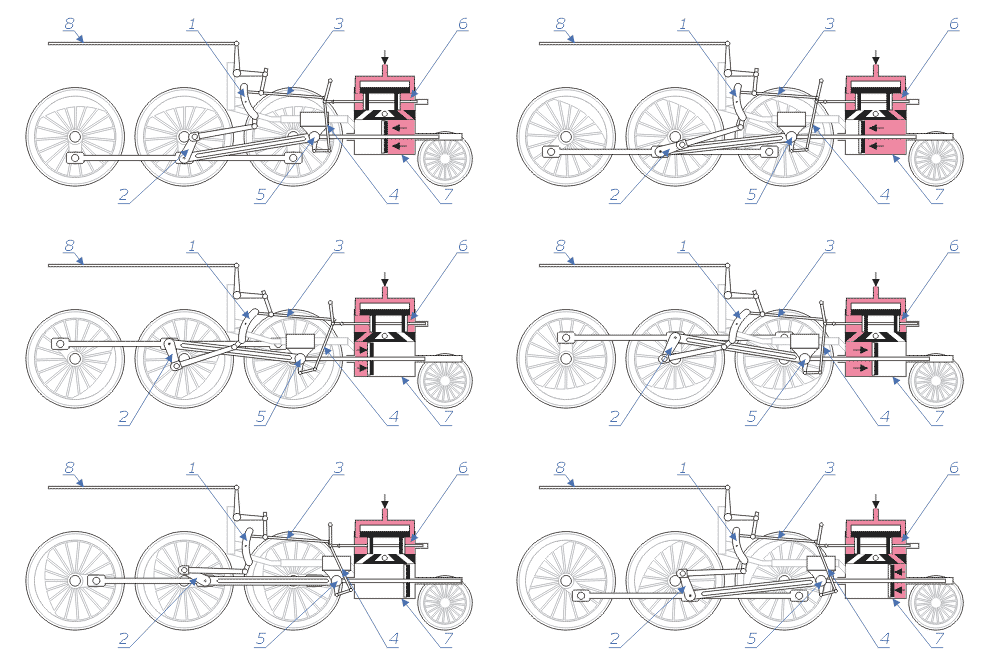
      [2] This described design is very inefficient and very simplified. Usually the piston is made so steam is supplied in turns supplied to either side of the piston. Then the work will both removed the steam that already performed work as well as move the piston. That way you can have continous movement in both directions.

      See for instance this image.

      17 votes
    24. Creative process discussion

      I'd love to hear about how you create your favorite works. Of anything. How did you write your best music? How did you create your favorite character in a story you wrote? Anything of the sort....

      I'd love to hear about how you create your favorite works. Of anything. How did you write your best music? How did you create your favorite character in a story you wrote? Anything of the sort.

      I'd love to hear all the different processes people have. It's really quite an interesting topic of discussion, for me.

      Personally, I grab a cup of coffee and listen to instrumental music (mostly avant-garde jazz [Coltrane, Washington, etc]) while creating the world of the story I'm writing. There's something very productive-feeling about being wired on caffeine while also having a constant noise in your ears. It's how I compose some of my better characters and settings.

      Due to my constant writer's block phenomenon, sometimes I'll smoke some pot to get past it. It's almost like phasing through a wall you can't jump over. There's something lifting about it.

      16 votes
    25. Black Mirror S04E05 “Metalhead” Discussion Thread

      Previous episode | Index thread | Next episode Black Mirror Season 4 Episode 5 - Metalhead At an abandoned warehouse, scavengers searching for supplies encounter a ruthless foe and flee for their...

      Previous episode | Index thread | Next episode

      Black Mirror Season 4 Episode 5 - Metalhead

      At an abandoned warehouse, scavengers searching for supplies encounter a ruthless foe and flee for their lives through a bleak wasteland.

      Black Mirror Netflix link


      Warning: this thread contains spoilers about this episode! If you haven't seen it yet, please watch it and come back to this thread later.

      You can talk about past episodes, but please don't discuss future episodes in this thread!


      If you don't know what to say, here are some questions to get the discussion started:

      • How does the title relate to the episode itself?
      • Are there any similarities between real life events and the episode?
      • Are there any references or easter eggs in the episode, such as references to past episodes?

      Please rate the episode here!

      Sorry for being late with this one!

      11 votes
    26. This week in Anime: week 45 of 2018

      Sorry guys, been awfully busy this week so I hadn't really taken the time to watch this week's anime How do? Since we're currently lacking native spoiler tags, I'd ask all of you to follow this...

      Sorry guys, been awfully busy this week so I hadn't really taken the time to watch this week's anime

      How do?

      Since we're currently lacking native spoiler tags, I'd ask all of you to follow this scheme:
      Post a top level comment with the title and episode number of the anime you want to talk about like this
      **JoJo's Bizarre Adventure: Vento Aureo - Episode 1**
      Then reply to those top level comments with your thoughts. This way people who haven't seen something yet or plan on binge watching once all the episodes are out can simply collapase the top level comment to not get spoiled ^.^

      What do?

      Simply post, discuss or joke about any currently airing anime you want. For Anime you've been watching that aren't currently airing refer to Cleb's weekly thread.

      When do?

      But what if the anime I want to talk about hasn't aired yet?

      No problem, just post a comment here once the episode has aired, these threads aren't meant to last one single day.


      Archive

      Archives of these threads can be found at the unofficial wiki

      9 votes
    27. Tech Talk: What's the make & model of your current phone? What do you like about it? Dislike? What phones have you owned in the past?

      Following on from the Tildes 0.5 year survey in which 72% of users stated they used an Android device, and 24% used an iOS device, I thought it'd be fun to ask people in a longform manner to talk...

      Following on from the Tildes 0.5 year survey in which 72% of users stated they used an Android device, and 24% used an iOS device, I thought it'd be fun to ask people in a longform manner to talk about their current phone, and their dislikes & likes about it. What has your upgrade history been like?

      I'm currently utilising an iPhone XS (no "Max") in 256GB. This is my first phone upgrade where I've felt like the changes are a step sideways rather than forwards from what I've previously experienced. The minimal bezels are very nice, and once you understand how the iOS experience fits into the overall vision for Apple's phone lineup, the notch becomes an immediately obvious choice—a design compromise for the time being until we can place the sensor array under the display.

      Face ID is acceptable. It fails a bit more often than Touch ID ever did, but it fails in different situations, and also works better in others. For a first generation iteration it's acceptable; if it can get more diverse with time and work better in extreme sunlight and at wider angles, it'll become definitively better than a fingerprint scanner.

      I talked a bit about the OLED display in the XS in this comment here, where I can distinguish the pentile crosshatching pattern, and again, I feel that the OLED is a case of better in some situations, worse in others. The inky blacks are fantastic, but the dark ghosting is a compromise I'm less happy with. Apple's IPS LCD panels are so good, they had a high bar to meet here.

      The camera is again truly fantastic; not enough to ever make me consider selling my Sony mirrorless, but the computational photography aspects makes taking challenging photos more of a breeze than ever before.

      Finally, after living with a plus-sized phone for the past 4 years, a step back to a smaller form factor with a similar sized screen is a breath of fresh air—I can finally tie my shoelaces up with my phone in my jean pockets again.

      The watch & AirPods & continuity integrations will keep me happy in the Apple ecosystem for a while yet, but I'd need to see a very compelling new feature of aspect to a future phone to upgrade in the next 2 years at this point. Phones are lasting longer than ever before, as they should, and Apple knows this.

      Previously I've owned

      • iPhone 7 Plus, Jet Black 256GB. The Jet Black finish coupled with the weightier frame & thicker body definitely resulted in this feeling like the most polished iPhone 6-style design to date. Runner up for my favourite phone. Further more the P3-gamut display significantly improved image quality. I wasn't happy enough with the iPhone X to consider an upgrade.

      • iPhone 6 Plus, Silver 128GB. Might be my least favourite phone of all time? Too thin, slippery, suffered from bendgate; and had display issues which gave it a bad rap. Touch ID was cool; however.

      • iPhone 4, Black. Might be my favourite phone of all time, purely from a design standpoint? Utilising the steel frame around the edge of the phone as an antenna was completely unheard of back then and truly a fantastic design innovation. The sandwiched glass profile was both a fingerprint magnet and truly gorgeous; and the Retina display was breathtaking. I'd love to see a return to this design profile.

      • iPhone 3G. My first phone. I distinctly remember jailbreaking this device to change the cellular provider name in the top left corner & enable some extremely low quality video recording; this was also the good old days of fantastic games like Tap Tap Revenge.

      How about you?

      35 votes
    28. Defining and using "ask" tags

      Deimos and I were discussing the use of "ask" topic tags this week, and we agreed it might be a good idea to get a consensus on these. At the moment, Tilders are using four "ask" tags on topics:...

      Deimos and I were discussing the use of "ask" topic tags this week, and we agreed it might be a good idea to get a consensus on these.

      At the moment, Tilders are using four "ask" tags on topics:

      • ask

      • ask.survey

      • ask.recommendations

      • ask.help

      (There may be more "ask" tags created in the future, but these four are what we're all using at the moment.)

      Anything that's a question gets tagged with "ask". Some specific types of question will then get tagged with "ask.survey" or "ask.recommendations" or "ask.help", depending in the type of question being asked.

      • "ask.survey" is for questions about preferences and favourites. "What's your favourite horror movie?" "What's the best place you ever visited?" "What's your favourite type of holiday?" The asker is collecting data about people's likes and dislikes (even if they're not going to publish the results in a report later!).

      • "ask.recommendations" is for questions asking for recommendations. "What's a good browser to use?" "What book should I read next?" "Which brand of phone should I buy?" The asker is looking for people to recommend things to them.

      However, Deimos and I wondered about "ask.help". One interpretation we came up with was that "ask.help" is for questions looking for a specific answer, where it should generally be possible for people to think "yes, this is the right answer to the question". This would include questions seeking help learning about an academic topic, such as happens in /r/AskScience and /r/AskHistorians over on Reddit. Another interpretation we came up with was that "ask.help" is for questions looking for guidance on doing something, like a "how to" type question. This would be more like the types of questions in /r/Help and like the Help menus in software and the F1 key - helping people get things done.

      What do you think about the "ask" tags? In particular, what should the "ask.help" tag be used for? In general, are the existing "ask" tags okay? Do we need more "ask" tags? Do we need different "ask" tags?

      18 votes
    29. A layperson's introduction to LEDs

      Introduction I want to give an introduction on several physics topics at a level understandable to laypeople (high school level physics background). Making physics accessible to laypeople is a...

      Introduction

      I want to give an introduction on several physics topics at a level understandable to laypeople (high school level physics background). Making physics accessible to laypeople is a much discussed topic at universities. It can be very hard to translate the professional terms into a language understandable by people outside the field. So I will take this opportunity to challenge myself to (hopefully) create an understandable introduction to interesting topics in modern physics. To this end, I will take liberties in explaining things, and not always go for full scientific accuracy, while hopefully still getting the core concepts across. If a more in-depth explanation is wanted, please ask in the comments and I will do my best to answer.

      Previous topics

      Bookmarkable meta post with links to all previous topics

      Today's topic

      Today's topic will be light emitting diodes, better known as LEDs. As the name suggests, we'll have to discuss light and diodes. We will find out why LEDs can only emit a single colour and why they don't get hot like other sources of light. Let's start by discussing diodes, in case you are already familiar with diodes note that I will limit the discussion to semiconductor (p-n with a direct bandgap) diodes as that's the type that's used in LEDs.

      What's a diode?

      A diode is an electronic component that, ideally, only lets electric current through in one direction. In other words it's a good resistor when the current flows in one direction and a really good conductor when the current flows in the other direction. Let's look a bit closer at how diodes function.

      Semiconductors

      Diodes are made out of two different semiconducting materials. In everyday life we tend to classify materials as either conducting (metals being the prime example) or non-conducting (wood, plastics, rubber). Conductance is the flow of electrons through a material, a conducting material has a lot of electrons that can move freely through a material while an insulator has none. Semiconducting materials fall in between these two categories. They do conduct but not a lot, so in other words they have a few electrons that can move freely.

      N-type semiconductors

      We are able to change a semiconductor's conductivity by adding tiny amounts of other materials, this is called doping. As an example, we can take silicon (the stuff that the device you're reading this on is made out of) which is the most well-known semiconductor. Pure silicon will form a crystal structure where each silicon atom has 4 neighbours, and each atom will share 1 electron with each neighbour. Now we add a little bit of a material that can share 5 electrons with its neighbours (how generous!). What will happen? Four of its shareable electrons are busy being shared with neighbours and won't leave the vicinity of the atom, but the fifth can't be shared and is now free to move around the material! So this means we added more freely flowing electron and that the conductivity of the semiconductor increases. An illustration of this process is provided here, Si is chemistry-talk for silicon and P is chemistry-talk for phosphorus, a material with 5 shareable electrons. This kind of doping is called n-type doping because we added more electrons, which have a negative charge, that can freely move.

      P-type semiconductors

      We can do the same thing by adding a material that's a bit stingy and is only willing to share 3 electrons, for example boron. Think for a moment what will happen in this case. One of the silicon atoms neighbouring a boron atom will want to share an electron, but the boron atom is already sharing all of its atoms. This attracts other electrons that are nearby, one of them will move in to allow the boron atom to share a fourth electron. However, this will create the same problem elsewhere in our material. Which will also get compensated, but this just creates the same problem once more in yet another location. So what we now have is a hole, a place where an electron should be but isn't, that is moving around the crystal. So in effect we created a freely moving positive charged hole. We call this type of doping p-type. Here's an illustration with B the boron atoms.

      Creating a diode

      So what would happen if we took a n-type semiconductor and a p-type semiconductor and pushed them against one another? Suddenly the extra free-flowing electrons of the n-type semiconductor have a purpose; to fill the holes in the p-type. So these electrons rush over and fill the holes nearest to the junction between the two semiconductors. However, as they do this a charge imbalance is created. Suddenly the region of p-type semiconductor that is near the junction has an abundance of electrons relative to the positive charges of the atom cores. A net negative charge is created in the p-type semiconductor. Similarly, the swift exit of the electrons from the n-type semiconductor means the charge of the cores there isn't compensated, so the region of the n-type semiconductor near the junction is now positively charged. This creates a barrier, the remaining free electrons of the n-type cannot reach the far-away holes of the p-type because they have to get through the big net negative charge of the p-type near the junction. Illustration here. We have now created a diode!

      How diodes work

      Think for a moment what will happen if we send current* (which is just a bunch of electrons moving) from the p-type towards the n-type. The incoming electrons will face the negative charge barrier of the p-type and be unable to continue. This means there is no current. In other words the diode has a high resistance. Now let's flip things around and send electrons through the other way. Now they will come across the positive charge barrier of the n-type semiconductor and be attracted to the barrier instead. The electrons' negative charge compensates the net positive charge of the barrier on the n-type and it will vanish. This destroys the equilibrium situation of the barrier. The p-type holes are no longer repelled by the positive barrier of the n-type (as it no longer exists) and move closer to the junction, this means the entire barrier will fade and current can move through. We now have a conductor.

      OK, but I don't see what this has to do with light

      Now let's find out how we can create light using this method. When current is applied to a diode what happens is that one side of the diode is at a higher energy than the other side. This is what motivates the electrons to move, they want to go from high energy to low energy. If the p-type semiconductor is at a higher energy than the n-type the electron will, upon crossing the junction between the two types, go from a high energy level to a lower one. This difference in energy must be compensated because (as @ducks mentioned in his thermodynamics post) energy cannot be destroyed. So where does the energy go? It gets turned into light!

      The energy difference between the p-type and n-type is fixed, meaning a fixed amount of energy is released each time an electron crosses the junction. This means the light is of a single colour (colour is how we perceive the wavelength of light, which is determined by the energy of the light wave). Furthermore, none of the energy is lost so there is no energy being turned into heat, in other words the LED does not get warm.

      Conclusion

      So now we know why the LED is so power-efficient; it does not turn any energy into heat, it all goes into light. We now also know why they only emit a single colour, because the energy released when an electron crosses the junction is fixed.

      Next time

      I think next time I will try to tackle the concept of wave functions in quantum mechanics.

      Feedback

      As usual, please let me know where I missed the mark. Also let me know if things are not clear to you, I will try to explain further in the comments!

      Addendum

      *) Yes, current flow is defined to be opposite to the flow of the electrons, but I don't want to confuse readers with annoying definitions.

      34 votes
    30. Programming Challenge: Shape detection.

      The programming challenges have kind of come to a grinding halt recently. I think it's time to get another challenge started! Given a grid of symbols, representing a simple binary state of...

      The programming challenges have kind of come to a grinding halt recently. I think it's time to get another challenge started!

      Given a grid of symbols, representing a simple binary state of "filled" or "unfilled", determine whether or not a square is present on the grid. Squares must be 2x2 in size or larger, must be completely solid (i.e. all symbols in the NxN space are "filled"), and must not be directly adjacent to any other filled spaces.

      Example, where 0 is "empty" and 1 is "filled":

      000000
      011100
      011100
      011100
      000010
      
      // Returns true.
      
      000000
      011100
      011100
      011110
      000000
      
      // Returns false.
      
      000000
      011100
      010100
      011100
      000000
      
      // Returns false.
      

      For those who want a greater challenge, try any of the following:

      1. Get a count of all squares.
      2. Detect squares that are touching (but not as a rectangle).
      3. Detect other specific shapes like triangles or circles (you will need to be creative).
      4. If doing (1) and (3), count shapes separately based on type.
      5. Detect shapes within unfilled space as well (a checkerboard pattern is a great use case).
      13 votes
    31. A layperson's introduction to Thermodynamics, part 1: Energy, work, heat

      Intro Hello everyone, @wanda-seldon has been giving us an introduction to quantum physics. For now, she will be given a short break to prepare new stuff. In the meantime I will be covering some...

      Intro

      Hello everyone,

      @wanda-seldon has been giving us an introduction to quantum physics. For now, she will be given a short break to prepare new stuff. In the meantime I will be covering some classical mechanics, more specifically thermodynamics. In part 1, we need to work our way through some of the more dry concepts, so we can understand and appreciate the horrifying implications of the fun parts. So I promise, this will be the most verbose one.

      Some of you may have briefly seen a version of this posted, that was due to me misunderstanding the schedule with @wanda-seldon. If you saw that one, I will mention I rewrote nearly all of it to be more readable.

      Now, on today's agenda: The basics of heat, work and energy and how it's all related.

      Previous posts can be found here: https://tildes.net/~science/8al/meta_post_for_a_laypersons_introduction_to_series

      Important note

      If @wanda-seldon in her posts mention "energy", it's most likely in the context of energy operators, which is a concept in quantum physics. I'm not going to pretend I understand them, so I will not be explaining the difference. We will cover what energy is in classical mechanics. So keep that in mind if you read something from either of us.

      Subject

      Summarized

      What is heat? Using a lot of fancy words we can describe it as follows. Heat is an energy that is transferred between systems by thermal interaction. And what is work? Work is an energy that is applied in a way that performs... work. The combined energy in a system is called internal energy. This type of energy can be transformed or applied to other systems.

      These are a lot of new words, so lets break that down a bit.

      Systems

      A system is just a catch-all term for something that can be defined with a boundary of sorts. Be it mass, volume, shape, container, position, etc. A canister, your tea mug, the steam inside a boiler, your body, a cloud, a room, earth, etc. They are all systems because you can in some way define what is within the boundary, and what is beyond the boundary.

      In theory, you could define every single nucleid in the universe as an unique system. But that would be counter-intuitive. In thermodynamics we tend to lump things into a system, and treat it as one thing. As opposed to Quantum stuff that looks at the smallest quantity. Calculating every single water molecule in my coffee would be pure insanity. So we just treat my mug as the boundary, and the tea inside the mug as the system. And just so it's mentioned, systems can contain systems, for instance a tea mug inside a room.

      Energy

      Energy is some quantifiable property that comes in either the form of heat, work. It can be transferred to other systems, or change between the different energy types. An example of transfer is my coffee cooling down because it's in a cold room. That means heat has been transferred from one system (my mug) to another system (the room). Alternatively you could say my hot coffee mug is warming up the room, or that the room is cooling down my coffee. Thermodynamics is a LOT about perspective. An example of transforming energy types is when we rub our hands together. That way we convert work (rubbing) into heat. It's really not more complicated than that. An interaction in this case is just a system having an effect on a different system. So a thermal interaction means it's an interaction due to heat (like in the mug example).

      This brings us to an extremely important point. So important, it's considered "law". The first law of thermodynamics even. Energy cannot be destroyed, it can only change forms.

      Your battery charge is never really lost. Neither is the heat of your mug of coffee. It just changed form or went somewhere else. The combined energy of all types that is residing inside a system is called internal energy.

      Heat and work

      Let's say we have a system, like a room. And all windows and doors are closed, so no energy can leave. In this system, you have a running table fan connected to a power line, getting energy from outside the system. The table fan is making you feel cool. Is the fan cooling down the room, heating up the room, or doing nothing? Think about it for a moment.

      http://imgbox.com/CKtQLLOQ

      The first thought of many would be to think that this fan would cool the room down, it sure makes you feel cooler! But it's actually heating up the room. As we remember, internal energy is the energy inside a system (room, in this case). The fan is getting energy from outside, and uses this energy to perform work. The fan accelerates the air inside the room, and this accelerated air will evaporate some of your sweat, so you feel cool. But as we remember, energy cannot be destroyed. So we are importing energy into the system, increasing the internal energy. Some of the work from the fan is also directly converted to heat, since the motor of the fan will get hot.

      So if we are not getting rid of any of this excess energy, we are increasing the internal energy. And therefore actively increasing the temperature of the room.

      http://imgbox.com/SAtqk7YG

      To use a more tangible example: Simplified, this phenomena is why green house gases are bad. Lets define earth as a system. Earth gets a lot of energy from the sun. And a lot of this energy will be reflected and sent back to space. Green house gases will reflect back some of this energy trying to leave earth. So instead of having a roughly equal amount of energy enter the system (from the sun, from us doing stuff, etc) that leaves out in space, we have an increasing amount of energy on earth. This, as a consequence, increases temperature.

      Implications

      Now, what are the maybe not so obvious implications of this?

      Waste heat, from supplied energy or inefficient work is a constant headache in engineering. If we cannot remove enough heat, we will actively heat up objects until they are destroyed. Thats why good cooling systems are important in cars, computers, etc.

      Whats next?

      Now this was not so bad. In the future we will cover phase changes, equilibriums, entropy, the heat death of the universe and briefly touch upon engines. So thats most likely two more parts after this. After that @wanda-seldon will take over again.

      I plan on doing one main part per week, but if something is asked that warrants a small topic I might do smaller ones inbetween.

      Feedback

      Something unclear? Got questions? Got feedback? Or requests of topics to cover? Leave a comment.

      19 votes
    32. This is the most beautiful song I've ever heard - and it's country

      okay okay what in the actual fuck so i'm a southern boy myself. ever since i was a little kid my mom tried so hard to make me into a little cowboy. i was bought cowboy boots, cowboy hats, and...

      okay

      okay

      what in the actual fuck

      so i'm a southern boy myself. ever since i was a little kid my mom tried so hard to make me into a little cowboy. i was bought cowboy boots, cowboy hats, and boot-cut blue jeans. even at my young toddler age, i detested all of it lmao.

      i was always a city boy.

      i loved the idea of big cities like new york, los angeles, chicago, etc. hell, i even fantasized about spending my days in dallas of all places when i was in school daydreaming.

      my music tastes trended as far alternative as my style in clothes and girls - in middle school i listened to everything from Shinedown to Disturbed to A Day to Remember to Dimmu Borgir (spooky!)

      when i was in higschool - everything from showtunes (Phantom of the Opera) to Eminem to more metal (We Butter The Bread With Butter) to indie rock (Mumford and Sons)

      but never in my life was country even a blip on my radar.

      sure there were one or two songs you pick up that you get to know like

      "Back When" x Tim McGraw

      "Pretty Good at Drinking Beer" x Billy Currington

      (my stepdad is a country musician. it's hard not to pick up something here and there.)


      but

      i just discovered a new genre of music (new to me).

      i just discovered a new sound.

      i just discovered my new favorite song.

      and it's country.

      Hank Williams III - "Ghost to a Ghost"

      like oh my God

      i just earlier this week discovered something called "Outlaw Country". i'd somehow managed to go my whole life without ever coming into contact with this.

      will you listen to this fucking song??

      it's the same classic country instruments that we've heard for decades.

      paired with dark, angsty, grungy, emo lyrics.

      with an incredibly metal breakdown serving as the chorus.

      with a terrifically orchestral and bluesy viola/violin backing the entire song.

      WHAT IN TARNATION!?

      why did no one ever tell me there was an entire subgenre of emo cowboys running around talking about sleeping on the blacktop, relationship struggles, and popping hella pills


      i now listen to country music and i'm never admitting it to my parents lmao.

      if you didn't catch the link earlier, this song is a fucking work of art and literally brought me from awe to tears to fuck yeah! all in the span of six minutes in public in this cafe.

      https://youtu.be/RoJwrSTIZM0

      i think i've looped it back 7-8 times in a row now.

      i'm floored.


      what did you lot think?

      do you listen to outlaw country?

      please pass on any recommendations you have

      8 votes
    33. The endings of Far Cry 5

      TLDR at the bottom I played Far Cry 5 some time ago, and remember it as a good, albeit conventional, open-world FPS which freshened up the Far Cry formula and simplified it, for the better of the...

      TLDR at the bottom

      I played Far Cry 5 some time ago, and remember it as a good, albeit conventional, open-world FPS which freshened up the Far Cry formula and simplified it, for the better of the game. I also remember that while I enjoyed myself through it's entirety, the endings (as I immediatelly replayed the final mission to see the other ending) left such a sour taste in my mouth that it ruined the rest of the game's experience for me. I immediately uninstalled it and promised myself to never touch the game again. Both endings had completely ruined it for me. I wasn't there for the story, I was there to enjoy myself while hunting and exploring in rural Montana and occasionally killing people who deserved it (the cult is evil, the game makes this very clear).

      Then you get to the end, after dispatching of Joseph's lieuteants; Faith, John and Joseph in missions, that were started through terrible scripted sequences of you being hunted down. And as it turns out, no matter what you choose (engage Joseph in combat or walk away), you can't save your friends (in fact if you walk away it is implied that you kill them yourself because of sheer bad luck) or kill Joseph, for that matter. Your silent protagonist listens to his boring and frankly infuriating monologues after locking you into cutscene, even though you came to the mission wielding an array of very deadly weapons, ranging from assault rifles to rocket launchers to a shovel. But Far Cry 5 doesn't care, you get locked into a cutscene and you are disbarred from shooting the prime antagonist, the man that admitted to you personally that he smothered his infant daughter, the man who leads the cult which kills, kidnapps, tortures and most likely rapes the inhabitants of Hope County. And you don't even get to shoot him in his fucking arrogant face, you just get to listen to his monologue. You totally could! You still have your guns, actually, you pull them out immediately after the cutscene if you choose to engange in a boss fight! But it's a game and nothing makes sense.

      So Joseph shows you that he somehow captured your allies again, even though, to even engage him, you have to liberate the entire county from the grip of Eden's Gate, so realistically, there shouldn't be anyone left to capture your friends. The cultists are all dead, killed by bullets or your shovel.

      Ultimately, you get to pick between taking three of your friends, leaving the rest behind and driving away, only for the driver to turn on the radio, where it just so happens to play the song which was, during the story, implanted in your brain to send you on a murderous, uncontrollable rage. Or you fight Joseph, who, after the fight ends (WHERE YOU STILL DON'T KILL HIM) reveals, that he was right all along, just as atom bombs start falling from the sky. And even then, Joseph, on his own, manages to overpower all your friends and kill them, because for some reason he's the only one not affected in any way by the atom bomb that just detonated in the distance (it is implied that it was another country that dropped the bomb, not Eden's Gate, but then, who would bomb some random county in Montana in the US without any strategical value?), locks you and himself into a bunker (which had a very capable, armed to the teeth, inhabitant living in it, which Joseph somehow kills off screen even though he marched in there unarmed) probably to brainwash you. Of course, the only right choice would be to take the secret ending, but that means not playing the game at all, and still puts the atom bombs into question and if they would still explode, and all the inhabitants of Hope County at the mercy of an evil doomsday cult.

      As it turns out, in the world of Far Cry 5, the world is on the edge of starting world war 3, however, no one tells you this, there are only tidbits you hear on the radio if you drive to areas you've liberated. So everyone who turned off the radio didn't hear those. You could say that the world itself is a bit of foreshadowing, considering that everyone and their grandmother were building bunkers, but I thought that was another jab at the classic US rednecks the game parodied a lot, I missed that entirely. Apparently when you take drugs in the game, the hallucinations also hint at a looming world war, but I didn't take the drugs at all, so, barring the bunkers, the hints were too small to be noticed and gave the player something to think about.

      The ending sparked a lot of discussion and speculation(one even going as far as claiming that the protagonist is Jesus) on the internet, mutiple discussion on Reddit and other sites, most people seemed to very much dislike the ending because precisely it felt that everything you did in the game was for nothing, which is an ending you can pull off (See Spec Ops: The Line) but the game has to earn with a very good plot and fitting gameplay. My major problem with Far Cry 5 is that it didn't feel earned at all. There was too much of a disconnect between gameplay and narrative (narrative which on it's own wasn't good enough for such a conclusion) to warrant such a bleak ending and pull it off in a way that didn't send the player into a salty rage. There are also theories floating around the net saying that the entire atom bombs ending was one big hallucination, considering your (and your allies) exposure to Bliss at the start of the boss fight. Honestly, I think Ubisoft could've saved some grace if the post-launch content and the DLC were maybe more focused on apocalyptic content (perhaps one big DLC which turned Hope County into a Fallout-esque desert), I actually thought that such content was part of the game, considering that the main menu changes massively after the atom bomb ending. It would've really saved the game: A classic WTF into oh no you just did not! into Oh they actually didn't. You could've even had most of the characters survive, because there were bunkers everywhere in Hope County. Instead we got lackluster post-launch DLC and content, as all three of the DLCs had a very mediocre reception.

      The pcgamer article I linked makes a lot of points about how to make the game better, and ultimately I agree with them. It would've made a lot more sense if the entire plot had more gravitas from the beginning, if it were pictured more clearly that the world is in fact going bonkers, but also if the characters were a bit more realistic, both the villians and allies. You can't make a parody of rural America, structure the entire thing as a fun, wild, action-packed ride and then suddenly start dropping atom bombs and declare world war 3 at the end. People will feal cheated.

      I'm interested in what the community here on Tildes thinks of Far Cry 5 and if we could get a discussion going.

      TL;DR: Summing up, I don't think Far Cry 5 did enough to pull off the ending it gave us. For me and a lot of other people, it even went so far as to ruin the entire game, as everything I did was completely invalidated, all the time I spent on the game and with the characters I've grown to like (they were caricatures, but lovable ones) felt wasted, because there wasn't a single thing I could've to save anyone (except get the secret ending and don't play the game at all and even then, everything is still open). What are your thoughts?

      7 votes
    34. döner macht schöner aber ich ess nie

      When He broke the third seal, I heard the third living creature saying, “Come.” I looked, and behold, a black horse and he who sat on it had a pair of scales in his hand. a beer in my hand then a...

      When He broke the third seal, I heard the third living creature saying, “Come.” I looked, and behold, a black horse and he who sat on it had a pair of scales in his hand.


      a beer in my hand
      then a piss in a bush
      xans in the bedroom
      geeked off the kush
      half past nine, running dry
      you came thru
      bought an 18 pack
      and we split it in two
      didnt know what we
      were getting up to
      cuddled on the couch, you
      were watching cartoons
      slowly got up, said i
      got something to do
      headed outside, took
      a piss off the roof

      two more shots then i
      broke the seal, looked up
      at the sky saw the devil
      on a black horse
      headed right for me
      flying in a crash course
      spoke into my ear, and
      his voice was all coarse

      his fork-tongued words
      hit my ears like sand
      and he spoke in a language
      that i didn't understand
      my stomach felt tight
      pale white in my hands
      and i went back in at his command

      then i didn't sleep
      for the next three nights
      and i didn't eat shit
      popcorn, white rice
      dancing damning dreams of
      baby looking at me nice
      sugar plums withered to
      a kiss, a hug, and a good night

      -.

      soothe-speaking visions of
      your eyes like a blue quartz
      watching slowly, clouds morph
      devil on a pale horse
      memories in full force
      time has come, no recourse
      white wedding dressed corpse
      wicca phase task force

      -.

      as she spoke, her eyes became green
      stomach butterflies and weak knees
      god has sent an angel for me
      her hands crawled in my chest slowly
      said, "it's your heart which i'm holding"
      gently smiled and exposed her teeth
      then ate it whole, as a wild beast
      a soft call in the distance spoke in peace
      hades
      with arms open lovingly
      and i fell

      mutter-
      seel-
      inallein.
      mutter-
      seel-
      inallein.

      7 votes
    35. Why am I getting shocked in a very specific way when petting my cat?

      It's a dry, windy day. I had my left hand stationary on my cat's back and was petting him with my right hand. I noticed when I removed my right hand from contact with his fur, I got tiny shocks in...

      It's a dry, windy day. I had my left hand stationary on my cat's back and was petting him with my right hand. I noticed when I removed my right hand from contact with his fur, I got tiny shocks in the middle finger of my left hand, but only when removing my right hand and only in my left middle finger. (He didn't seem to notice any shocks.)

      Why is this very specific type of electric shock occurring?

      6 votes
    36. Black Mirror S04E04 “Hang the DJ” Discussion Thread

      Previous episode | Index thread | Next episode Black Mirror Season 4 Episode 4 - Crocodile Paired up by a dating program that puts an expiration date on all relationships, Frank and Amy soon begin...

      Previous episode | Index thread | Next episode

      Black Mirror Season 4 Episode 4 - Crocodile

      Paired up by a dating program that puts an expiration date on all relationships, Frank and Amy soon begin to question the system's logic.

      Black Mirror Netflix link


      Warning: this thread contains spoilers about this episode! If you haven't seen it yet, please watch it and come back to this thread later.

      You can talk about past episodes, but please don't discuss future episodes in this thread!


      If you don't know what to say, here are some questions to get the discussion started:

      • How does the title relate to the episode itself?
      • Are there any similarities between real life events and the episode?
      • Are there any references or easter eggs in the episode, such as references to past episodes?

      Please rate the episode here!

      17 votes
    37. House of Cards season 6 - what did you think of it?

      So I've just finished watching the new season. I had low expectations going in, given how the writers had to cut out their main character at the eleventh hour, but I still can't help but feel...

      So I've just finished watching the new season. I had low expectations going in, given how the writers had to cut out their main character at the eleventh hour, but I still can't help but feel disappointed.

      Soo many plot threads left open. No repercussions for any of the shit that went down over the last 5 years. The good journalist ends up dead, Claire Underwood commits murder literally in the oval office while secret service is right outside the door and then... nothing. That's it. That's what we get for series a finale. I mean, what?

      I've also been quite pissed off how they tried to turn Claire into a feminist icon. Claire is a monster. She is at least as bad as Frank. She wanted to literally start a nuclear war to deflect attention away from herself.

      Don't get me wrong, having a feminist message is ok. It's good. It's even timely. But not with Claire fucking Underwood for fucks sake! In the first episode where that female soldier asks her if she even has a plan so that more soldiers won't end up dead, Claire snarks at her with "you wouldn't ask me that if I was a man". Really? This fresh recruit, this soldier who you will be sending to her death is asking you - someone who never held any public office before - whether you have a plan and your response is fuck patriarchy?

      How about that scene where she fires her entire cabinet and fills it with an all-female cast? Forget about real life, it's not even realistic in the show's world. Remember how hard Frank had to fight, how many people he had to cross, bribe and even murder just to replace a single seat in earlier seasons? Where was the senate? Did everyone else just roll over; how come nobody fought her on this? It felt like the writers really, really wanted to play out their deepest, guilty-pleasure Hillary 2016 fantasies out on the show and the script suffered for it.

      If they just left things at the last season's finale where Claire looked into the camera with "my turn!" it would have been a much more powerful moment, certainly better than this disorganized, directionless mess we got.

      So yeah, that's where I'm at. How about you?

      9 votes
    38. This week in Anime: week 44 of 2018

      Technically I'm late again, but it's still Friday somewhere right? How do? Since we're currently lacking native spoiler tags, I'd ask all of you to follow this scheme: Post a top level comment...

      Technically I'm late again, but it's still Friday somewhere right?

      How do?

      Since we're currently lacking native spoiler tags, I'd ask all of you to follow this scheme:
      Post a top level comment with the title and episode number of the anime you want to talk about like this
      **JoJo's Bizarre Adventure: Vento Aureo - Episode 1**
      Then reply to those top level comments with your thoughts. This way people who haven't seen something yet or plan on binge watching once all the episodes are out can simply collapase the top level comment to not get spoiled ^.^

      What do?

      Simply post, discuss or joke about any currently airing anime you want. For Anime you've been watching that aren't currently airing refer to Cleb's weekly thread.

      When do?

      But what if the anime I want to talk about hasn't aired yet?

      No problem, just post a comment here once the episode has aired, these threads aren't meant to last one single day.


      Archive

      Archives of these threads can be found at the unofficial wiki

      5 votes
    39. Triple the apparatuses, triple the weirdness: a layperson's introduction to quantisation and spin, part 2

      EDIT: With the help of @ducks the post now has illustrations to clear up the experimental set-up. Introduction I want to give an introduction on several physics topics at a level understandable to...

      EDIT: With the help of @ducks the post now has illustrations to clear up the experimental set-up.

      Introduction

      I want to give an introduction on several physics topics at a level understandable to laypeople (high school level physics background). Making physics accessible to laypeople is a much discussed topic at universities. It can be very hard to translate the professional terms into a language understandable by people outside the field. So I will take this opportunity to challenge myself to (hopefully) create an understandable introduction to interesting topics in modern physics. To this end, I will take liberties in explaining things, and not always go for full scientific accuracy, while hopefully still getting the core concepts across. If a more in-depth explanation is wanted, please ask in the comments and I will do my best to answer.

      Previous topics

      Spintronics
      Quantum Oscillations
      Quantisation and spin, part 1

      Today's topic

      Today's topic will be a continuation of the topics discussed in my last post. So if you haven't, please read part 1 first (see link above). We will be sending particles through two Stern-Gerlach apparatuses and then we'll put the particles through three of them. We will discuss our observations and draw some very interesting conclusions from it on the quantum nature of our universe. Not bad for a single experiment that can be performed easily!

      Rotating the Stern-Gerlach apparatus

      We will start simple and rotate the set-up of the last post 90 degrees so that the magnets face left and right instead of up and down. Now let's think for a moment what we expect would happen if we sent silver atoms through this setup. Logically, there should not be in any difference in outcome if we rotate our experiment 90 degrees (neglecting gravity, whose strength is very low compared to the strength of the magnets). This is a core concept of physics, there are no "privileged" frames of reference in which the results would be more correct. So it is reasonable to assume that the atoms would split left and right in the same way they split up and down last time. This is indeed what happens when we perform the experiment. Great!

      Two Stern-Gerlach apparatuses

      Let's continue our discussion by chaining two Stern-Gerlach apparatuses together. The first apparatus will be oriented up-down, the second one left-right. We will be sending silver atoms with unknown spin through the first apparatus. As we learned in the previous post, this will cause them to separate into spin-up and spin-down states. Now we take only the spin-up silver atoms and send them into the second apparatus, which is rotated 90 degrees compared to the first one. Let's think for a moment what we expect would happen. It would be reasonable to assume that spin-left and spin-right would both appear 50% of the time, even if the silver atoms all have spin-up too. We don't really have a reason to assume a particle cannot both have spin up and spin right, or spin up and spin left. And indeed, once again we find a 50% split between spin-left and spin-right at the end of our second apparatus. Illustration here.

      Three Stern-Gerlach apparatuses and a massive violation of common sense

      So it would seem silver atoms have spin up or down as a property, and spin left or spin right as another property. Makes sense to me. To be sure, we take all the silver atoms that went up at the end of the first apparatus and right at the end of the second apparatus and send them through a third apparatus which is oriented up-down (so the same way as the first). Surely, all these atoms are spin-up so they will all come out up top again. We test this and find... a 50-50 split between up and down. Wait, what?

      Remember that in the previous post I briefly mentioned that if you take two apparatuses who are both up-down oriented and send only the spin-up atoms through the second one they all come out up top again. So why now suddenly do they decide to split 50-50 again? We have to conclude that being forced to choose spin-left or spin-right causes the atoms to forget if they were spin-up or spin-down.

      This result forces us to fundamentally reconsider how we describe the universe. We have to introduce the concepts of superposition and wave function collapse to be able to explain these results.

      Superpositions, collapse and the meaning of observing in quantum physics

      The way physicists make sense of the kind of behaviour described above is by saying the particles start out in a superposition; before the first experiment they are 50% in the up-state and 50% in the down-state at the same time. We can write this as 50%[spin up]+50%[spin down], and we call this a wave function. Once we send the particles through the first Stern-Gerlach apparatus each one will be forced to choose to exhibit spin-up or spin-down behaviour. At this point they are said to undergo (wave function) collapse; they are now in either the 100%[spin up] or 100%[spin down] state. This is the meaning of observing in quantum mechanics, once we interact with a property of an atom (or any particle, or even a cat) that is in a superposition this superposition is forced to collapse into a single definite state, in this case the property spin is in a superposition and upon observing is forced to collapse to spin up or spin down.

      However, once we send our particles through the second apparatus, they are forced to collapse into 100%[spin left] or 100%[spin right]. As we saw above, this somehow also makes them go back into the 50%[spin up]+50%[spin down] state. The particles cannot collapse into both a definite [spin up] or [spin down] state and a definite [spin left] or [spin right] state. Knowing one precludes knowing the other. An illustration can be seen here.

      This has far reaching consequences for how knowable our universe it. Even if we can perfectly describe the universe and everything in it, we still cannot know such simple things as whether a silver atom will go left or right in a magnetic field - if we know it would go up or down. It's not just that we aren't good enough at measuring, it's fundamentally unknowable. Our universe is inherently random.

      Conclusion

      In these two posts we have broken the laws of classical physics and were forced to create a whole new theory to describe how our universe works. We found out our universe is unknowable and inherently random. Even if we could know all the information of the state our universe is in right now, we still would not be able to track perfectly how our universe would evolve, due to the inherent chance that is baked into it.

      Next time

      Well that was quite mind-blowing. Next time I might discuss fermions vs bosons, two types of particles that classify all (normal) matter in the universe and that have wildly different properties. But first @ducks will take over this series for a few posts and talk about classical physics and engineering.

      Feedback

      As always, please feel free to ask for clarification and give me feedback on which parts of the post could me made clearer. Feel free to discuss the implications for humanity to exist in a universe that is inherently random and unknowable.

      Addendum

      Observant readers might argue that in this particular case we could just as well have described spin as a simple property that will align itself to the magnets. However, we find the same type of behaviour happens with angles other than 90 degrees. Say the second apparatus is at an angle phi to the first apparatus, then the chance of the particles deflecting one way is cos^2(phi/2)[up] and sin^2(phi/2)[down]. So even if there's only a 1 degree difference between the two apparatuses, there's still a chance that the spin will come out 89 degrees rotated rather than 1 degree rotated.

      32 votes
    40. Daughters - You Won't Get What You Want (2018)

      it's here. anthony fantano's 5th 10-star rating ("strong 9, light 10", ten-status granted) "You Won't Get What You Want" by Daughters the other albums rated this highly from fantano have been:...

      it's here.

      anthony fantano's 5th 10-star rating ("strong 9, light 10", ten-status granted)

      "You Won't Get What You Want" by Daughters

      the other albums rated this highly from fantano have been:

      "The Money Store" - Death Grips

      "Kids See Ghosts" - Kids See Ghosts (Kanye West, Kid Cudi)

      "To Be Kind" - Swans

      "To Pimp A Butterfly" - Kendrick Lamar


      what do you think about this album? what'd you like, what'd you hate?

      where would you rate it, out of 10?

      how do you feel it performs compared to it's compatriot records listed above?

      how would you rank those?

      cheers!

      6 votes
    41. ~music Listening Club 20 - Washing Machine

      Hey, we made it to week 20! Here we've got this week's user-voted record: Washing Machine by Sonic Youth! Washing Machine is the ninth studio album by the American experimental rock band Sonic...

      Hey, we made it to week 20! Here we've got this week's user-voted record: Washing Machine by Sonic Youth!

      Washing Machine is the ninth studio album by the American experimental rock band Sonic Youth, released on September 26, 1995 by DGC Records. It was recorded at Easley Studios in Memphis, Tennessee and produced by the band and John Siket, who also engineered the band's previous two albums. The album features more open-ended pieces than its predecessors and contains some of the band's longest songs, including the 20-minute ballad "The Diamond Sea", which is the lengthiest track to feature on any of Sonic Youth's studio albums.

      Taken from @Cleb's pitch:

      I listened to this fairly recently and after my previous experience with Sonic Youth (Daydream Nation, Sister), which I thought was mostly just okay, fine, whatever, I did not expect to get as much enjoyment out of this album as I did. Yeah, it's Sonic Youth going even less no-wave inspired than before, but I think they fit far better into that groove of noisy-ish alt rock without the no-wave coming in at times. Maybe I just think the writing is cooler. All I know is it made me finally able to say "I appreciate Sonic Youth."

      Here's the place to discuss your thoughts on the record, your history with it or the artist, and basically talk about whatever you want to that goes along with Washing Machine. Remember that this is intended to be a slow moving thing, feel free to take your time and comment at any point in the week!

      If you'd like to stream or buy the album, it can be found on most platforms here.

      7 votes