• Activity
  • Votes
  • Comments
  • New
  • All activity
    1. Immersive and maladaptive daydreaming

      So I was wondering if anyone else here is an immersive or maladaptive daydreamer. If you've never heard of those terms, this site describes it pretty well: [They are a] detailed, vivid and...

      So I was wondering if anyone else here is an immersive or maladaptive daydreamer.

      If you've never heard of those terms, this site describes it pretty well:

      [They are a] detailed, vivid and narrative form of daydreaming, featuring complex plots and a cast of characters (either imaginary or based on real people). Daydreams may focus on one scene for many minutes or hours at a time, and usually return to the same story in future daydreaming sessions, so that the plot evolves over weeks, months or years. Often, the topic of the daydream is unconnected to the daydreamer’s real life.

      If it helps you get a clearer understanding, I personally like to describe it as never really outgrowing playing pretend. To this day I still call it "playing my game", and I use fictional worlds as a basis (which I then load with tons of original characters and lore of my own design).

      The main difference between maladaptive daydreaming and immersive daydreaming is that with maladaptive, it gets in the way of life since you let it take precedence over life. One article I read when I first learned about the terms had someone describe it as an addiction to your own mind, which... Yeah, I think you can see why that's a challenge to overcome.

      I personally think I'm more in the immersive category, with some maladaptive tendencies, but I think it's helped me overall more than harmed me. I'm an only child and was "the weird kid", so I spent a lot of time daydreaming as a kid. I credit it with why I'm able to relate to other people so well, and why my sense of self is so defined. I got to do all my self-exploration pretty directly inside the daydreams, and it let me explore a lot of scenarios I'd never encounter in real life. As a writer, I also use it sometimes to explore story ideas and concepts.

      The downsides for me personally: I'm definitely able to "disconnect" from reality more easily than others, for better and worse. If I don't have time or space to play for an extended period of time, I can get pretty restless too. Also, music is both my greatest motivator and my bane. I sometimes spend more time trying to find a song to fit a scene's mood than actually daydreaming. I also learned that music can actually drain my energy after working at Goodwill one Christmas. My mom described the playlist as "dirges", which is the best word because those songs were all super slow (minus one high-energy Jingle Bells cover that was honestly jarring). I'd come home from work feeling exhausted.

      What about you guys? Anyone else here an immersive or maladaptive daydreamer?

      21 votes
    2. What opportunities exist for those suffering from severe chronic depression/OCD?

      I have a very close friend that has been in the deepest troughs of depression for the past couple of years. They live about an hour away, so though my wife and I try to physically show up to...

      I have a very close friend that has been in the deepest troughs of depression for the past couple of years. They live about an hour away, so though my wife and I try to physically show up to support them whenever we can, that's much less often than we'd like. Their support network is thin, and day-to-day basically consists of only their partner, with whom they live, and who is visibly fraying at the seams.

      This person (I'll just call them John for the sake of readability) is currently on medication for their depression and OCD (I'm nearly certain it's Lexapro, can't remember for sure) and has on and off therapy, though they often find themselves at odds with their therapists' perspectives. Some of this is because it feels like the profession has been flooded with folks who lack experience with patients with severe chronic mental illness, and some of this is (I suspect) John's illness distorting their thinking, leading to frustration and anger in the moment that doesn't make sense in retrospect.

      John had a particularly bad day yesterday, and after I spent some time with them, we started talking about how they felt like they needed considerably more support than they were able to get in their current situation. Unfortunately, the only option he was aware of was "group homes", which seems like a pretty broad term and I don't know much about what they look like (or how successful they are at helping people like John).

      I'm trying to get a sense of the spectrum of options available for people like John who are suffering from severe chronic mental illness. On the one end, there's what we're doing now; regular psychiatry and counseling, and on the other end, I guess, is involuntary in-patient behavioral health/medicine clinics. Being involuntarily committed to such programs has been a source of trauma for them in the past, so I'd like to avoid anything even close to that end of the spectrum, if possible. I know that there are, for example, 90-day rehabilitation centers for folks with substance use disorders (I have a family member that found a lot of success at one of these), but do similar programs exist for folks non-substance-related mental illness? Does anyone have personal experience with any of these programs?

      Thanks in advance to anyone who takes a moment to read and share their thoughts; I know this is a really challenging topic.

      17 votes
    3. Books that changed your perception

      I’m looking for new things to read, having more time on my hands as I work on some things in my personal life. No rules, I just want to challenge the way that I think. Anything goes. Edit: wow, I...

      I’m looking for new things to read, having more time on my hands as I work on some things in my personal life.

      No rules, I just want to challenge the way that I think. Anything goes.

      Edit: wow, I didn't expect such an incredible response, thank you everyone! I will try my best to grab as many of these that sound up my street as possible, and I will reply properly with my thoughts. Bare with me! <3

      82 votes
    4. Looking for suggestions on new piano pieces to learn

      I've recently started teaching myself piano again after a long hiatus. I started by picking back up a piece I half-remembered from years ago -- Chopin's Nocturne in E Minor, Op. 72 No. 1 -- and...

      I've recently started teaching myself piano again after a long hiatus. I started by picking back up a piece I half-remembered from years ago -- Chopin's Nocturne in E Minor, Op. 72 No. 1 -- and about the first half of it feels right for my current skill level (basically everything up until all the RH 16th note runs start). While that's going great so far, I no longer have a piano teacher to recommend me new pieces beyond just this one, and I'm not entirely sure where to look myself to find things that are interesting without being too technically challenging. Would love a few recommendations from any pianists on here, either for specific pieces to look into and/or for good ways to find suitable pieces more broadly!

      15 votes
    5. I love fantasy books with quality plot, character development and well written romantic content - These are my favorites

      Reddit refugee here, I've been posting my book reviews on /r/Fantasy for years and figured some of you all would be interested in a best of list. My full list of all book reviews can be found...

      Reddit refugee here, I've been posting my book reviews on /r/Fantasy for years and figured some of you all would be interested in a best of list. My full list of all book reviews can be found here, but most of the links are broken right now because the Fantasy subreddit is still private. Still, perhaps the titles, authors and keywords are helpful.

      What I enjoy

      A brief list of things I care about in books, to help you jugde whether your taste overlaps:

      • a good balance of romance and plot, where there is prominent romance but never feels like the story is just about that
      • quality prose and dialogue
      • believable relationship development, including romantic tension and explicit payoff for it
      • high stakes drama, be it interpersonal, warfare, duels, court politics or heists
      • LBGTQ+ main characters and queer romance

      Note that these aren't the only qualities of the books listed below, just generally what I look for. I'll also gladly take recommendations for fantasy books that fit these criteria if you have any!

      Books

      Kushiel's Legacy by Jacqueline Carey

      A divinely blessed masochistic courtesan and spy uncovers conspiracies against the crown of fantasy France. This series is probably my absolute favorite for how it combines intrigue, romance, kink and action, all with excellent prose and characterization. It has deliciously horny worldbuilding and ends up telling an epic fantasy story with an incredibly unique protagonist.

      Silver Under Nightfall by Rin Chupeco

      A recent addition to my absolute favorites. The author described the book as "vampire couple finds himbo in the trash and takes him in". If you're not sold on that, imagine a vibe like Netflix Castlevania and The Witcher - vampire hunter who's highly competent but looked down upon, vampire science, undead threat, dark gothic kind of setting, sprinkled with some "who's the real monster actually?" philosophy.

      A Dowry of Blood by S.T. Gibson

      A Dowry of Blood is about healing from abusive relationships through murder. It's also walks an excellent line between being sexy and horrible. It tells the story of Dracula's "brides", and the beautifully messed up relationship the four of them have.

      Note: this one can't be described as having a "romantic subplot", since that implies some sort of happy ending. You know, because of the murder. (that's not a spoiler, it's revealed on page one)

      A Charm of Magpies by KJ Charles

      A disgraced nobleman returns to England years after escaping his father and finds himself and his family estate haunted. He hires a magician - who happens to bear his family a grudge. The Magpie series is fast paced, highly entertaining, well written, and plays with some delicious power dynamics between its initially hostile and soon reluctantly mutually attracted main characters.

      Folk of the Air by Holly Black

      The only YA series on this list, Folk of the Air holds a special place in my heart for its delicious fairy court politicking and for not pulling its punches. The titular Cruel Prince is a wonderfully hateable love interest, and even though I feel a few years too old to properly enjoy this series, the stabby and vicious dynamics between the two leads is just wonderful.

      Nightrunner by Lynn Flewelling

      A young man gets innocently imprisoned and receives unexpected help from his cellmate: a spy, rogue, thief and nobleman. The latter offers him a way out and an apprenticeship, which leads to well... spying and thievery, but also sinister necromantic plots against the throne. The highlight of this series is the ongoing relationship development between its leads. Book 1-2 are fantastic, book 4-5 are really weird, but the whole series remains a favorite despite some strange choices.

      Rook & Rose by M.a. Carrick

      A skilled con artist, a masked vigilante that challenges aristocrats to duels, and a dashing crime lord turned nobleman. The Rook & Rose series shines in its rich worldbuilding and prose, but especially in its handling of its main characters' multiple secrets, cons and identities. And especially shines when those schemes start crumbling down and some of the secrets become unveiled.

      If the third book in the trilogy sticks the landing later this year, this series will firmly establish itself among my all time favorites.

      The Stariel Quartet by AJ Lancaster

      Years after leaving her family, a young woman returns home for her father's funeral and soon needs to deal with a magical estate that has a mind of its own, and discover that there may be more magic in the world around her than she's realized. The Stariel series is cozy and home-y in many ways, but doesn't shy away from tension either, and I find myself still in love with the main characters even long after finishing the series. I also really enjoyed the spinoff, A Rake of His Own recently!

      Harrow Faire by Kathryn Ann Kingsley

      Most of the books on here are fantasy with romance, while this one sits more firmly in the capital R Romance genre. But it is dark romance ("villain gets the girl"), and features an absolutely unhinged love interest, a lot of murder, and an evil circus. The series isn't without flaws (some of the side characters get a bit too much page for
      how flat they are, and the pacing is a tiny bit uneven in parts), but I blasted through all five (short) books in a week because I had so much fun with it.

      The Last Binding by Freya Marske

      This series takes place in an early 20th century England where a secret magical society exists in parallel to the world 'as we know it'. There's even a bit of magical British bureaucracy that reminded me of aspects of the Harry Potter books, though the series have little in common otherwise.
      Every book in this trilogy follows the same overarching plot, but features a different pairing of main characters and romantic leads. It's queer, fun and fast-paced, though sometimes a bit on the fluffy and romancey side for my taste.


      That's just a brief selection of favorites, I highly recommend heading over to the reddit post (I should back that up at some point with Reddit's future being a bit shaky rn) to find more titles.

      Thank you for reading! There's lots more to say on each of theses books of course, but I didn't want this to get way too long.
      Let me know if you found this interesting, if you have similar books you'd recommend to me, or just share if you also enjoyed any of these books. This is my first post on Tildes and I'm happy to meet new fellow readers :)

      69 votes
    6. AEW Dynamite weekly discussion thread: June 14, 2023

      I don't know if I'll do this every week but I figured now is as good a time as any to start. With their new show AEW Collision premiering this Saturday on TNT at 8pm Eastern featuring the return...

      I don't know if I'll do this every week but I figured now is as good a time as any to start. With their new show AEW Collision premiering this Saturday on TNT at 8pm Eastern featuring the return of CM Punk, their upcoming Wembly Stadium All In PPV (which is their equivalent to Wrestlemania), and the Forbidden Door collaboration show with New Japan Pro Wrestling, there has never been a better time to jump into AEW. That being said, welcome to the very first AEW Dynamite tildes discussion thread for June 14, 2023! We're returning to the Capital One Arena in Washington D.C., home of the very first episode of Dynamite that I was fortunate enough to attend.

      MATCH CARD

      World Title Eliminator: MJF vs Adam Cole

      After a break from the spotlight, AEW World Champion MJF is stepping back into the ring to face Adam Cole in a high-stakes World title eliminator. Can Cole seize the moment to secure his title shot, or will MJF demonstrate the truth in his claims of a lack of competition?

      Trios Match: Blackpool Combat Club vs The Hung Bucks

      Riding the wave of their victory over The Elite at Double or Nothing 2023 PPV, the Blackpool Combat Club—made up of Jon Moxley, Claudio Castagnoli, & Wheeler Yuta—are set to square off once again against Hangman Adam Page and The Young Bucks. Can they replicate their previous success, or will The Hung Bucks turn the tables?

      Women’s Title Match: Toni Storm (c) vs Skye Blue

      In the first defense of her second reign, Toni Storm is up against Skye Blue, the current #1 contender after winning the 4 way last week. Will Skye Blue bring another upset and put an early end to Storm's first "non-interim" reign or will The Outcasts interfere as usual?

      TNT Title Match: Wardlow (c) vs Jake Hager

      Even as his feud with Christian Cage and Luchasaurus continues, Wardlow has issued an open challenge for his TNT Championship this week on Dynamite. Jake Hager has stepped up to the plate. Can he prove to be more than a practice match for Wardlow or will Wardlow get his win back from their MMA rules match a few years back?

      8-man Tag Team Match: Mogul Embassy vs Sting, Darby Allin, Keith Lee, and Orange Cassidy

      The Mogul Embassy, led by Swerve Strickland, is set to confront their rivals in a massive 8-man tag team match. Can they overcome the combined forces of Sting, Allin, Lee, and 'Freshly Squeezed' Orange Cassidy?

      Additional Information

      • Venue: Capital One Arena, Washington D.C.
      • Airing Live On: TBS at 8pm Eastern Time
      18 votes
    7. The Expanse: Thoughts on railguns

      Having finished out the Amazon Prime series "The Expanse" I'm now working my way through the novels and I keep coming up against a problem with with railguns. Specifically, the way that railguns...

      Having finished out the Amazon Prime series "The Expanse" I'm now working my way through the novels and I keep coming up against a problem with with railguns. Specifically, the way that railguns are used in The Expanse doesn't mesh well with the way they're portrayed.

      First, some background. Ships in The Expanse are generally unarmored. There are a bunch of reasons for this but the short version is "most things that can hit you in space will kill you anyway" and armor adds mass which makes every manuver more expensive in terms of reaction mass. So no one has armor. This is important because it means that ships in the Expanse can get ripped up by something as mundane as a stray bullet from a Point Defense Cannon (PDC). PDCs are... well, they're guns. Regular guns which are flinging around much less mass and at much lower velocities than railguns.

      Thus, ships in the Expanse are equipped to handle impacts but nothing much bigger than a sand-grain moving at a few km/s.

      When we're introduced to rail-guns in the series we're given to understand that they use magnetic acceleration to chuck a 5kg chunk of tungsten and/or uranium at a target at an "appreciable percentage of C." That's much faster than a bullet or any micrometeors ships are likely to encounter. Even 1% of C is ~3,000 km/s.

      5 kg of Tungsten is less than you think. Some back of the envelope math suggests that's about cube about 2.6 inches on a side... which is not big. That works out to an incredible energy density which would make a lot of sense if railguns were routinely being fired at planets or asteroids but, since they seem to mainly target ships, the vast, vast majority of the energy that goes into flinging that slug at its target is going to carry through to the other side of the ship.

      All total we're talking about 488.5 million Newtons of force for 1% of the speed of light. Helpfully, this scales roughly lineraly so long as we don't get too close to C and induce relativistic mass issues, so 10% of C is 4.8 billion Newtons and so on. So, that railgun slug is carrying a lot of energy. At 1% of C it represents 22.5 trillion joules of kinetic energy. Written out long-ways so we can appreciate all those zeros it's 22,500,000,000,000 J. At 10%, we're talking 2.25 quadrillion joules. To give some sense of scale, that means that, at 1% of C, three rail-gun slugs are delivering about as much energy as the bomb that destroyed Hiroshima in 1945. At 10% of C one round carries about 537 kilotons, or about the yield of a modern, city-busting hydrogen bomb.

      Those are absolutely titanic amounts of energy but, realistically, they'll never deliver that much power to a target. After all, a railgun round can only push on its target as hard as the target can push back on it. If the round just punches through the entire ship like it's made of paper, most of the energy stays in the railgun slug as it exits the other side of the ship and you get a neat hole rather than a gigantic flash as trillions of joules of kinetic energy turn into heat.

      And obviously, if we're trying to kill things, we want the latter. The solution to this problem is fairly obvious: you need fragmentation. While it's great to have a tungsten cube all tightly packed together as you accelerate it, if you're shooting at a ship, you want a fairly diffuse impact, especially if we're talking about a 10% of C railgun slug. There aren't a lot of things out there in the solar system which can take 500 kilotons of hate and come out the other side in one piece. Moreover, at the distances at which a rail-gun fight happens, that spread would help ensure that you hit your target. Like a shotgun loaded with birdshot, a fragmenting railgun round would provide a cone of impact rather than a line, making dodges less effective.

      And, as I mentioned earlier, you don't need a ton of mass to make this work. If a PDC round can go straight through a military craft then we can safely assume that a chunk of tungsten with the same kinetic energy will do the same thing. PDCs look rather a lot like the close in weapons systems in use on many naval ships today so we'll use those as a guide. The 20mm cannon on a Phallanx CWIS tosses out rounds at about 1,035 m/s. Those rounds weigh about 100 g (0.1 kg) which gives them a kinetic energy at the muzzle of 53,422 J.

      So, if we could predictably shatter our 1% C railgun round into 421,136 pieces, each would have about the same kinetic energy as a PDC round and be able to hole the ship. At 10% C we could go even smaller and do the same thing with upwards of 40 million shards. 1% is plenty though. Each hull-penetrating piece of our original 5 kg bullet needs only weigh about 1/100th of a gram, which works out to being about 1/100th of the size of a grain of sand.

      Put another way, if the fragmentation of a rail round could be precisely controlled, a target ship would experience hundreds of thousands of individual hull breaches with the mean distance between them determined only by the geometry of the ship and the angle of the attack. The result of this would be either the delivery of a titanic amount of energy to the ship itself as the armor attempts to absorb the impact or, if no armor is present (as seems to be the case in the Expanse) the rapid conversion of the interior of the ship to a thin soup.

      This, however, seems never to happen in the series and what leaves me scratching my head. As a book and TV series, The Expanse does an otherwise bang-up job with hard science fiction. Most things in universe make sense. This, however, does not. We have take as a given that the materials science technology exists to allow the mounting and firing of a railgun on a ship -- there are a lot of challenges there -- but the straight-line-of-fire use of them is a rare problem with the world-building.

      Any fans have any suggestions to help me square this circle?

      45 votes
    8. 76th Tony Awards, 2023

      I'm following the New York Times' liveblog and list of winners; I'll try to update this post. Best Play: “Leopoldstadt” “Leopoldstadt,” a wrenching drama that explores the destructive toll of...

      I'm following the New York Times' liveblog and list of winners; I'll try to update this post.


      • Best Play: “Leopoldstadt”

      “Leopoldstadt,” a wrenching drama that explores the destructive toll of antisemitism by following a family of Viennese Jews through the first half of the 20th century, won the Tony Award for best play on Sunday night.

      The play is by Tom Stoppard, an 85-year-old British playwright who is widely regarded as among the greatest living dramatists, and who had already won the best play Tony Award more times than any other writer. This is his 19th production on Broadway since his debut in 1967, and his fifth Tony for best play, following “Rosencrantz and Guildenstern Are Dead,” “Travesties,” “The Real Thing” and “The Coast of Utopia.”

      “Leopoldstadt” is an unusually personal work for Stoppard, prompted by his late-in-life reckoning with his Jewish roots, and the realization that many of his relatives were killed in the Holocaust. Stoppard was not yet 2 years old when his own family fled what was then Czechoslovakia, where he was born, to escape the Nazi invasion; he was raised in Britain and has said he only fully came to understand his family’s Jewish heritage when he was much older.

      “Leopoldstadt,” directed by Patrick Marber, was first staged in London, where it opened in 2020, shortly before the coronavirus pandemic forced the shutdown of theaters, and then resumed performances in the West End after theaters reopened in 2021. That production won the Olivier Award for best new play in 2020.

      The Broadway production began previews Sept. 14 and opened Oct. 2 at the Longacre Theater. The run is scheduled to end on July 2.

      The play, named for a historically Jewish section of Vienna, begins in 1899 in the living room of an affluent and assimilated Austrian Jewish family and continues until 1955, after much of the family has perished; some members of the family had mistakenly thought that their integration into Viennese society would somehow protect them.

      The show is quite large for a Broadway play, with a cast of 38, including several children. It was capitalized for up to $8.75 million, according to a filing with the Securities and Exchange Commission.

      The lead producer is Sonia Friedman, a prolific British producer who has notched an impressive set of wins on Broadway: She was also a lead producer of the best play Tony winners in 2020 (“The Inheritance,” which was granted the award at a pandemic-delayed ceremony in 2021), 2019 (“The Ferryman”) and 2018 (“Harry Potter and the Cursed Child”).

      • Best Musical: “Kimberly Akimbo”

      “Kimberly Akimbo,” a small-scale, big-hearted show about a teenage girl coping with a life-shortening genetic condition and a comically dysfunctional family, won the coveted Tony Award for best musical Sunday night.

      The musical is the smallest, and lowest-grossing, of the five nominees in the category, but it was also by far the best reviewed, with virtually unanimous acclaim from critics. (Nodding to the show’s anagram-loving subplot, New York Times critic Jesse Green presciently suggested one of his own last fall: “sublime cast = best musical.”)

      The show, set in 1999 in Bergen County, N.J., stars the 63-year-old Victoria Clark as Kimberly, a 15-going-on-16-year-old girl who has a rare condition that makes her age prematurely. Kimberly’s home life is a mess — dad’s a drunk, mom’s a hypochondriac, and aunt is a gleeful grifter — and her school life is complicated by her medical condition. But she befriends an anagram-obsessed classmate and learns to find joy where she can.

      “Kimberly Akimbo,” which opened at the Booth Theater in November, was written by the playwright David Lindsay-Abaire and the composer Jeanine Tesori, based on a play Lindsay-Abaire had written in 2003. The musical, directed by Jessica Stone, began its life with an Off Broadway production at the nonprofit Atlantic Theater Company in the fall of 2021.

      The musical, with just nine characters, was capitalized for up to $7 million, according to a filing with the Securities and Exchange Commission; that’s a low budget for a musical on Broadway these days, when a growing number of shows are costing more than $20 million to stage. The lead producer is David Stone, who, as a lead producer of “Wicked,” is one of Broadway’s most successful figures; this is the first time he has won a Tony Award for best musical.

      • Best Revival of a Play: "Topdog/Underdog"

      A new production of “Topdog/Underdog,” Suzan-Lori Parks’s tour de force about two Black brothers weighted down by history and circumstance, won the Tony Award for best play revival Sunday night.

      The play, first staged at the Public Theater in 2001, was already a widely hailed masterpiece: In 2002 it won the Pulitzer Prize for Drama, making Parks the first African American woman awarded that prize, and in 2018 a panel of New York Times critics declared it the best American play of the previous quarter century.

      The new production, which ran from September 2022 through January 2023 at the John Golden Theater, was directed by Kenny Leon. It starred Corey Hawkins and Yahya Abdul-Mateen II as the two brothers, ominously named Lincoln and Booth.

      In the play, Lincoln works in whiteface as a Lincoln impersonator at an arcade, while Booth makes ends meet by shoplifting. They share a one-room apartment, a fondness for three-card monte, and a set of familial and societal burdens from which they cannot escape. “‘Topdog/Underdog’ is both a vivid, present-tense family portrait and an endlessly reverberating allegory,” the New York Times critic Ben Brantley wrote in 2018.

      • Best Revival of a Musical: "Parade"

      “Parade,” a musical based on the early 20th century lynching of a Jewish businessman in Georgia, won the Tony Award for best musical revival Sunday night.

      The prize cements a remarkable rebirth for the show, which was not successful when it first opened on Broadway in 1998, but which is shaping up to be a hit this time, thanks to strong word-of-mouth and the popularity of its leading man, Ben Platt. It was one of several shows this season about antisemitism, as the number of reported incidents has been rising.

      The success of “Parade” is also a significant milestone for the musical’s composer, Jason Robert Brown, who is widely admired within the theater community but whose Broadway productions have struggled commercially. Brown wrote the music and lyrics for “Parade,” and the book is by Alfred Uhry; both men won Tony Awards for their work on the show in 1999.

      ... Audible groans here as Jason Robert Brown, the composer behind “Parade,” gets cut off at the microphone. He started to say something about Mary Phagan, the girl whose murder in Georgia set the Leo Frank trial in motion.

      • Best Leading Actor in a Play: Sean Hayes, “Good Night, Oscar”, as Oscar Levant

      Sean Hayes, who portrays the witty but troubled pianist Oscar Levant in “Good Night, Oscar,” won the Tony for best lead actor in play.

      Best known for his long-running role as Jack McFarland in the television series “Will & Grace,” Hayes received critical praise for his drastic transformation in this stage production, adopting the hunched posture, irritable scowl and anxious twitching of Levant, who channeled his neuroticism into crowd-pleasing radio and television banter.

      Hayes, 52, has also brought one of his lesser known talents to the stage for this performance: classical piano, which he started studying at age 5.

      Telling the story of one night in 1958 when Levant finagled his way out of psychiatric hospital to be interviewed on Jack Paar’s “Tonight Show,” the play focuses on the pianist’s idiosyncrasies, compulsions and struggles with opioid addiction as surrounding characters try desperately to manage him.

      This is Hayes’s first Tony Award. He was previously nominated for his Broadway debut in the 2010 revival of “Promises, Promises,” a musical adaptation of the Billy Wilder film “The Apartment.”

      • Best Leading Actress in a Play: Jodie Comer, "Prima Facie", as Tessa Ensler

      The leading actress in a play category this year was a face-off of extremes: Jodie Comer, who delivers a physically and emotionally exhausting performance in Suzie Miller’s one-woman legal thriller “Prima Facie,” versus Jessica Chastain, who scarcely stirs from her chair during the entirety of “A Doll’s House.”

      In the end, it was Comer who triumphed, for her tour-de-force solo turn as a lawyer who defends men accused of sexual assault. Jesse Green, the chief theater critic for The New York Times, described it as “a performance of tremendous skill and improbable stamina.”

      It was a remarkable win for the 30-year-old English actress, who is best known for playing the assassin Villanelle on the television show “Killing Eve.” She not only took home her first Tony Award on her first try; she won it for her first performance on a professional stage — ever.

      “It kind of felt unattainable,” she told The Times in April of the prospect of doing theater.

      • Best Leading Actor in a Musical: J. Harrison Ghee, "Some Like It Hot", as Jerry/Daphne

      J. Harrison Ghee, whose portrayal of a gender-questioning musician fleeing the mob in “Some Like It Hot” has charmed critics and audiences, won a Tony Award for best leading actor in a musical Sunday night, becoming the first out nonbinary actor to win that award.

      Ghee’s victory came shortly after Alex Newell, who is also nonbinary, won a Tony Award for best featured actor in a musical, becoming the first out nonbinary performer to win a Tony.

      The Tony Awards, like the Oscars, have only gendered categories for performers, and Ghee and Newell agreed to be considered eligible for awards as actors. (Another nonbinary performer this season, Justin David Sullivan of “& Juliet,” opted not to be considered for awards rather than compete in a gendered category.)

      Asked in a recent interview with The New York Times about having been nominated in a gendered category, Ghee said: “Wherever I am, I will show up as who I am. Someone’s compartmentalization of me doesn’t limit me in any way.

      “I hope for the industry we can remove the gender of it,” they added, “because we are creators and we should free ourselves beyond so many labels and let the work speak for itself.”

      At least two performers who later came out as nonbinary have previously won Tony Awards as best featured actress in a musical: Sara Ramirez, who won in 2005 for “Spamalot,” and Karen Olivo (also known as K O), who won in 2009 for a revival of “West Side Story.” Also: Last year, the Tony Award for best score went to Toby Marlow and Lucy Moss for “Six,” and Marlow is nonbinary.

      Ghee’s depiction of a main character in “Some Like It Hot” reflects the way views on gender have evolved since 1959, when the Billy Wilder film it was based on was released. In the movie Jack Lemmon plays a musician named Jerry who dresses as a woman named Daphne to flee the mob; in the musical Ghee plays the same character, but Jerry’s path to becoming Daphne becomes one of self-discovery, not disguise.

      The performance earned critical praise. Jesse Green, The Times’s chief theater critic, wrote that Ghee “carefully traces Jerry’s transformation into Daphne, and then the merging of the two identities into a third that takes us into territory that’s far more complex than jokey drag.”

      Ghee, 33, worked as a drag performer before finding success in musical theater, with key roles on Broadway in “Kinky Boots” and “Mrs. Doubtfire” before “Some Like It Hot.”

      • Best Leading Actress in a Musical: Victoria Clark, “Kimberly Akimbo”, as Kimberly Levaco

      Victoria Clark won the Tony for best leading actress in a musical on Sunday night for her role in “Kimberly Akimbo,” in which she plays a teenager with a rare disease that causes her to age rapidly.

      As unusual as Clark’s role has been as a sexagenarian playing a gawky teenager with a fatal diagnosis, critics pointed to the pedestrian subtlety with which she imbued her performance.

      “So remote is she from the bellowing divadom of those tourist-bait extravaganzas that I’m tempted to call what she does not singing at all, but acting on pitch,” wrote Jesse Green in his review of the musical for The Times.

      This is Clark’s second award in the category: In 2005, she won for “The Light in the Piazza,” a musical in which she played an American tourist traveling with her daughter — a performance that Ben Brantley of The Times praised as a rare reflection of a “real human being” in an American mainstream musical.

      A veteran stage actress, Clark, 63, has performed on Broadway since the 1980s, earning Tony nominations for featured roles in “Sister Act,” “Rodgers and Hammerstein’s Cinderella” and “Gigi.”

      • Best Featured Actor in a Play: Brandon Uranowitz, “Leopoldstadt”, as Ludwig Jakobovicz and Nathan Fischbein

      Brandon Uranowitz, a four-time Tony nominee, won his first Tony Award on Sunday for performing a pair of featured roles in the critically acclaimed play “Leopoldstadt.”

      The play, by Tom Stoppard, follows an Austrian Jewish family — the Merzes — from 1899 to 1955. In the early days, the bourgeois family is comfortable and complacent, shown enjoying time together at holiday gatherings and family functions. But eventually the Nazis arrive, and their lives are upended and destroyed.

      “My impostor syndrome is on fire,” he said in accepting the award.

      “Thank you, Tom Stoppard, for writing a play about Jewish identity and antisemitism and the false promise of assimilation with the nuances and the complexities and the contradictions that they deserve,” he added. “My ancestors, many of whom did not make it out of Poland, also thank you.”

      • Best Featured Actor in a Musical: Alex Newell, "Shucked", as Lulu

      Alex Newell, a “Glee” alumnus who is bringing down the house nightly with a barn-burning number in “Shucked,” won the Tony Award for best featured actor in a musical Sunday night, becoming the first out nonbinary actor to win a Tony for performance.

      Newell, who identifies both as nonbinary and gender fluid, plays a fiercely self-reliant whiskey distiller in “Shucked,” which is a country-scored, pun-rich musical comedy about a small farming community whose corn crop begins mysteriously dying.

      “The standing ovation isn’t jarring as much as the consistency of it,” Newell told The New York Times last month. “I’m beside myself a lot of the time because I’m like, ‘Y’all are really still standing up.’”

      Newell agreed to be considered in the gendered actor category, explaining, “I look at the word ‘actor’ as one, my vocation, and two, genderless. We don’t say plumbess for plumber. We don’t say janitoress for janitor. We say plumber, we say janitor. That’s how I look at the word, and that’s how I chose my category.”

      • Best Featured Actress in a Play: Miriam Silverman, “The Sign in Sidney Brustein’s Window”, as Mavis Parodus Bryson

      Miriam Silverman, the only acting nominee from “The Sign in Sidney Brustein’s Window,” has been with this production since its Chicago debut. “I’m always more drawn to complicated, tricky, flawed characters,” she told the Times. “And not trying to make them likable, per se, but just trying to be inside of them in all of their humanity.”

      Alice Ghostley won a Tony for the same role when the play debuted in 1964.

      • Best Featured Actress in a Musical: Bonnie Milligan, “Kimberly Akimbo”, as Aunt Debra

      On Sunday night, Milligan, 39, took home her first Tony Award for best featured actress in a musical, for her scene-stealing performance as Debra, Kimberly’s scheming aunt.

      It was the first Tony nomination for Milligan, known for her vocal range and vocal belting, who made her Broadway debut in 2018 in “Head Over Heels,” a musical that combined a Renaissance pastoral romance with the music of the Go-Go’s.

      • Best Direction of a Play, Patrick Marber, “Leopoldstadt”

      Patrick Marber won his first Tony on Sunday for his direction of the harrowing, critically acclaimed Tom Stoppard play, “Leopoldstadt.”

      Marber, who was previously nominated for directing a 2018 revival of Stoppard’s “Travesties” has also written plays and worked as a stand-up comedian.

      “I’m thrilled to win this,” he said, calling Stoppard one of his heroes.

      • Best Direction of a Musical: Michael Arden, “Parade”

      “‘Parade’ tells the story of a life that was cut short at the hands of the belief that one group of people is more or less valuable than another and that they might be more deserving of justice,” he said in accepting his award. “This is a belief that is the core of antisemitism, of white supremacy, of homophobia, of transphobia and intolerance of any kind. We must come together. We must battle this. It is so, so important, or else we are doomed to repeat the horrors of our history.”

      Arden went on to recall how he had been called a homophobic slur — “the F-word,” he said — many times as a child. And he drew raucous cheers as he reclaimed the slur, making clear that he was now one with a Tony. “Keep raising your voices,” he said.

      One of the production’s most talked-about features is Platt’s wordless presence onstage during the entire 15-minute intermission. Arden recently told Michael Paulson that he “wanted to challenge the audience, when they’re getting their cocktail or texting their friends or talking about what they’re having for dinner, to look back and see Ben onstage, and to get a sense that while the world was turning, this man was sitting in a prison cell.”

      • Best Book of a Musical: David Lindsay-Abaire, "Kimberly Akimbo"

      A tough category this year, with fine work addressing daunting needs. David West Read somehow made a jukebox musical (“& Juliet”) witty. Robert Horn (“Shucked”) came up with more corn puns than anyone thought possible. Matthew López and Amber Ruffin revamped a classic farce (“Some Like It Hot”) as a contemporary exploration of race and gender. But David Lindsay-Abaire may have had the hardest job of all: turning his own play “Kimberly Akimbo” gently, cleverly, ruthlessly into a great musical.

      • Best Original Score: Jeanine Tesori (music) and David Lindsay-Abaire (lyrics), “Kimberly Akimbo”
      • Best Choreography: Casey Nicholaw, “Some Like It Hot”

      Casey Nicholaw won the Tony for best choreography for “Some Like It Hot,” a boisterous Prohibition-era musical with tapping, swing dancing and intricate staging.

      Nicholaw, who also directed the production, has been nominated in the category six times before, but this is his first win. In 2011, he shared the Tony for best direction of a musical with Trey Parker for “The Book of Mormon.”

      • Best Orchestrations: Charlie Rosen and Bryan Carter, “Some Like It Hot”

      Broadway World: In their visit to the press room, recently annointed Tony winners, Some Like It Hot orchestrators, Charlie Rosen and Bryan Carter discussed the timely and important subject of the need for Broadway-sized orchestras for Broadway shows.

      Bryan said, "Having an 18-piece orchestra is a luxury. We're hoping that the show inspires new companies to use large orchestras because orchestras really are the heartbeat of musical theatre."

      In discussing the challenges of bringing their larger-than-life orchestrations to life, Charlie shared, "The challenge of this show, in particular, was that I hold Marc Shaiman and Scott Wittman in such high regard. They're such legends, I really thought twice, three times, four times, about every single note that I wrote on the page. I really wanted to do their score justice because they're so incredible and so prolific," Charlie added.

      • Best Scenic Design of a Play: Tim Hatley and Andrzej Goulding, “Life of Pi”

      NYTG: The Broadway transfer gave the cast and creative team the opportunity to make changes. "We were able to make some positive adjustments to the story based on the feedback from the West End," said director Max Webster, noting the first act was tightened.

      The move also gave the designers the opportunity to expand the design elements of the show. “It is always good to get the opportunity to work on a show for a second (or third, or fourth...) time,” said scenic and costume designer Tim Hatley. “In my experience designing for theatre and film over the past 30 years, I have never walked away from a production thinking I have managed to get it all right.”

      Most importantly, the design teams needed to adjust the scope and scale of the scenic design to fit the Gerald Schoenfeld Theatre in New York, which is wider and shallower than Wyndham’s. “This has, of course, had a knock-on effect, and video and lighting have had to adapt their designs to work with the new dimensions,” Hatley said.

      For his part, video designer Andrzej Goulding (co-nominated with Hatley in the scenic design category) upgraded the show’s simulations. He also worked with lighting designer Tim Lutkin to recolor some scenes for the Broadway run and blend his projections, which naturally light the set, with Lutkin's lighting of the actors. The designers also had to adjust certain visual elements to accommodate different sight lines.

      “The heart of the design is the ability to transition seamlessly from the hospital into Pi’s story, which is, for the most part, at sea,” said Hatley. The split-second transitions, which happen in full view of the audience, are integral to the narrative. “This was my challenge as the designer of the show, and I am pleased to have pulled it off.”

      • Best Scenic Design of a Musical: Beowulf Boritt, “New York, New York”
      • Best Costume Design of a Play: Brigitte Reiffenstuel, “Leopoldstadt”
      • Best Costume Design of a Musical: Gregg Barnes, “Some Like It Hot”
      • Best Sound Design of a Play: Carolyn Downing, “Life of Pi”
      • Best Sound Design of a Musical: Nevin Steinberg, “Sweeney Todd: The Demon Barber of Fleet Street”
      • Best Lighting Design of a Play: Tim Lutkin, “Life of Pi”
      • Best Lighting Design of a Musical: Natasha Katz, “Sweeney Todd: The Demon Barber of Fleet Street”
      • Special Tony Award for Lifetime Achievement: Joel Grey and John Kander

      The actor and director Joel Grey, 91, will be honored for Lifetime Achievement at the Tony Awards this evening for his “everlasting impact” to the theater, said Heather Hitchens, president and chief executive of the American Theater Wing.

      • Isabelle Stevenson Award: Jerry Mitchell

      Parade: When Jerry Mitchell moved to New York City in 1980 to dance in his first Broadway show, Brigadoon, he'd inadvertently walked into one of the worst tragedies of American history. By 1985, he'd lost his first friend to AIDS. By 1990, he'd lost four more. As a gay dancer and choreographer performing in New York, he lived in the epicenter of the AIDS epidemic and felt helpless as his friends and colleagues died.

      That helplessness turned into action in the early '90s, after Mitchell was cast in The Will Rogers Follies, in which he was "dancing every night...practically naked" in a tribute to the Ziegfeld Follies. "I was really in great shape," he told me over coffee on a warm May afternoon in a park only a few blocks from Broadway. "I looked hot, and people were noticing...and so a friend of mine said, you should go dance at the Splash Bar on 17th St., which was this famous gay bar, and raise money for our fundraiser." The fundraiser in question was for Broadway Cares/Equity Fights AIDS, an organization founded in the theater community to fight back against the disease that ravaged their friends and loved ones.

      "A light bulb went off over my head. I called seven friends who were in Broadway shows who also, I knew, had great bodies, and I put together a strip show, a burlesque show on the bar. We made $8,000." And that was the birth of Broadway Bares.

      While Broadway Bares my have started as an eight-man strip show in a gay bar, its Chelsea nightclub days are long behind it. In total, the dancing/body-celebrating fundraiser has earned more than $22.5 million for Broadway Cares/Equity Fights AIDS, with the burlesque dancers raking in nearly $1.9 million last year alone. The charity provides lifesaving medications, health care, nutritious meals, counseling and emergency financial assistance to those in need due to HIV/AIDS and other illnesses.

      • Regional Theater Tony Award: Pasadena Playhouse

      LA Times: Pasadena Playhouse will receive the 2023 Regional Theatre Tony Award, becoming only the second Los Angeles institution to earn the honor and continuing its triumphant streak after years of turbulence.

      The prize, which includes a $25,000 grant sponsored by City National Bank, will be presented at the 76th Tony Awards on June 11 in New York.

      The Mark Taper Forum, in 1977, was the first L.A. theater to receive the Regional Theatre Tony. Other Southern California recipients include the Old Globe in 1984, South Coast Repertory in 1988 and La Jolla Playhouse in 1993.

      The award marks an astonishing turnaround for Pasadena Playhouse, which was on the verge of shutting down in 2010, when it laid off most of its staff, canceled the remainder of its season and filed for Chapter 11 bankruptcy protection. Rescued by the generosity of donors, the theater was back on shaky ground when producing artistic director Danny Feldman was appointed to succeed long-term artistic director Sheldon Epps in 2016.

      • Tony Award for Excellence in Theater Education: Jason Zembuch Young

      Jason Zembuch Young is the artistic director of the public South Plantation High School in Plantation, Fla. He stages full-length musicals and a full-length plays in both voice and American Sign Language.

      Now, his efforts are being rewarded with a special Tony Award, granted each year in partnership with Carnegie Mellon University to a U.S. educator who has “demonstrated monumental impact on the lives of students and who embodies the highest standards of the profession.”

      • Tony Honors for Excellence in the Theater: Lisa Dawn Cave, Victoria Bailey and Robert Fried

      Broadway will have an unusually busy summer

      There usually tends to be a lull in new Broadway shows between the Tony Awards eligibility deadline in late April and the start of the school year. But this season is shaping up to be different, with seven openings between Memorial Day and Labor Day.

      The first, a horror play called “Grey House” starring Laurie Metcalf, has already opened. Jesse Green had mixed feelings about it, describing it in his review as “so expertly assembled from spare parts by the playwright Levi Holloway and the director Joe Mantello that you may not notice, between the jump scares and the shivery pauses, how little it has on its mind.”

      Up next is “Once Upon a One More Time,” about the feminist awakening of fairy tale princesses set to the music of Britney Spears. That show will be followed by two other big musicals: “Here Lies Love,” about Imelda Marcos, a former first lady of the Philippines, with a score by David Byrne and Fatboy Slim; and “Back to the Future,” adapted from the hit film.

      Broadway’s summer openings will also feature a comedian, Alex Edelman, performing his acclaimed solo show, “Just for Us,” as well as two comedic plays, “The Cottage,” which is a contemporary version of an old-school farce, and “The Shark Is Broken,” which is about the backstage chaos that challenged the making of “Jaws.”
      16 votes
    9. What do you struggle with, how are you doing, and (how) do you try to get better?

      I'm writing this post in the spirit of the powerful conversations that I had participated in on reddit in /r/adhd. I'm giving up reddit, after this recent fiasco. And, so, I hope to find a similar...

      I'm writing this post in the spirit of the powerful conversations that I had participated in on reddit in /r/adhd. I'm giving up reddit, after this recent fiasco. And, so, I hope to find a similar community here.

      And, so, here we go.

      I recently quit my job in Big Tech after 7 years in that space. Corporate America, and Big Tech in particular (among other fields) is a human meat grinder. Humans go in and husks come out. After taking a medical leave of absence from work due to complications from anxiety, and multiple medical interventions, I realized that I needed to evaluate whether my job, even my career, was sustainable for me. It only took a few weeks, after returning to work, to accept that, yes, this job and perhaps this career are actively harming me. After talking about it with my wife, at length, I found relief in quitting.

      At the core of it: my career has simply been incongruent with my values.

      Sure, I've always been a nerd. I was the "brainy" kid. I didn't know how to people well (though I'm told that I'm not on the spectrum or not in any meaningful way). I'd always been overweight and prone to stress. Throughout my life, I was often labeled as the "sensitive" one by people. I rarely felt as though I fit in with any group of people, save perhaps for the other misfits who would band together because they didn't with in with any group of people.

      Just before the pandemic began, at the tender age of 47, I was diagnosed with ADHD Combined type. More recently, I was diagnosed with C-PTSD, that I have likely suffered for 40 of my 50 years.

      Now I know where that weight comes from: self-medication to give me a dopamine hit and numb me to layers of trauma. I also know where the emotional reactivity comes from: emotional flashbacks resulting from the C-PTSD.

      1. Lexapro for well over a decade. It helped to blunt the lows but, I've found, also the highs. I rarely feel poignancy with Lexapro. When I have occasionally been able to ween from it, I have felt a far greater range of emotions.
      2. I've had an excellent therapist for going on 8 years who practices ISTDP. He's helped me learn to show up for my more challenging emotions instead of instantly reaching to numb them.
      3. Adderall and Vyvanse both used to help until I received a stellate ganglion block (Disclaimer: I have been a client of Dr Mulvaney's practice though I link to it as his explanation is excellent; I'd make this a footnote alas tildes doesn't support that extension for markdown)
      4. Ketamine (prescribed) to better address the depression and anxiety. Ketamine, as a psychedelic, combined with the skills learned in therapy has let me dig deeper into my layers of trauma, leading to better overall mental health and better self-understanding.
      5. Stellate Ganglion Block mentioned above. Short version: it reduced my seemingly PTSD-driven emotional reactivity to about 10% of what it was prior to the SGB. It's like getting a new nervous system. Unexpected side effect: medications that act on my nervous system now respond differently. As a result, stimulants are now extremely uncomfortable for me whereas before they were effective. Before the SGB, I would say that fear was my primary emotion. Now, I feel things.

      I know: I'm privileged. I'm an "old white dude who profited from being in Tech". Yep. True. But I can't retire yet; we don't have that kind of money. We do, however, have enough such that I have the luxury of time to figure out my next steps.

      What I have right now is the plan to make a plan. The core of it: live a life congruent with my values--not just at some far off retirement but here, now.

      At first, step 1 was to answer this question: "What is the minimum amount of money that I need to earn for us to not massively disrupt our lives?" But then I realized that this is a fear-based question. It means starting out by saying "no" to everything that doesn't earn "enough" money for some arbitrary value of enough.

      Where I'm at now, Step 1 Mark II, poses a more inspiring question: "What does retirement look like for my wife and I?" I don't know that we truly get to retire in the sense of living a life of leisure as seemingly many Boomers and earlier were privileged to do. Besides, part of my sense of accomplishment and peace is knowing that I did something to make the world better.

      So what do you struggle with?
      How are you doing?
      What are you doing about it?

      Be well.

      P.S. This is me trying to do my part, as a new member of this community, to encourage growth not in membership but into different areas of discussion.

      41 votes
    10. 2024 mid-year Guild predictions

      For those of you who are new I usually post awards predictions from time to time. Some people seem to like it, at least when it was just a handful of active users. Anyways these are predictions I...

      For those of you who are new I usually post awards predictions from time to time. Some people seem to like it, at least when it was just a handful of active users.

      Anyways these are predictions I currently have for “the guilds” meaning industry awards that are not the Oscar’s. Segmented by different unions. They usually are more populist than the Academy, due to many members being from the TV and commercial world. Whenever there’s an artsy contender that they avoid, the Academy nominates it anyway (Drive My Car, Triangle of Sadness, Phantom Thread being some recent examples that come to mind).

      Producers Guild of America Awards (PGA):

      1. The Holdovers
      2. Killers of the Flower Moon
      3. Oppenheimer
      4. Dune: Part Two
      5. Barbie
      6. Past Lives
      7. The Zone of Interest
      8. The Killer
      9. Saltburn
      10. Mission Impossible: Dead Reckoning - Part 1

      Directors Guild of America Awards (DGA):

      1. Martin Scorsese - Killers of the Flower Moon
      2. Christopher Nolan - Oppenheimer
      3. Alexander Payne - The Holdovers
      4. Denis Villenueve - Dune: Part Two
      5. Greta Gerwig - Barbie

      Writers Guild of America Awards (WGA):

      Original:

      1. The Holdovers
      2. Past Lives
      3. Saltburn
      4. May/December
      5. Air

      Adapted:

      1. Barbie
      2. Killers of the Flower Moon
      3. Oppenheimer
      4. Dune: Part Two
      5. The Killer

      Screen Actor’s Guild Awards (SAG):

      Ensemble:

      1. The Holdovers
      2. Barbie
      3. Killers of the Flower Moon
      4. Oppenheimer
      5. The Color Purple

      Lead Actor:

      1. Paul Giamatti - The Holdovers
      2. Cillian Murphy - Oppenheimer
      3. Leonardo DiCaprio - Killers of the Flower Moon
      4. Colman Domingo - Rustin
      5. Barry Keoghan - Saltburn

      Lead Actress:

      1. Margot Robbie - Barbie
      2. Greta Lee - Past Lives
      3. Natalie Portman - May/December
      4. Zendaya - Challengers
      5. Fantasia Barrino - The Color Purple

      Supporting Actor:

      1. Robert Downey Jr. - Oppenheimer
      2. Ryan Gosling - Barbie
      3. Robert DeNiro - Killers of the Flower Moon
      4. John Magaro - Past Lives
      5. Dominic Sessa - The Holdovers

      Supporting Actress:

      1. D’avine Joy Randolph - The Holdovers
      2. Lilly Gladstone - Killers of the Flower Moon
      3. Emily Blunt - Oppenheimer
      4. Julianne Moore - May/December
      5. Taraji P. Henson - The Color Purple

      American Cinema Editors Awards (ACE):

      Comedic Editing:

      1. Barbie
      2. The Holdovers
      3. Next Goal Wins
      4. Poor Things
      5. No Hard Feelings

      Dramatic Editing:

      1. Dune: Part Two
      2. Killers of the Flower Moon
      3. Oppenheimer
      4. Past Lives
      5. The Killer
      2 votes
    11. Geocachers in the house?

      Hello Tildes geocachers! Found any good caches lately? Going in any good trips? Going to the Greater Bay Area Mega at the end of the month? I would love to know, and meet you online! I’d love to...

      Hello Tildes geocachers! Found any good caches lately? Going in any good trips? Going to the Greater Bay Area Mega at the end of the month? I would love to know, and meet you online! I’d love to learn more about any interesting caches you’ve found lately and maybe we can discuss puzzles and challenges here.

      32 votes
    12. Focused music listening/appreciation projects

      Many of us listen to whatever music strikes our mood, but there are some out there who, in addition to mood, listen to and appreciate music in focused listening projects. It could be a discography...

      Many of us listen to whatever music strikes our mood, but there are some out there who, in addition to mood, listen to and appreciate music in focused listening projects. It could be a discography of an artist you want to finish, or it could be listening to all the top 10 albums from each year. There's really no end to the listening projects we get ourselves involved in. I'd like to open a discussion about this.

      I've been involved in a number of listening/appreciation projects over the years. For example, even though half the year hasn't elapsed, I've already finished my 2023 Listening Challenge, in which I listened to 50 albums on a variety of criteria.

      Right now I'm discog diving some of my favorite artists, and the experience has really opened my ears to the lesser-known avenues of exploration. I've completed so many already, satisfying my urge to always be doing something goal-oriented. Right now, for example, I'm listening to The Musings of Miles as part of my Miles Davis discog dive.

      So what are you into project-wise? Please share your experiences!

      15 votes
    13. Programming Challenge: Mini Calendar Display

      It has been a while since the last time we did something like a programming challenge, so here's one for ya. The life story of the author before you get to the recipe I've been working on a little...

      It has been a while since the last time we did something like a programming challenge, so here's one for ya.

      The life story of the author before you get to the recipe

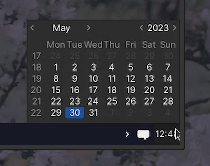
      I've been working on a little "today" website, showing what day it is, if it's a significant date for holiday/independence/... reasons, and one of the things I wanted was a small calendar display that showed the full month and days in each week. Like how XFCE's Clock plugin does it.

      So I got to figuring it out and after finishing it up I thought this could be a nice little programming challenge. It has one input (the date) that can be in any of the rows and columns, and it's up to you to figure out all the rest.

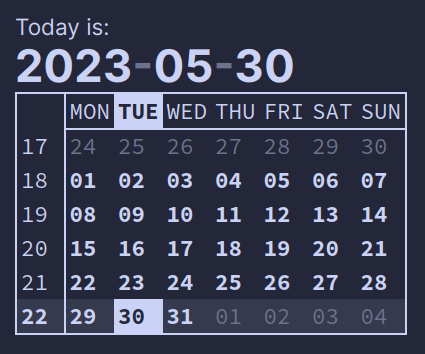
      Here's how mine looks in about 250ish lines of TypeScript (TSX technically) and SCSS.


      The Recipe

      Make a mini calendar display that shows all the days of the current month and at least one day of each adjacent month. So for example for May 2023: the 31 days in May, the 30th of April and the 1st of June should at least be visible.

      It can be in any language with any method of rendering; simple text, TUI/GUI toolkit, web-based, raytraced in some game engine, nixie tubes, whatever.

      Bonus Points

      • Highlight the current day name in the first row, if you're including day names.
      • Highlight the current day number, wherever it is.
      • Highlight the current week row, wherever it is.
      • Differentiate the days of current month and the days of the other adjacent months, wherever they are.

      Some Tips

      The week number

      If your programming language of choice doesn't have a built-in way to get the week number, like JavaScript doesn't, this website may have you covered.

      Testing

      Make sure to test multiple different input dates, I thought I was finished with my display until I tried some other dates and noticed that there were still some bugs left to squash.

      Starting

      If you know what the first day in the calendar should be, counting up is as easy as "one two three"!

      Weeks

      If you use 6 weeks in the display, you will always have enough space to fit all the current month's days and the minimum 1 day of the adjacent month's too.


      Showcase

      If at all possible and with at least a few entries I will try to run all the submissions myself and create a little showcase website for it.

      16 votes
    14. Updated post-Cannes 2024 Oscar predictions

      Picture: The Holdovers Killers of the Flower Moon Dune: Part 2 Oppenheimer Past Lives Barbie The Zone of Interest May/December Saltburn The Killer Director: Martin Scorsese - Killers of the Flower...

      Picture:

      1. The Holdovers
      2. Killers of the Flower Moon
      3. Dune: Part 2
      4. Oppenheimer
      5. Past Lives
      6. Barbie
      7. The Zone of Interest
      8. May/December
      9. Saltburn
      10. The Killer

      Director:

      1. Martin Scorsese - Killers of the Flower Moon
      2. Christopher Nolan - Oppenheimer
      3. Alexander Payne - The Holdovers
      4. Denis Villeneuve - Dune: Part 2
      5. Jonathan Glazer - The Zone of Interest

      Original Screenplay:

      1. The Holdovers
      2. Past Lives
      3. May/December
      4. Saltburn
      5. Drive Away Dolls

      Adapted Screenplay:

      1. Barbie
      2. Killers of the Flower Moon
      3. Dune: Part 2
      4. Oppenheimer
      5. The Zone of Interest

      Lead Actor:

      1. Paul Giamatti - The Holdovers
      2. Cillian Murphy - Oppenheimer
      3. Leonardo DiCaprio - Killers of the Flower Moon
      4. Barry Keoghan - Saltburn
      5. Colman Domingo - Rustin

      Lead Actress:

      1. Margot Robbie - Barbie
      2. Greta Lee - Past Lives
      3. Natalie Portman - May/December
      4. Annette Bening - Nyad
      5. Zendaya - Challengers

      Supporting Actor:

      1. Robert Downey Jr. - Oppenheimer
      2. Robert DeNiro - Killers of the Flower Moon
      3. Ryan Gosling - Barbie
      4. Jesse Plemmons - Killers of the Flower Moon
      5. John Magaro - Past Lives

      Supporting Actress:

      1. D’avine Joy Randolph - The Holdovers
      2. Lilly Gladstone - Killers of the Flower Moon
      3. Emily Blunt - Oppenheimer
      4. Julianne Moore - May/December
      5. Rosamund Pike - Saltburn
      3 votes
    15. World Chess Championship 2023 thread - Ian Nepomniachtchi vs Ding Liren

      Anyone else following the world chess championship? Background info (feel free to skip if you're already familiar with this): After reigning champion and world #1 Magnus Carlsen declined to defend...

      Anyone else following the world chess championship?

      Background info (feel free to skip if you're already familiar with this):

      After reigning champion and world #1 Magnus Carlsen declined to defend his title, the winner of the Candidates tournament 2022, Russia's Ian Nepomniachtchi (world #2), faces the second place finisher in the Candidates, China's Ding Liren (world #3). The championship match takes place over 14 games from April 9-April 30 in Astana, Kazakhstan. As of today, April 13, the score is even at 2-2 after 4 games.

      Ian Nepomniachtchi (aka "Nepo") won the Candidates tournament in 2020-21, which was split in two due to covid. He proceeded to challenge Magnus Carlsen for the title in late 2021. Both players performed with computer-like precision for the first five games. Game six became the turning point, when Nepo made a serious blunder which allowed Carlsen to eventually convert the game to a win in what would turn out to be the longest game in world championship history, lasting more than 7 hours and 136 moves. After this grueling loss, Nepo's play seemingly collapsed, allowing Carlsen to take a comfortable win with games to spare.

      However, Nepomniachtchi would bounce back to win his second Candidates tournament in a row in 2022. When it became clear that Carlsen would not defend his title, the runner-up of that tournament, Ding Liren, became the second player to compete for the title.

      Ding has been a top 5 player for years, with 2018-2019 being his best period yet, when he reached world #2 with well over 2800 Elo, and was undefeated for 100 games of classical chess. This is his first appearance in a world championship final, and also a first for China as a nation.

      Russia, of course, has a long history of world champions, dominating the chess world for most of the 20th century. Nepomniachtchi, who is a critic of the invasion of Ukraine, competes under a neutral FIDE flag in this match.

      This is only the third time the reigning champion has not defended his title since the first world championship in 1886. Bobby Fischer famously disagreed with the match regulations proposed by FIDE, chess' international governing body, and refused to defend his title in 1975. He subsequently retired from competitive chess and didn't re-emerge until the 1990s. The other instance was Alekhine in 1948 -- he had died two years earlier. (There was also a time in the 1990s when the reigning champion, Garry Kasparov, broke with FIDE and organized his own world championship, but I won't get into that complicated story here.) This is the first time a world champion has continued to play competitive chess while refusing to defend their title.

      Nepomniachtchi comes into the match ranked as the world #2 (2795 Elo) while Ding is #3 (2788). The abdicated king of chess, Magnus Carlsen, remains #1 (2853).

      How to watch

      If you want to watch live, the time zone is a bit unfavorable to European and American viewers, as the games start at 3PM Astana time (11 AM Central European summer time, 2 AM Pacific). You can follow the games without commentary here: lichess chess24 chess.com. There's several streams with grandmaster commentary available. FIDE has an official broadcast, but my favorite is chess.com's coverage, which features commentary by GMs Anish Giri, Daniel Naroditsky and David Howell.

      For live computer analysis that's stronger than what you can (likely) get from running a local instance of Stockfish on your own computer, check out Sesse (which is just Stockfish running on a decently beefy server setup).

      If you want shorter after-the-fact recaps, there are several Youtube channels catering to differing levels of chess skill, including:

      And probably at least a half-dozen more.


      Who's your favorite to win it all? Does the fact that the clearly best player in the world refused to compete make the whole thing uninteresting to you? Will Nepo crumble again like he did against Carlsen, or will Ding's inexperience with world championship matches be his undoing?

      6 votes
    16. Racing / driving games: What do they get right? What do they miss?

      I was playing Mario Kart 8 Deluxe with my kid the other day and it was a blast. Nintendo have really nailed this game, especially in the balance of accessible enough for beginners to have fun but...

      I was playing Mario Kart 8 Deluxe with my kid the other day and it was a blast. Nintendo have really nailed this game, especially in the balance of accessible enough for beginners to have fun but hard enough for people to have a challenge too.

      My other favourite game (although I haven't played it for a while) is Sega Rally Championship on Sega Saturn. This game has 4 tracks (one of which needs to be unlocked) and 3 cars (and again, one of these needs to be unlocked). The tiny number of cars and tracks means that you get to do the same corners over and over. This might sound tedious, but when you hit the corner just right you know it. You can get a sense of mastery over it. I've spent many hours playing games in the Gran Turismo series, and I really enjoy them, but fair play some of the tracks and cars are just shovelled into the game and you don't spend much time with them

      In the first Gran Turismo the licensing tests were properly hard. They weren't messing around. Getting bronze requires people to read the manual and understand what the point of the test is. Getting all gold is an actual challenge for experienced players. I feel like the tests (at least, the bronze levels) got easier in later games. The UK soundtrack was small but pretty good.

      My final mention is the Burnout series. I loved the crash junctions. I'm not sure the open world of Paradise was fun - it meant spending a lot of time driving across a map to get to the start line of various events. I feel the same way about many games - I'd rather just have a menu of levels and what I need to do to complete them (GoldenEye, SNES PilotWings, BlastCorps are all good examples) than have this stuff obscured by the open world. Burnout on the Nintendo DS was a genuinely awful game. I think Burnout Dominator was my favourite in the series.

      So, what do driving games get right? What do they miss? What interesting game mechanics do you enjoy?

      7 votes
    17. Announcing Tildes' Make Something Month (Timasomo) for 2022!

      Timasomo is "Tildes' Make Something Month": a creative community challenge that takes place in the month of October. This is its fourth year! If you would like to participate (or simply follow...

      Timasomo is "Tildes' Make Something Month": a creative community challenge that takes place in the month of October. This is its fourth year!

      If you would like to participate (or simply follow along), make sure you are subscribed to ~creative.timasomo.1

      The Roll Call thread will be posted there on October 1st. That is where people will formally commit to projects for Timasomo.

      1: All previous subscribers of ~creative have been automatically subscribed to ~creative.timasomo. However, if you're interested in participating, it's worth double-checking, just to be sure!


      FAQs

      What is Timasomo really though?

      Timasomo is a chance to create something/anything!

      There are no restrictions on what you can choose to make.

      The best way to get a feel for Timasomo is to check out the previous showcase threads:
      2021 Showcase
      2020 Showcase
      2019 Showcase

      These showcases are the culminating event of Timasomo -- a public gallery of participants' creations. Each item in the showcases was a project that community members chose to complete for the event.

      In the weeks leading up to the showcase, discussion threads will be posted where people can share their progress.

      Can I participate?

      Yes! Timasomo is open to anyone on Tildes! Please make sure you are subscribed to ~creative.timasomo.

      The greater Tildes community is also encouraged to participate in discussion threads even if you are not actively working towards a creative goal. This is meant to be an inclusive community event -- all are welcome!

      If you are interested in participating but do not have a Tildes login, please e-mail the invite request address here for an invite to the community.

      How do I sign up?

      Make sure you are subscribed to ~creative.timasomo.

      On October 1st, there will be a Roll Call thread. By posting your plans to participate in that thread, you have formally signed up for Timasomo!

      Didn't it used to be in November?

      Yes. Timasomo was originally inspired by NaNoWriMo, the National Novel Writing Month, which takes place in November.

      Initially, I wanted people participating in NaNoWriMo to be able to share their work with Timasomo as well. Over the past three years, however, no participant has publicly submitted any work from NaNoWriMo to Timasomo. Instead, Timasomo has gained its own identity independent of NaNoWriMo.

      Many participants from previous years have shared that October would be a better month for them personally, so we moved the event to October this year.

      Also, the event was so fantastically popular that it regularly upstaged American Thanksgiving, thus we only felt it fair that Canadian Thanksgiving be targeted as well.

      What are the rules?

      Timasomo is self-driven and its goals are self-selected.

      On October 1st, participants will commit to a creative project (or projects) that they plan to complete within the month of November.

      There is no restriction on the methods/products of creativity: writing, painting, code, food, photos, crafts, songs -- if it's creative expression for you, it works for Timasomo!

      Though most will be participating individually, collaborations are welcome too!

      What is the schedule?

      Timasomo begins October 1st and ends October 31st.

      All creative output towards your goal(s) should be confined to this time.

      This week prior to the start of October is for planning. There will be a few days at the beginning of November given to "finishing touches" before we have our final thread, which will be a showcase of all the completed works.

      Below are the dates that I will be posting weekly threads:

      Saturday, October 1, 2022: Roll Call Thread
      Saturday, October 8, 2022: Update Thread #1
      Saturday, October 15, 2022: Update Thread #2
      Saturday, October 22, 2022: Update Thread #3
      Saturday, October 29, 2022: Final Update Thread
      Saturday, November 5, 2022: Timasomo Showcase Thread

      Do I have to share my creation(s) publicly?

      Tildes is a privacy-respecting site, and you are not obligated to share your creation here if you do not want to. We'd still love to hear about it though, if you're willing to share process and details!

      Is it Timasomo or TiMaSoMo?

      Either.

      I personally use "Timasomo" because I think it looks cleaner and because too much time on the internet has made my brain incapable of reading "TiMaSoMo" as anything other than sarcasm, but go with whichever you prefer.

      The best option, however, is “𝑻𝑰𝑴𝑨𝑺𝑶𝑴𝑶” for reasons that are self-evident.


      This Thread: Planning!

      Post your ideas.

      Give feedback to others.

      Set up collaborations.

      Ask questions.

      Everything in this thread is non-commital! Bounce around ideas and figure out what you'd like to do in our communal brainstorming session.

      Also, please do NOT start work on your project yet! Stage setting, planning, and other preparations are allowed (e.g. getting supplies/materials, setting up workspaces, etc.), but save the creation initiation for the 1st.

      Get excited for another round of awesome projects!

      24 votes
    18. The Proverbial Pen #3

      Today is day three of my "war against writer's block"! As I keep fighting with my proverbial pen, I hope that some day I'll be able to get out of my block and be able to write some real stuff like...

      Today is day three of my "war against writer's block"!
      As I keep fighting with my proverbial pen, I hope that some day I'll be able to get out of my block and be able to write some real stuff like research paper or novel or story book.

      What I realized today is that Word Power is a very important skill. A writer is essentially a Wordsmith or someone who carves and arranges the words and phrases into sentences, just as a sculptor or carpenter would do with wood or other raw materials. To be a better writer, you must learn to fall in love with words which is probably easier said than done - especially for us non-native speakers!

      Having a regular habit or routine helps with this. Each time you come across a difficult word, you open the dictionary software or app and learn its meaning. It hardly takes a few minutes but it's a very useful skill as each new word you know of acts like a raw material or building block for your writing. Better still, develop linguistics as a hobby as mastery of grammar is equally important and so is learning about how languages, cultures and people basically work and interact at the core.

      Apart from that, noting down right ideas as they come is also very important. For example, the idea about the Wordsmith thing occurred to me yesterday when I was having a cup of tea. I noted it on time (before it could vanish into the depths of that dark matter called subconscious mind and become irretrievable again!), and made a note of that on my computer so that I can write it in today's proverbial pen.

      Even after having these basic tools and ingredients, you may not be able to write anything at all if you lack that focused energy or passion to write about a particular topic - be it a research paper, novel, story book or something else. You need to have that energy to write which I feel I'm lacking right now. I might be able to feel that energy some day as I continue with my battles, at least I hope so! Thanks for reading this and staying with me in these challenging times.

      7 votes
    19. From beginner to conversational in three months of learning Russian: My takeaways

      I'm posting this outside of the language learning thread because I worry those not currently learning languages are skipping it altogether :) In this post, I want to share general advice and...

      I'm posting this outside of the language learning thread because I worry those not currently learning languages are skipping it altogether :) In this post, I want to share general advice and takeaways about language learning, so this is for everybody, not just current learners!


      Today, I've hit I think a big milestone: I am now comfortable calling myself "conversational" in Russian. This comes on the heels of a 30 minutes, all-Russian, naturally-flowing conversation with my coach who was very impressed, and a couple days after having participated in a total of 4+ hours of conversations that included a native speaker who doesn't actually speak English (training wheels are off, now!).

      The goal I set myself mid-may to reach in 1 year, has been reached in 3 months. My Duolingo streak is on 87 days (or 89? I don't know if it counts the two streak freezes that were used), but I picked up DL a week after I started.

      During this time, I journaled my progress here on Tildes (1, 2, 3, 4, 5, 6, 7 - really, I hope Tildes isn't getting sick of my spam!), and rekindled my love for learning languages. I think it's time for a recap: What worked, what helped the most, etc.

      Summary

      I didn't follow one specific technique or guide. Everything from the beginning has been improvised, based on experience from previous languages, and gut feel.

      I talked about my methods in-depth in the journaling posts, but here's the bird's eye view of it:

      1. Learn the script first, and how it's pronounced (I had already done that years ago, kinda)
      2. Rigorously followed a single, complete-beginner crash course to get me started. In my case, a 9-hour, 30 episodes youtube series called Russian Made Easy, at an average of 45 min/day.
      3. Started using Drops to start accumulating vocabulary; this replaced Flashcards for me.
      4. After a little while, started the Duolingo course (but I don't use Duolingo the way most people do - See the old journals for details) and kept up with the streak since.
      5. Started listening to spoken material on YouTube, as much as possible, even before I could understand what was being said.
      6. Force myself to interact with the language by switching away from English in a variety of devices and apps
      7. Watch loads of short videos on various bits and pieces about grammar, etymology, word lists and misc advice
      8. Started writing in Russian on IM apps (at first using Google Translate, then without) with natives. Ask for feedback on it all.
      9. Regularly try to speak, to whomever would have a conversation with me.
      10. Regularly introspect: appreciate my progress, share it, and think about what I need to work on

      Deep dive


      Motivation

      I wrote about how important motivation is. People start learning a language and then abandon it after a few weeks like a gym membership purchased on January 2nd. Having a motivator that goes beyond "this sounds cool" is really important, because all this is a lot of effort and your brain won't see the point of making all that effort if you don't have a proper need to go through it all.

      I found that motivation is not a constant, either. It is something which has to be maintained. Sharing this experience with you all has been immensely useful in that process. And having native speakers in your life who can really appreciate your progress and encourage you is excellent.

      Variety

      The most useful part of my "method" is definitely the variety of the language diet. It seems to me that following only a set of single-source courses will just leave you with huge gaping holes as soon as you leave its bubble. It'd be like learning to read by only reading the same 100 words, over and over, until you become very quick at reading specifically those words. And then you're done and you come across the word "exhaustion" and you're like, what the fuck do I do with this?

      So yes, a variety of activities that will cover all types of input (reading, listening) and outputs (speaking, writing and thinking). And with the varied diet, one should also be careful not to burn themselves out by doing too much. I ensured that a lot of what I was "doing" was passive: Switching my phone's language, leaving audio in the background, asking others to speak to me in the language and translating if I need, etc. My active learning was only being done when I felt like it. This circles us back to the motivation aspect: If that's rock solid, then you will want to keep studying/reading/learning, and you'll do more.

      Regularity

      So yes, quantity and regularity are also important, and keeping the language in your brain every single day is, I believe, critical to help it develop. The languages I do not think about on a regular basis don't develop. Despite speaking Greek my whole life, only interacting with that language once every couple weeks at most has kept it from evolving beyond a pretty basic level, and now I'm convinced my Russian is better than my Greek. Oof, this puts shame on my supposed bilingual heritage.

      Finding comfort

      I think it's easy to get frustrated at a language you're not yet good at, because you're so used to how you normally do things, that communicating is SO FRUSTRATING when you don't have your whole toolkit.

      Speaking in the target language, with people who know your primary language(s), can also highlight that frustration because the barrier feels "artificial". For me, I have not particularly enjoyed speaking to non-natives, and that hasn't motivated me much. However, speaking to natives has been much easier because it's really nice to think "Hey, you've been making all these efforts to speak in a language I understand, let me do the effort this time".

      And well, finding a way to be comfortable speaking is critical. Olly Richards mentions that, if you start speaking too early and in an unsafe space, you can scare yourself into a "bad experience" and regress because of that. I can definitely see that, and I personally was careful to challenge myself without trying to push too hard.

      Over time, you can get very good at getting a sense of how difficult a certain activity or material is for you. You have three grades: Things you are comfortable with (level+0), things that are challenging and teach you (level+1), and things that are straight up too difficult for you (level+2).Input-based method proponents often advise staying at +1, without really defining what that means, but it's true you kinda know it when you see it. For example, watching Let's Plays in Russian is still my_level+2 for me, but I see them slowly edging towards +1, and that type of material is super effective because, any time you see the progress happening, your motivation is massively improved.

      Mistakes

      Developing on comfort: You have to be comfortable making mistakes. This is what really scares everybody, and it was definitely the case for me as well.. I was (and still am) ashamed of my bad grammar especially, and if I don't know how to say something properly, I hesitate to say it at all. But you gotta push through that. There's a balance to strike as always, and you still need to be ok with

      How I use Google Translate

      I've been doing something which has helped a lot, and in hindsight it's obvious to me why, so I want to share this and popularize this technique.

      I started writing to native speakers on IM very, very early (people often use and recommend Tandem for this). Because I didn't have a good enough control over the language yet, what I would do was: Write in Google Translate what I want to say. But without writing long, complex sentences; instead, I would write things I felt I wanted to be able to say. So instead of "Hey, I'm super hungry right now, do you wanna meet me and grab a bite on the way?", I would write "Hey, I am a bit hungry. Can we go eat together?".

      I would take the translation, understand it, and usually I would write it again on the keyboard rather than copy-paste (this helps with memorization). Sometimes I would use voice input, because cyrillic keyboard hard.

      Then, over time, as I got better at output, I would think about what I want to say directly in Russian and write that into Google Translate to check it (and sometimes do a little back-and-forth dance to see if it suggests alternate forms).

      So, yeah, this has been extremely helpful because it's given me a way of using the language as a tool from pretty early on. It's great because Google Translate really is going to adapt to your level, so if you want to be at "level+1", you just have to figure out what that looks like for you in your native language.

      Conclusion

      Wow, what a journey. Of course it's not over, but I've actually hit my goal... with nine months to spare! That's enough time to make, like, a whole baby.
      I want to keep improving, not stagnate, so I'm now going to keep using the language and I think wait that full year before I really start learning a new one. (Ukrainian was next on my list, but I'm shocked at how much I now understand of it, it's much closer to Russian than I thought; so I'm still undecided).

      I have loved sharing this experience with you, Tildes, and I really, really hope I motivated some of y'all in your own language learning journeys. If these threads have helped you in any way, please do share it with me here or by DM, I want to know!

      12 votes