CGA-2026-03 🕹️🐸🕌🔔 REMOVE CARTRIDGE ⏏️ Kaeru no Tame ni Kane wa Naru (The Frog for Whom the Bell Tolls)
switches to an emotional ending music
Once upon a time, in the sun-dappled realm of Millefeuille, a tale of courage, folly, and friendship came to a close. After enduring countless trials born of pride and greed, our gallant yet hapless Prince of Sablé has reached the end of his journey.
It all began when the Prince learned that the radiant Princess Tiramisu had vanished, spirited away just after his umpteenth defeat in a duel against the ever-boastful Prince Richard. Barred from sailing beside his rival, our humble hero took to the road alone, his purse light and his hopes heavy. What he lacked in fortune, he made up for in heart (and the occasional odd purchase).
Along the way, he fell for a trickster's promise, a ludicrously-expensive potion said to restore his human form "at any time", though bound by more strings than a puppet show. In his kindness, he even repaid the damages wrought upon Saltwater Town, tossing a mountain of Nuts to a boy whose gratitude shone brighter than gold.
Though tempted by greed and misled by pride, the Prince of Sablé's heart remained pure. Through tangled mazes and fierce foes he pressed on, never losing sight of his mission to rescue Tiramisu. By the end, even the proud Richard bowed his head, moved by the Prince's resolve to fight without malice and spare his old rival from needless harm in their final duel.
Yet behind every fairytale lies a clever twist. For while our Prince was chasing glory, he unwittingly became a key piece in the grand design of Polnareff's scheme to save Millefeuille from the sly serpent Delarin. His bravery, fuelled more by sincerity than wisdom, turned the tide at last.
And where was the Princess, you ask? Why, she was by his side all along! In disguise as the wise witch Mandola, Tiramisu guided her beloved Prince more times than he ever realized. Perhaps he should have noticed the resemblance in their mannerisms a bit sooner.
And as our story fades to its final act, the air fills not with solemn silence but with the rhythm of celebration, a raucous DJ's beat spun by a mad scientist in his whirring metal giant. A strange ending, perhaps, but a joyous one all the same.
So then, dear travellers, as the curtain falls on this comical and heartfelt adventure, let us gather 'round and share our thoughts on the tale of The Frog for Whom the Bell Tolls, a story where even the smallest frog may leap into legend. I'll start.
The Frog for Whom the Bell Tolls feels less like a traditional video game and more like an interactive storybook, something remarkably ahead of its time for the early '90s. The combat, platforming, and puzzle segments are kept simple on purpose, serving as stepping stones for the charming storytelling that carries the whole adventure.
Battles play out automatically when you bump into an enemy strong enough to challenge you, with the outcome depending on your stats like HP, attack, defense, and speed (plus whatever items you might have on hand). It's a good idea to keep your health up and hunt for stat-boosting items if you want to make steady progress.
A sprinkle of puzzles and light platforming keeps things fresh, and the ability to switch between forms adds some fun variety, the strong human, the amphibious and nimble frog who can breathe underwater, and the slinky snake who can turn some foes into stepping blocks.
Sure, none of these mechanics are deep by modern standards, but their simplicity works in the game's favor. It keeps the spotlight on the story, one that explores how kindness, greed, and good intentions can intertwine in unexpected ways. It's funny, heartfelt, and often downright ridiculous in the best way possible.
While I might not revisit this one as often as other Nintendo classics, I'm glad I played it. Not only is it interesting to see where Link's Awakening borrowed a few ideas (and a certain prince!), but it's also worth it for the humor alone.
As I make more progress in Cure Dolly's Japanese lessons, I might even try the original version one more time someday. Who knows what little translation quirks or cultural touches I've missed?
That about wraps it up for this month's game. Our time in the whimsical world of the Millefeuille Kingdom may be over, but the adventure continues.
Next time, u/vili takes us on a trip to outer space aboard an overly complicated spaceship, hopefully with fewer spacetime mishaps... but no promises.
Until then, jot down your thoughts and memories; no moment of gaming glory deserves to be forgotten!
THE END
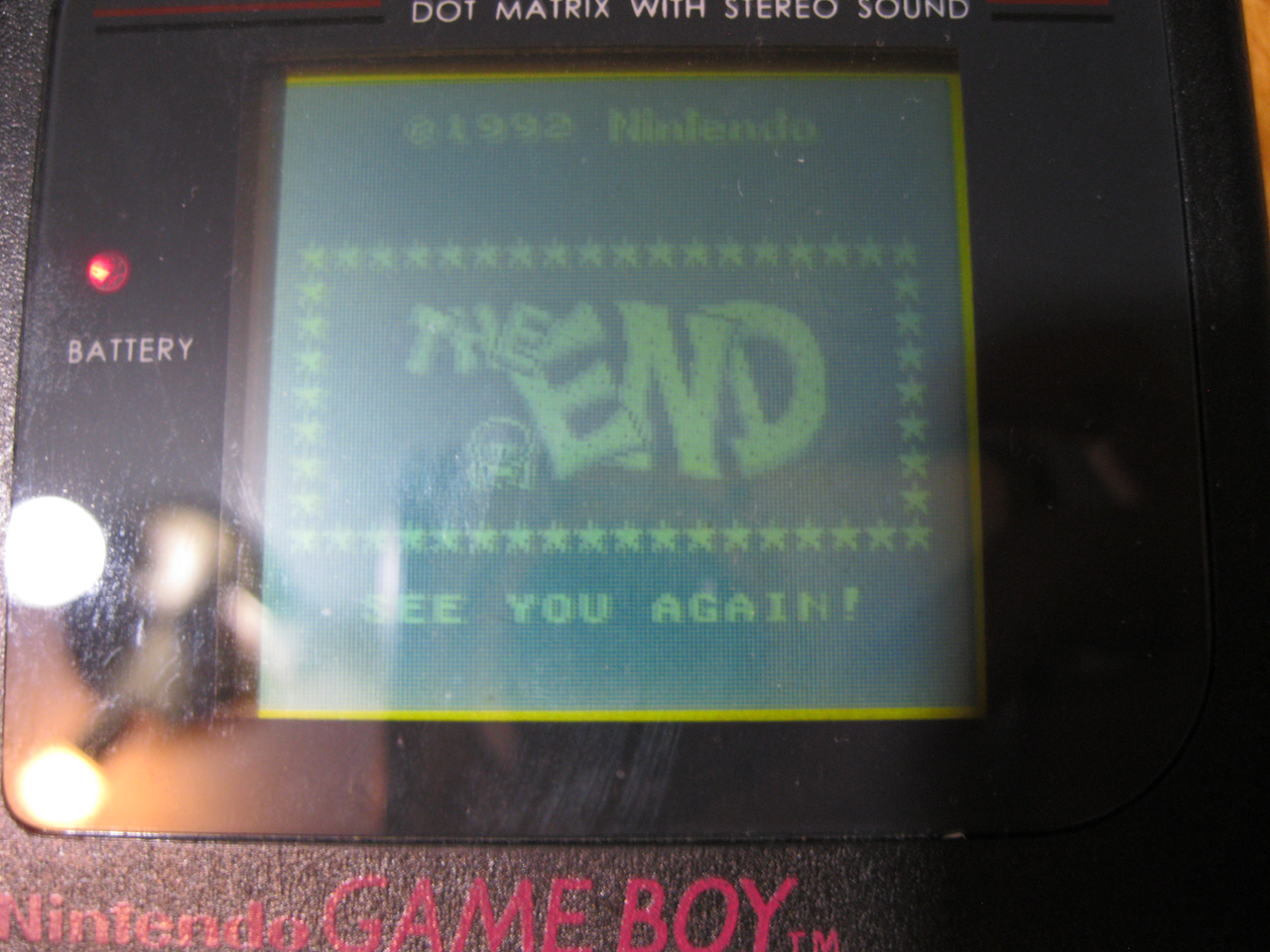
(sorry for my rookie attempt at photographing this screen in real life!)
| Month | Game | Host |
|---|---|---|
| April 2026 | Space Rogue | u/vili |
| May 2026 | Sid Meier's Pirates | u/vili |
| June 2026 | Castlevania: Aria of Sorrow | u/Lapbunny |
| July 2026 | Lufia II: Rise of the Sinistrals | u/zod000 |
| August 2026 | The Legend of Zelda: A Link to the Past | u/Boojum |
| September 2026 | Tony Hawk's Pro Skater 2 | u/J-Chiptunator |
Well that was a cute little adventure.
It was different than I was expecting. I knew The Frog for Whom the Bell Tolls was a shorter title, but I think I was expecting a more traditional RPG. Instead, it was a quirky, almost deconstructive game, where it felt like the developers were largely just having fun with it. I'm fine with that! The levity really shined through in all aspects of the design, and made for a light-hearted adventure.
Mostly, I really enjoyed the dialogue. I'd obviously have been completely lost if it wasn't translated, but the writing was hilarious and kept defying my expectations. That's actually pretty impressive for a Game Boy game from 1992.
One of the biggest departures from other RPGS of the era is the combat system. It was largely deterministic, and entirely stat-based. This put most of the game's progression on exploration and discovery rather than player skill. Definitely a unique system, and I enjoyed hunting for and opening chests. If I couldn't beat a boss, I knew immediately I was missing something. It never felt unfair, like having a hidden chest three towns back that would prevent your progress.
I really enjoyed the final boss sequence. My favourite moment was when Richard employed the "Zapp Brannigan" strategy of sending all of his frogs at the enemy, one by one, to be eaten. That kind of forward-thinking strategy is why he's the commander.
The game's puzzles were not heavy-handed, and mostly served as minor road bumps. For example, the famous "Lost Woods" trope was there, but with a literal sign post that told you where to go. The jungle also had a maze-based design, though as far as I could tell, was just trial by error.
I did enjoy a number of the transformation-based puzzles, where swapping between the three forms was required to progress through a room. At times though, it could get a little repetitive, with the solution sometimes being obvious but the game still requiring you to go through the motions. This was especially annoying when running through an area for the second or third time.
On that note, some of the instant deaths felt a little unfair. While a lot of the enemy interactions were obvious or explained, like frogs being able to eat bugs, there were times that it was not so obvious. You'd need to learn by doing, then remember next time that if a frog so much as grazes a bat, it's game over for you. That could be particularly rough when deep into a dungeon, and for that reason I started using save states about midway through the game.
I was glad that the transformation items were so cheap. It made it feels less punishing to lose progress. Money was actually a bit silly in this game, and another way that the developers had fun with the player. Those billions of
coinsnuts were easy-come, easy-go. Even during regular gameplay, it seemed like I was only ever notoriously rich or in the poor house, with no in-between.I enjoyed the game! It feels like a cult classic that I didn't know existed. That makes it an excellent CGA pick in my book.
I also didn't realize just how nostalgic I was for the Nantendo Game Boy. The big pixels, limited colour palette, and chirpy sound effects all took me back. The only thing missing was a contrast slider! It made for a cozy experience, and had me wanting to dust off Pokemon Blue or Link's Awakening again.
I really enjoyed this game! It was simple in the best ways, and I imagine a lot of the ideas were great in the era. It's really cool to see a game that so many legends at Nintendo touched. The looney tunes battle mechanics were interesting. Probably could have used a bit more depth, but it worked. The music was great, as was the world design. I also enjoyed the platforming between human, frog, and snake forms. Finally, I loved the expressiveness of the game ("WHAAAAT?").
Playing Link's Awakening right after this really made me appreciate The Frog for Whom the Bell Tolls. Suddenly there's color, you can and have to manually attack, there are deeper item pick ups that require learning them rather than allowing you to progress by simply holding them. It clearly built off of this game and did it so well. Besides Prince Richard's cameo, you get the switch from top down to side scrolling once again. Link's Awakening is probably my favorite Game Boy game, so it was really fun to visit its roots and see the context of how that game didn't appear out of thin air.
This is a PERFECT name for it. Love it.
This was a fun game. Maybe also the first Game Boy game that I have ever completed.
"Interactive storybook" is a good way to describe the game. There wasn't much challenge, even if there were some interesting game mechanics. Midway through I thought that the various mechanics were going to be put together into a puzzle-heavy second half, but that never materialised. With the final boss, I again thought that I would need to put everything I knew together and puzzle my way into victory, but in the end it was basically just a long cutscene with a simple quicktime sequence.
The ending was subversive also in another way. The final, post-credits bit of dialogue puzzled me in its English translation, so I checked out the Japanese original. If I understand correctly, the Prince seeks clarification to the question whether it was Princess Tiramisu who transformed into Mandora, and not Mandora who has actually transformed into Princess Tiramisu. The answer he gets is that there is probably no difference, as the two are the same.
It raises interesting questions about identity, trust, romantic love and sexual interest. Can the Prince live happily ever after, as should be the convention, if he is simultaneously both attracted and repulsed by the woman he is to marry? Can he trust her, knowing now that she has manipulated him through his adventure for her own needs? And, most interestingly, does it indeed actually matter if she is Mandora who transformed into the Princess or the Princess who transformed into Mandora?
It’s a creative little game with plenty of attention to detail both in design and narration. Lots of quirky little jokes and nudges. My main criticism would probably be that the last third of the game felt a little samey and repetitive. It never quite evolved or ramped up to reach a “next level”, whatever that could have been. Still, it absolutely was a fun experience and something that I had never even heard of before CGA. Thank you everyone who voted for this one and huge thanks to @J-Chiptunator for being such a great host (just like everyone else who has hosted CGA — those are some big shoes for me to fill)!
I'm glad you mentioned the closing line, because I was confused by that too. The translated quote in English was:
It was seemingly played as a joke, but I definitely whooshed on it. I like your interpretation.
The Japanese I think reads:
Which I think would literally translate into something like:
Take that with a grain of salt, though. My Japanese is poor so I don't know exactly how much to trust my abilities or online translators, especially when it comes to nuances.
Apologies for the faux pas of replying to my own comment but I woke up thinking that there is an interesting dimension to Polnareff’s statement that I hadn’t quite appreciated earlier.
In many ways, how you feel about the relationship between the Princess and Mandola is connected also to how you perceive the Prince. He too transformed, multiple times, into a frog and a snake. How does that thought influence the Princess and her feelings towards him?
But more importantly, you as the player transformed into the Prince through the act of playing. Is there a difference between you two? Are the choices made in a video game separate from you as a person, or is it still you, either way?
Maybe it was just me but when I read those ending lines as I played, they sounded sort of suggestive (derogatory). Honestly, they gave me the ick. It felt like they were a coy, off-color adult joke being shoved into an otherwise kid-friendly game, and they were given undue emphasis as they were literally the final words in the whole story.
I like your translation and interpretation a lot better. It ties the game's mechanics into its narrative theme, which is quite lofty for a 1992 Game Boy game! Makes the ending feel resonant instead of cheap. An all-around upgrade.
I don't think this is the only time this game flirts with rather adult themes. It does include unemployment induced alcoholism (there actually seems to be something of a persistent undercurrent of class struggle satire?), features women in the bar that are if not prostitutes at least adult-only hostesses, and so on.
But probably the sequence that most raised my eyebrows is the one with the Red Riding Hood. When you find her, she breaks down crying that she doesn't want to go back to the shop as the shop keeper makes fun of her and ties her up. Or so the English translation goes. I was a bit concerned about her well-being, so I thought I'd check the Japanese original to see if she's doing better there.
Oh boy. As far as I can understand, in the original, she describes not only being tied up tight with a straw rope (あらなわでしばり上げられて), but she says that she is actually beaten with a hundred lashes of a whip (ムチで百たたき). And then, most disturbingly, she finishes with the vague and suggestive "In addition to that, he does this and that too..." (その上,あんなコトやこんなコトも‥‥)
The original Little Red Riding Hood is a folktale that is often interpreted as an allegory of rape and abuse, and may indeed have its origins in a more explicit version of such a tale. Whether the developers considered this, I don't know, but the choice of the character's name is definitely quite suggestive, considering what she is saying about her treatment.
How charming! This was a delight.
The whole ending sequence was surprisingly bold and cinematic for a Game Boy game. I was impressed. I also thought the game had a lot of neat ideas as it progressed, delivered with a lot of character. I can pretty much co-sign on what everybody else has said here about all the game's good parts (especially the music -- it was great!).
I used save states to make the game less punishing (one wrong move and you're back at the hospital), but I also didn't realize that you could actually heal at the hospitals as well. Instead, for most of the game, I was buying wine to heal a few hearts, but because you can only carry one wine, I had to buy->use->buy->use->buy->etc. to get myself to full hearts.
Suffice it to say that this might have entirely negated the frustration I avoided through save states? I was mad when I stumbled into a doctor and he offered to heal me fully more quickly and way cheaper than multiple bottles of wine.
Similar to with Racing Lagoon, I was very impressed with the quality of the translation. I didn't feel like I was playing a fan-translated romhack -- it felt like I was playing the official English release of the game. This might be me waxing too poetic about things, but it feels like fan translations are a beautiful, selfless way of bringing meaningful experiences to more people.
Whoever made this isn't making money off of it (I assume?). They purely did it for the love of the game, and that means that someone like me (who had never even heard of this game before and definitely wouldn't ever have had it not been translated) has the chance to play it and love it.
I often say "we're living in the future" because of stuff like this. It feels especially odd to say that about a 34-year-old monochromatic game with ultra chunky pixels, but it's undeniably the truth! Our future is one where old games can reach audiences even their own developers never could have intended, all because people still care enough about them to not just keep them alive but bring new life to them entirely.
EDIT: I forgot to mention: FROGS FROGS 🐸 FROGS 🐸🐸🐸 FROGS 🐸🐸 FROGS
I actually used save states quite liberally towards the end of the game, even if I had made use of healing services (and hot springs, and wonder balls) throughout the game. After a couple of misplaced jumps that threw me out of the castle and forced me to re-repeat sections that I had already cleared, I just didn't feel like spending more time with areas that I already knew. Especially as I'm not particularly fond of platforming challenges when playing with a controller that I find somewhat cumbersome (I played the game with a Miyoo Mini Plus, which I realised is just a little too small for my hands).
Had there not been a time pressure to finish the game by the end of the month, and had this been 1992 when it probably would have been the only game that I could afford for a couple of months, I would certainly have been ok with this game design decision. But in today's world, with all the time pressures and responsibilities and competing entertainment, I'm glad I could take the easy way out. We are indeed living in the future.
CGA Announcement: We have officially ejected the cartridge for Kaeru no Tame ni Kane wa Naru (The Frog for Whom the Bell Tolls). No worries if you're not done -- there is still some time left in the month to play!
This topic is for people to share their parting thoughts and experiences. Spoilers are NOT required to be hidden for this topic, so if you're reading this before you've finished, be careful about reading any comments here.
If you would like to be added or removed from the Notification List, please PM u/kfwyre.
Notification List
@1338
@Akir
@ali
@arctanh
@AriMaeda
@atomicshoreline
@avirse
@balooga
@BeardyHat
@Boojum
@Bwerf
@CannibalisticApple
@chocobean
@clayh
@datavoid
@Debook
@DistractionRectangle
@dotsforeyes
@dozens
@Dr_Amazing
@endymiion
@granfdad
@Gummy
@hamstergeddon
@IsildursBane
@J-Chiptunator
@JCPhoenix
@joshbuddy
@kaiomai
@Kawa
@kej
@kfwyre
@kingofsnake
@Kirisame
@Lapbunny
@mayonuki
@Mendanbar
@mysterylevel
@PancakeCats
@Pavouk106
@PetitPrince
@Plattypus
@polle
@preposterous
@psi
@rosco
@rubix
@Rudism
@SloMoMonday
@Sodliddesu
@Soggy
@sotix
@Spore_Prince
@SpruceWillis
@squidwiz
@talklittle
@ThatMartinFellow
@tildes-user-101
@Timwi
@tomorrow-never-knows
@Trobador
@Venko
@vili
@Weldawadyathink
@xk3
@zod000