• Activity
  • Votes
  • Comments
  • New
  • All activity
    1. What are your favorite third-party controllers?

      What are the best controllers for console and PC that you've used that aren't just official console controllers? I'm a nerd when it comes to getting a million different input methods for games,...

      What are the best controllers for console and PC that you've used that aren't just official console controllers? I'm a nerd when it comes to getting a million different input methods for games, and I'm always looking for new ones to play with.

      Glad we'll never go back to the hellish days before Valve and various FOSS projects fixed the nightmare that controllers on PC used to be.

      15 votes
    2. Misguided things our parents did

      I'd like to hear your stories of things your parents did with good intentions that went wrong. This is mine. When I was very young – old enough that I can remember it, but young enough that I...

      I'd like to hear your stories of things your parents did with good intentions that went wrong. This is mine.

      When I was very young – old enough that I can remember it, but young enough that I wasn't going to school full time yet – my mother would volunteer at a local nursing home. I never met my maternal grandmother. I think she died a year or two before I was born. I have a vague memory of meeting my maternal grandfather, and there are photos of it, but he died when I was still quite young. Maybe 4 or 5. I don't believe either of my grandparents were in ill health before their deaths. But I think that their deaths affected my mother and she wanted to help other elderly people, so she started volunteering at the nursing home.

      I have 2 older brothers who by this time were in school most of the day, leaving my mother and me at home alone. I think she also got bored of doing housework and wanted to do something useful with her time. (I can't say I blame her!) I suspect she also thought that the residents of the nursing home would enjoy interacting with a child, even if it wasn't their own grandchild. So she took me with her. I think she wanted me to learn to value elderly people and to learn to value community service.

      Unfortunately, she failed miserably. What I learned was that old people are scary as fuck and I didn't want to be anywhere near them. You this was a nursing home. This was not an "old folks home" where they play canasta, have dances, and engage in elderly hanky panky. This was end-of-life care for people dying of cancer, and the now-preventable diseases like polio. The entire place reeked of vomit, and the old people were hard of hearing and weird. They were almost always in a bed or wheelchair, and usually in hospital gowns. There were often sounds of screaming from other rooms where some patient was in terrible pain from whatever ailment they suffered.

      The residents were all old and gray haired except for one. He was a young man. He had to be younger than my mother who would have been in her early 30s. He was probably 20-ish years old. His hair was not gray - it was dark black and close cut with electric clippers, though not quite a crew cut. He was always in a hospital gown and always in a wheelchair that had an IV pole on it (though I don't recall there ever being anything hanging from it). And while he looked normal, he had some sort of mental deficit where he could only grunt and moan. I would often see him loudly moaning and gesticulating as if trying to point at something to say, "give me that," or "take me over there."

      The one bright side to this place was that there was a woman in a red and white striped uniform who pushed around a cart full of every type of candy imaginable! I wanted so much to get a peanut butter cup or a chocolate bar from her, but no. Her candy was strictly off-limits to me. (I don't know whether it was cost or health that made my mother refuse to ever let me have a piece of candy.)

      I'm pretty sure my mother was trying to teach me the value of both old people and volunteering to help our community. But as a ~4 year old, it was too much. It instead taught me that getting old meant pain, suffering, and eventually death, and that old people are scary as fuck. I didn't want to get old or be around old people. (I eventually got over it and now am nearing being an old person myself. 😉)

      20 votes
    3. How can we change the site's structure/mechanics/patterns so that we're not discouraging posting "too much" on particular subjects?

      Over the weekend, @skybrian posted a topic about feeling like you're posting "too much" if you submit too many links on the same subjects. As I said in my comment in there, I've definitely felt...

      Over the weekend, @skybrian posted a topic about feeling like you're posting "too much" if you submit too many links on the same subjects. As I said in my comment in there, I've definitely felt the same way sometimes, and I think we should try making some changes that can improve on this.

      One of the most common complaints about Tildes is that there isn't much content overall, and that most of it's very "general interest". This is largely because of how the site is set up now, where instead of having different communities, we basically just have one community that's lightly categorized by the groups. It's mostly the same users posting and discussing topics, regardless of which group they're posted in. This is totally fine and has worked well in a lot of ways, but it's also limiting in other ways, especially that it basically discourages posting "too much" about any particular subject because that will be annoying to all the users that don't want to see so much of that content.

      One of the best ways that Tildes will be able to grow is by being a place that's known for having good content on different topics. When I started /r/Games on Reddit, I was one of the heaviest submitters for quite a while, making sure that the subreddit was always full of the type of high-quality content I wanted to see. There weren't many viewers or commenters initially, but continuing to consistently post a lot of good content attracted more and more people, and eventually it became self-sustaining.

      We need to be able to take a similar approach here, but the current structure of the site is preventing it. For example, I'm one of the most frequent submitters to ~games (I've submitted about 1/3 of the topics in the last month), but I usually try to only post 1 or 2 topics there per day. I could easily submit 10-20 most days, but I know that will annoy a lot of users that don't care that much about games. That feeling isn't a good thing—it prevents any group from being able to "take off" individually.

      So to improve this, I think we're going to need to make some changes, and/or figure out some new patterns that we can use.

      First of all, I think it may be time to switch away from the current "opt-out" setup for groups (where you see everything by default) into an "opt-in" one where you have to specifically choose what you're interested in. This is something I've always planned to do eventually, because I think "forcing" everyone to see things that they're not especially interested in is both harmful to quality and causes a lot of strife. Switching will absolutely have some downsides too though, including that the activity in the more-niche groups will probably drop even more.

      It may also be best to switch away from "Activity" being the default sorting method. Again, this is something I didn't really expect to keep as the default forever, but it's been helpful while the site is small. However, having every new topic show up immediately in the most prominent position on the site just makes it even more annoying for people that aren't interested in the subject. For them, the top of the site keeps getting taken over by posts they don't care about. We're seeing this happen with ~music right now, because some users are trying to make it more active—which, again, should be a good thing—but I know that it's annoying some others.

      Some other things that might be worth considering include making it easier and more obvious that you can ignore individual topics and tags, adding new options for creating and filtering different "views", adjusting site behavior so it balances how many posts it shows from each group (but that would likely be confusing), etc.

      Another related topic I wanted to bring up (which @skybrian mentioned and I think is an interesting idea) is that we might be able to use "megathreads" more extensively somehow. For example, maybe having a megathread on a particular topic is a better way to judge the demand for a group/sub-group on a particular topic. Right now it's hard to do that because there isn't really any dedicated place to post if you're interested in something specific, but we might be able to encourage more activity by using a megathreads as almost a "testing ground".

      For example, if someone's particularly interested in woodworking, it would feel awkward to post a bunch about it in ~hobbies and effectively take over the group with woodworking content. But if there was a "woodworking megathread", it would be both more encouraging and contained (and easily ignored by other users), and if that thread started getting consistent activity from multiple users it would be a good indication that a ~hobbies.woodworking group would probably be able to stand on its own.

      I don't really have any particular plans for that kind of thing yet, but I think it's a possibility with a lot of potential, and we might even be able to find some ways to improve how megathreads work to support it. I'm definitely interested in hearing thoughts about how we could enhance threads to make them work especially well for that, including better ways for users to find and know about megathreads they'd want to read and participate in.

      I feel like this was a fairly scattered post with a lot of different thoughts in it, but overall I'm just looking for feedback or other ideas for ways we can adjust so that the site can keep growing and increasing in activity smoothly. This is important to figure out, and I think we're reaching the point where it's starting to become more urgent to do it soon. Let me know what you think.

      66 votes
    4. Microsoft announces new Surface Laptop Go and Surface Pro X

      I couldn’t find a good roundup that covered both of these and didn’t want to add clutter to the front page with two posts. From The Verge: Microsoft’s new $549 Surface Laptop Go aims to compete...

      I couldn’t find a good roundup that covered both of these and didn’t want to add clutter to the front page with two posts.

      From The Verge:

      The Surface Pro X seems like just a spec bump, so there isn’t too much interesting there. But the Surface Laptop Go is interesting. The base model is absolute garbage (4 GB of RAM and 64 GB of EMMC storage) but the other models are somewhat decent.

      The overall design of the Surface products is really striking. I honestly think they look much more modern and clean than Apple’s laptops. I also really love that they are offering colors. I wish Apple would offer more colors than just gray, silver and pink/gold on their laptops.

      9 votes
    5. The Tildes Best of 2020 Music Dropbox - please bookmark, or ignore

      I sense some folks are chomping at the bit so let's get this party started. Think of this thread as a gigantic pile of records. This is our pile - there are many like it, but this one is ours....

      I sense some folks are chomping at the bit so let's get this party started.

      Think of this thread as a gigantic pile of records. This is our pile - there are many like it, but this one is ours. Don't waste a second worrying about what anyone else thinks. Got a record, even an EP that you've been spinning since it dropped? Find some random album from a /mu/ sharethread that blew your hair back? Throw it on the pile. Tracks for the stacks, just keep dropping them in the comments. If it's enough for you to spin repeatedly or to buy, it's worth sharing.

      Stick to one comment per album, so that each album can be voted on individually. All we need is the artist and album name, brief/generalized genre tag (folk, metal, rock, indie, etc) and a listening link. Oh, and just a short sentence-to-paragraph size plug telling us what you're digging so much about the record. No need to go all war-and-peace on it, listening is always better than reading. ;)

      Don't forget to name a favorite track (or two, three) from the record so the rest of us can easily dip a toe in.

      No singles as top level comments. I'll leave a special comment below (mark it as joke/noise to keep it at the bottom) and you can drop your singles in there. The circumstances around covid-19 have lead to an absolute glut of singles coming out this year, even from artists who don't usually bother. I have a hunch it's worth keeping track of this year.

      What we need here is albums, ears, and votes. We've got two months until the next thread, these things are best done slow so people can fit the listening time with their schedules. Dust off your favorite listening nook and make a date with some excellent albums, you might even feel better. :)

      Bookmark this post if you plan to keep tossing albums in over the next two months. Also bookmark it if you want to comment and vote on the albums, find the best. We need all the ears we can get, and there is no such thing as layman opinions in music - you know what you like and that's all you should think about when voting.

      Ignore it if you don't, because this thing is going to bump a lot as it builds.

      If the album is on Bandcamp then that's the preferred stream source. If it isn't, then go with whatever streaming link floats your boat. You'll find most albums are on youtube (as playlists) this year due to their progress replacing google play music with youtube music. Hardly ideal listening with all the ads, but it is the most accessible to people who aren't paying for streaming services.

      Right now this is more about building the library than it is about voting and vetting on the posts. We'll have another thread for that during the first week of December, and to collect late releases. The goal is to get the final set up as nice easy-to-consume playlists on most streaming services, and that's a job for late December, not right now.

      When voting - upvote if you dig it, simple as that. If after listening, you think it's epic as hell and should be at the top of the list (a must-listen pick) then hit it with your exemplary token and thank the folks who brought you all the shiny gems to brighten up this wreck of a year.

      2020 releases only, of course. Some albums may have been released in 2019, then pulled down and re-released in 2020. Those are just fine too since we didn't do one last year. Generally best to err on the side of inclusion.

      28 votes
    6. Deciding between Godot and Unity

      Hey, all. I'm back four weeks to the day after you guys gave me a lot of great advice about potentially making a 2D RPG out of my tabletop RPG. I decided to try both Godot and Unity given what...

      Hey, all. I'm back four weeks to the day after you guys gave me a lot of great advice about potentially making a 2D RPG out of my tabletop RPG. I decided to try both Godot and Unity given what people told me and I completed two tutorials for each over the last few weeks. After completing these two tutorials, I have some questions that I hope maybe some of you can answer to help me choose between the two.

      TL;DR at the bottom. This is a long post.

      For context, here's the tutorials I did:

      Godot - https://www.davidepesce.com/godot-tutorials/
      Unity - https://learn.unity.com/project/ruby-s-2d-rpg

      To be frank, the Unity tutorial wasn't really an RPG. There were no stats, no quests, XP. It was much more of an adventure game. That's fine, it still gave me a lot of time inside the engine to learn a lot of basics.

      So, working with each one had it's own up and downs.

      Unity's use of an external scripting program seemed to hurt me quite a bit, from simple things such as forgetting to save before going back to Unity (I did this way too much) to having to declare public variables in the script and then filling them in the Unity GUI rather than just doing it all by script. The editor itself also seems to be kind of heavy, I was get the spiral beach ball for a second or two every time I went between the script editor and Unity and I have a machine that can edit 8K video without proxies. These general load times and stuff like that seemed to come up regularly. Tilemapping in the tutorial didn't include autotiling, I assume Unity has this somewhere built in? Or do you need to purchase an asset to get this functionality?

      On the plus side, Unity overall seemed easier to use for a non-programmer. A lot of things are done through the GUI. Animations seem easier to handle for sure. The Unity tutorial was also more written for someone that hasn't coded much as it explained what specifically the code was doing (so I assume more resources for Unity will be helpful in that way that perhaps Godot will not).

      For Godot, GScript was easier to use than C#, but I do feel like it was easier to get my head around prefabs in Unity than the Node system in Godot. The Godot tutorial took almost twice as long as the Unity one, but I don't know if that's because Godot is more difficult or the combination of the Godot tutorial being more thorough (I feel like I mad an actual, if very uncomplicated game, plus I did Godot first, which probably helped me just learn more about scripting and thinking like a programmer that I took into Unity). The node/scene system seemed more difficult to get my head around than game objects and prefabs. That said, my Godot program felt very tight. There weren't things happening that I was having a tough time explaining or figuring out why they weren't working quite right, at least at the graphical level (this might have more to do with the Godot tutorial using 8-bit graphics and Unity using a more modern sprite look). Having the scripts in the editor meant I never ran into a case like in Unity where I couldn't attach code to a game object because it was failing to compile, but it was failing to compile because it wasn't attached to a game object (that headache took at least a half an hour to sort out).

      Overall, I was able to finish both tutorials mostly understanding what the code I was given was doing and was able to edit it to get some different affects and kind of just play around. So, on that level, I'd say they're about equal.

      One big thing I want for sure out of the engine we use is to be able to handle a lot of conversations and variables there from. We're hoping to make a "choices matter" (TM) game, and very story/dialog heavy. Ink seems like a good plug-in to do this in Unity, but implementation doesn't seem easy (though I did find a pretty good looking tutorial that may help de-mystify). Godot seems to have some assets available for handling dialog trees, but i haven't had a chance to really dig in to them yet. So, that could definitely be a decider for me: which engine has assets that make a dialog/choice heavy game easier to make.

      While I had originally thought about making a tactics RPG for this project, looking around at both the Godot and Unity scenes, it seems like few people are making these types of projects that are giving out free advice on how to make them work in those engines. After talking with my team (I have a team!, see my post from a while back), it seemed like a good idea both to keep the game within the scope of a novice, but still tell the story we wanted, to do a skill role system instead. Since this came from a tabletop session anyway, seemed to make the most sense to do skill rolls rather than develop a whole combat system.

      TL;DR - Looking for advice on which engine, between Godot and Unity, would be handle a 2D RPG that relies on a lot of dialog and choices along with skill rolls for the gameplay. Thanks in advance!

      12 votes
    7. Thoughts on feeling like you're posting too many links when there is not enough content

      It seems like there are not that many new topics posted on Tildes, and that we could post a lot more. But I sometimes find myself reluctant to do so. Don't I post too much already? Recently there...

      It seems like there are not that many new topics posted on Tildes, and that we could post a lot more. But I sometimes find myself reluctant to do so. Don't I post too much already?

      Recently there was a survey and apparently many people think Tildes is too tech-oriented. I don't think it's all that tech oriented, not like Hacker News or lobste.rs, but that makes me a little more reluctant to post tech links. (Though, really, other people should post more of the kind of links they want to see.)

      I suspect it's not just me. Periodic topics sometimes get a lot of comments. Periodic topics have been started specifically to avoid having too many top-level topics on one subject.

      But, why are we avoiding this? What's wrong with posting more links? If this were a social bookmarking site, I'd be saving more links. Maybe I'd save a bunch of accordion links, without any regard for whether people are interested?

      It seems like we need something like folders. When new links are posted in a folder, they don't get listed individually at top-level. You could drop a bunch of links in a folder if you felt like it, without feeling like you're monopolizing conversation, because people would have to open the folder to see what's there. Or maybe instead of folders it would be something like creating a playlist. You could start a topic that's basically a list of links, and then anyone can add links to it if they want.

      It seems like groups don't really do this, somehow? They feel a bit too open and exposed. Everything shows up on the front page regardless of group. (I mean, you can filter or unsubscribe from groups, but many of us don't. Partly because they're too broad. Who's going to unsubscribe from music just because they aren't interested in some music?)

      So instead we use topics and post links as comments. It sort of works, but it's given me a lot of practice at writing markdown-formatted links on a mobile keyboard, and they appear differently in search and aren't tagged.

      It seems like links posted within a topic and posted top-level should be more similar in the UI. Maybe if there's some conversation about a link within a topic, a moderator could promote it to top-level? Maybe a lot of topics would start that way, and then the site would feel a bit more full.

      25 votes
    8. Are there any aspects of your mental life that you know/suspect to be idiosyncratic?

      As it is only possible to know what it is like to be yourself, it could be that you perceive the world in a completely different way than is typical and have no idea that that is the case. Hence...

      As it is only possible to know what it is like to be yourself, it could be that you perceive the world in a completely different way than is typical and have no idea that that is the case. Hence the existence of invisible disabilities such as face blindness or double vision, conditions such as synesthesia and aphantasia, etc. I am curious if anyone here experiences any such mental/perceptual phenomenon that could possibly be unique to you/atypical. Or if you experience one of the above it would be very interesting to hear about as well!

      Some examples of what I'm going for:

      • a YouTuber/blogger I follow claims their internal monologue takes the form of a humming or buzzing following the cadence and intonation, but not the sounds, of speech.
      • my personal inner monologue is usually more of a "dialogue", as in a discussion between me and 1+ imaginary participants (usually someone I know IRL or a character from a book). Although I don't perceive "them" as a separate entity I can't really predict what "they" will say. (feel free to comment if you experience this as well! I only suspect this is weird because mental vocalization is typically referred to as monologue but maybe this is totally normal?)
      • I'm pretty sure I experience emotions at a much shallower level than most. When I was very young I actually considered the possibility that I was a robot constructed by my parents, based on some Twilight Zone episode. I would say 95% of the time I don't really feel any emotion and when I do, it feels much less intense than it seems to be for most people judging by their behavior.
      • When I'm reading particularly dense text or have spent some time memorizing things, there is sometimes a certain sensation in my head, which, while I wouldn't really call it tiredness or exhaustion, does compel me to stop studying or whatever I'm doing. It's almost analogous to muscle soreness?
      22 votes
    9. I can't make it any clearer. Any advice?

      Last Thursday, at my workplace, we rolled out a software upgrade across the company. The server side was upgraded overnight to ensure there was minimal downtime, and we had instructions for users...

      Last Thursday, at my workplace, we rolled out a software upgrade across the company. The server side was upgraded overnight to ensure there was minimal downtime, and we had instructions for users posted on our Intranet (pinned to the top for the next 4 days), on exactly what they needed to do to run the upgrade on their PCs and ensure everything was working correctly.

      The instructions were written with the help of my 4-year-old to ensure it was clear enough for anyone to read and follow along.

      I still received at least 40 messages and emails from people complaining the upgrade didn't work or that certain Outlook plugins are now missing (which was covered in the instructions).

      My question is, has anyone found a good way to ensure people follow instructions, or the best way to ensure that your instructions are easy to understand and follow along with?

      It is very frustrating to take the time to ensure things go smoothly and write what even my 4-year-old thought was clear instruction, and still have a third of the company not be able to figure it out?

      This is not meant to be mean hearted in any way, I genuinely would like some advice or tips on how I can improve on this the next time around.

      Thanks.

      16 votes
    10. Do stories need conflict?

      In school we teach kids that good stories have conflict and have them fill out plot diagrams, analyzing the different parts relative to the conflict of the story. Every time this comes up, I...

      In school we teach kids that good stories have conflict and have them fill out plot diagrams, analyzing the different parts relative to the conflict of the story.

      Every time this comes up, I always wonder about its universality. As it's taught to kids, this is "how stories are" and conflict itself is considered essential to storytelling. The conventional wisdom goes that a story without conflict is "boring".

      Is this the case, though? It's always felt to me like a very limited way of looking at stories -- fine for children but something that doesn't necessarily scale up past the early stages of literary analysis -- but I don't have anything to back that up. I don't have enough in my repertoire/expertise to really go beyond it, and I'm left with just a sort of empty suspicion that may or may not be justified.

      • Is conflict essential to storytelling?
      • Are there examples of good stories without conflict?
      • Is teaching narrative in this way effective, or limiting?
      22 votes
    11. Any motorcyclists here?

      I live in Colorado and I love cycling along twisty mountain roads. The experience of being on a bike rather than in a car is a completely different way of experiencing the state. I'm always going...

      I live in Colorado and I love cycling along twisty mountain roads. The experience of being on a bike rather than in a car is a completely different way of experiencing the state.

      I'm always going like 40 mph slower than the cars that pass me though, and I can only go so far before I'm completely exhausted, so I'm considering getting a motorcycle (It seems like I'd actually be safer, since at least I'm going the same speed as the people trying to kill me now). I'm signed up for an MSF class next week to get my endorsement.

      I'd love to hear people's opinions on first motorcycles if anyone has them. I don't think the type of motorcycles people normally recommend (Suzuki TU250X etc) will work for me because of the large amount of steep road riding I'm planning to do, so I think I need something with a bit more torque. Something like the Triumph Street Scrambler seems like a good idea!

      I'm also looking for advice about whether it's completely insane to store such a bike outside. I don't have a garage, but I do have a driveway behind my house in an alley where mostly only the residents of the block ever go. I can also block my bike in with my car when I'm not using it. Is this situation plus a disc brake and a cover enough to keep my motorcycle safe-ish from theft?

      6 votes
    12. No news 'til November

      I'm going on a news fast until after Samhain (that's Hallowe'en for you non-heathens). Still figuring out what, exactly, that means, but basically, I'm minimizing (ideally, eliminating) my...

      I'm going on a news fast until after Samhain (that's Hallowe'en for you non-heathens). Still figuring out what, exactly, that means, but basically, I'm minimizing (ideally, eliminating) my exposure to ... hmmm ... I guess "unnecessary stress and anxiety" is the best summary.

      Turned off my Feedly (ahem) feed. No more Mastodon, etc. I'll still be visiting Tildes, but less ... and I just finished tuning out the news from my postings list (unsubscribed from ~enviro, ~finance, ~health, ~lgbt, and of course, ~news ... added a bunch of tag filters — covid, Trump, politics, the FAANG corps, etc). That seems to have killed 95% of the stress-inducing headlines. Will add more tag filters, as they prove necessary.

      Thoughts? Anyone already try this? Anyone wanna join me?

      PS: I have no idea how to tag this post. Tildes ModGods, please have at it, but try not to add any tags that'll inadvertently hide my own post from me. Danke, y gracias.

      22 votes
    13. Tildes Census Deep Dive - What do you dislike about Tildes?

      What do you dislike about tildes? Overview I read through the 'what do you dislike about tildes?' responses and attempted to classify them. A link to the excel document containing one row for each...

      What do you dislike about tildes?


      Overview

      I read through the 'what do you dislike about tildes?' responses and attempted to classify them. A link to the excel document containing one row for each comment, a classification, and totals is provided. I figured a deep dive into this question (I am considering doing a deep dive on the other end of the spectrum - what do you like about tildes) may provide some insight on how we, as a community, can strive to be better.

      Here's what I found:

      Total number of free-text comments: 181
      No comment, N/A, "nothing", etc.: 14

      Category Count
      Too small 74
      Diversity 39
      Intolerance 14
      Tech-centric 14
      Website Functionality 14
      Elitism 12
      Federation 2
      Too serious Not serious enough
      12 1
      Politics - too left Politics - too right
      4 2

      Tildes is too small

      44% of the user-base indicated that they felt that Tildes was currently too small. There's really not a lot to be said here, other than a large number of those who filled out the survey wanted to express that they felt Tildes should still continue to grow.

      I think a major point of discussion here should be around how best to grow. What do you like about tildes is not covered in this post, but some common themes are around enjoying the discussion and the community. Many individuals also seem to like the small community, showing an interesting division between a like and dislike of the size. From my own perspective, I enjoy how I recognize and see many of the same users on this website, but I also don't enjoy how the size leads to a lack of diversity and content.


      Diversity, Tech-centric

      Both of these topics are hitting on the same fundamental problem, which could be seen as an extension of the size of Tildes, but really refers more to who is using Tildes, rather than how many users. There is a lot of overlap between these two classifications, but sometimes people mention the tech centrism as a problem of content (too many tech/computing discussions) and not a problem of culture. In these cases there's not complete overlap.

      Many individuals commented both on the size of the community and the diversity. Overall, roughly 23% of individuals who responded commented in some fashion on the lack of diversity on the website. The general sentiment from people who commented on the need for diversity was that Tildes was white, male, and working in tech. Given that the survey found 86% of us are male, the majority work in STEM and are primarily based in the US, this is not a very surprising finding.

      An important point of reflection comes out in some of the longer form comments here and I think is also captured in many people who felt that tildes was "too serious" - discourse is firmly rooted in STEM interests. Several comments discussed a desire to see more artistic/creative discussions. There was also a strong sentiment for more non-US centric discussion. Interestingly (and perhaps described by our rather large LGBTQ+ contingent), diversity mostly focused on the dominance of male opinions (sometimes I wonder how people know what gender is behind a username unless they specifically state so) and the only comment on LGBTQ+ diversity was that there was a "lack of posts about anything other than tech or lgbt+ politics".


      Intolerance

      Intolerance is the unwillingness to accept views, beliefs, or behavior that differs from one's own. Many comments talked about users 'talking past' each other, getting into long bickering arguments that went nowhere, or targeted harassment of some sort. Several people mentioned specific users or powerusers not operating under good faith, and users which annoy or are hostile towards them.

      If a user is being hostile to you, please report their comments.

      While only 8.4% of us reported intolerance as being something they actively disliked, it is troublesome to see. I don't have a good frame of reference of what an 'acceptable' level is, because you're bound to have some people who are more emotionally sensitive than others and confrontations that don't always end the way you want them to. I hope we can discuss this in a broader context, however, because I have personally seen what I believe is an increasing number of intolerant posts often masquerading as 'honest discourse'. Whether this is me jumping to conclusions about potential alt-right trolls (which I do not discount) or an actual increase in not-so-good-faith arguments, I don't know, and would like to hear how you all feel.

      As an aside, I wonder if I'm included in any of these lists of annoying powerusers, or if I was the one who 'picked a fight' with someone and got their 'comments deleted and that REALLY annoyed me'. If I am, please send me a message. I greatly enjoy most of you but I also know that I'm human and make mistakes and whether I agree with you or not, it's not cool to forget the human on the other side of the computer.


      Elitism

      Generally speaking any comments around power-users or some users believing their opinion, culture, or viewpoint is more important or more correct landed the comment in the category of elitism. Certain users being 'combative', 'bickering', and 'pedantic' came up several times. With regards to powerusers, they were generally mentioned alongside some form of narcissism or a 'holier-than-thou' attitude. Reddit hivemind or a lack of diversity was also sometimes cited alongside complaints of elitism.

      I used to be much worse when it comes to this, and the constant back and forth with people who will not have their viewpoint changed. I believe I've learned to tailor this and cut off conversations sooner, but I know that some individuals can at times get under my skin, particularly when they are being actively harmful to minorities or other groups with limited power, speech, or representation. With that being said, I wonder how best we can provide a culture to teach others to limit their responses when they go nowhere. There was at least one mention of how limiting the response rate between individuals had cut off two users who were always bickering over politics, so perhaps a more aggressive form of this?

      But I also wonder what we can't do as a community together to actively recognize and point out when two people are not able to reach an agreement and to jump in and mediate or otherwise help them to stop a pointless argument.


      Website Functionality

      Several people commented on a lack of a mobile app, a want for embedded images and videos, and the voting system. Other suggestions - comment threading, user blocking, differentiation between reasons why a post was bumped in the activity feed (?), mobile design (easier to click links), a desire for a more robust topic log, and that the website is too minimalist/sterile.


      Tildes is too serious

      Only a single person complained that tildes was not serious enough (or perhaps not, you decide... they said, "increasing creep of low effort posts"). The majority of posts complaining about tildes being too serious were often also complaints about people bickering. When it wasn't about how users interacted, it was about the form of dicussion available - people often brought up the "meaningful conversation" portion of the tildes documentation and culture, but often had a desire to have memes, shitposts, humor, or some outlet for conversation that isn't as effort based. Perhaps they like the culture and just want to do more with the people here? Perhaps they simply want to get to know their fellow users in a way they can't currently.

      From my own perspective, I'd love to see more memes and humor. I tend to shitpost a lot on the unofficial discord. I've seen quite a few of you all on there as well, and would highly recommend it to anyone who feels like they want to get to know other users better.


      Politics

      More people complained about Tildes being too left than too right, which makes sense given the aggregated political compass from the survey. I think more people complained about there being too much politics than commented on politics whatsoever. I'm leaving this section relatively small because I'm not sure this is something that needs significant discussion at this point. But if you feel strongly, please help to direct a discussion in this thread.


      Post-script

      I hope you all found this analysis useful and a good starting point for discussions. I really do love this platform and have found it to be quite literally life changing. If you found it useful and want to return the favor, check out my soundcloud

      50 votes
    14. Which podcast is your go-to recommendation to others?

      I listen to quite a few, from ones related to my industry to ones related to my hobbies, to some just related to history or storytelling. Most of my choices have been at the recommendation of...

      I listen to quite a few, from ones related to my industry to ones related to my hobbies, to some just related to history or storytelling. Most of my choices have been at the recommendation of others, so I'm looking to add some to this week's lineup.

      Queued up for my upcoming week:

      • Citations Needed
      • Darknet Diaries
      • Reply All
      • Rev Left Radio

      If you don't know of a good recommendation, what podcasts do you have queued up for this week?

      19 votes
    15. The Results of the Actual Unofficial 2020 Tildes Census

      Collect and code, until it is done. And now it is. Ladies (the few that we have, I mean holy FUCK ), gents and everyone inbetween, welcome to the results of the 2020 Tildes census, which is only...

      Collect and code, until it is done.

      And now it is.

      Ladies (the few that we have, I mean holy FUCK ), gents and everyone inbetween, welcome to the results of the 2020 Tildes census, which is only 34% less horrifying than 2020 itself. And you better believe I'm going to keep this up for the whole post, because fuck the responses this year, while greater in numbers, were occasionally still [REDACTED].thanks, thought police

      In the year of the lord, 2020CAN YOU PLEASE END ALREADY, we got 350 responses in, which is a whopping 100 more than last year. I don't know how many accounts we have in total, no one does, and I'm too lazy to calculate the percentages right now because I'm calculating as we go so from the point of me writing this to clicking Post Topic an hour or two will probably pass.Update: I went to bed, so like 10 hours passed Absolute numbers is all you're going to get here, so fuck me, fuck you and fuck off.I need some alcohol

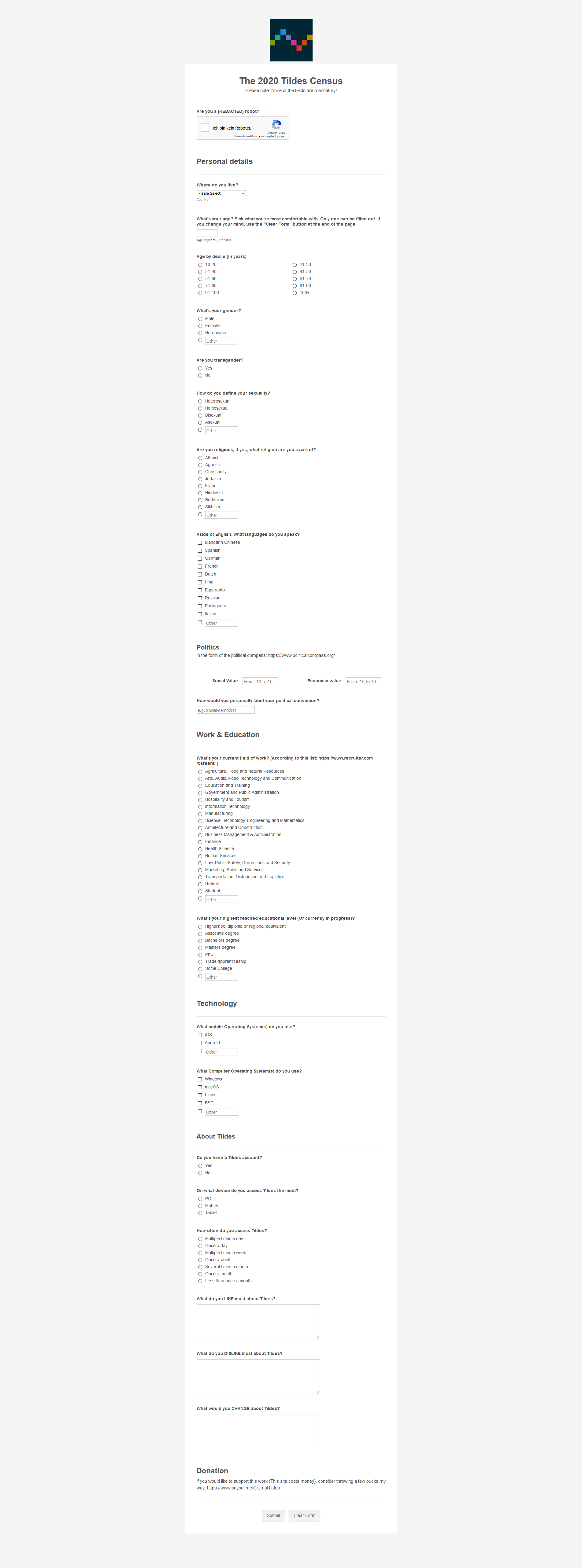
      Anyway, let's go through the census. I let JotForms compile this nice graphical report that is pretty much useless because it completely breaks once either sexuality, gender or the myriad of various operating systems the people on here have get involved. But it's still funny seeing it struggle. Have a link to the PDF. So back to good Excel, my old nemesis.

      Aggregated Data

      Thankfully, this time around you'll have access to generate all this shit yourself, HERE YOU GO. The thing is in JSON, so easily deserializable, etc etc. I'm sure you people are skilled enough at typing the words into the IDEs to magic the data into your memory.

      Important info: Empty answers are usually marked NO ANSWER, in case of numerical values it's usually -1 for age, -2 for the Kinsey scale (-1 is taken) and -69 for the 3 political values from the Sapply test, as these range from -10 to 10. Yes I made the default value -69. It's everyone's favourite number after all. Also, for some absolute FUCKED reason one of the values has 3 more entries than the other ones, I'm sure it has a totally VALID reason that has nothing to do with people entering bullshit. NOTHING.FuckingKILLME

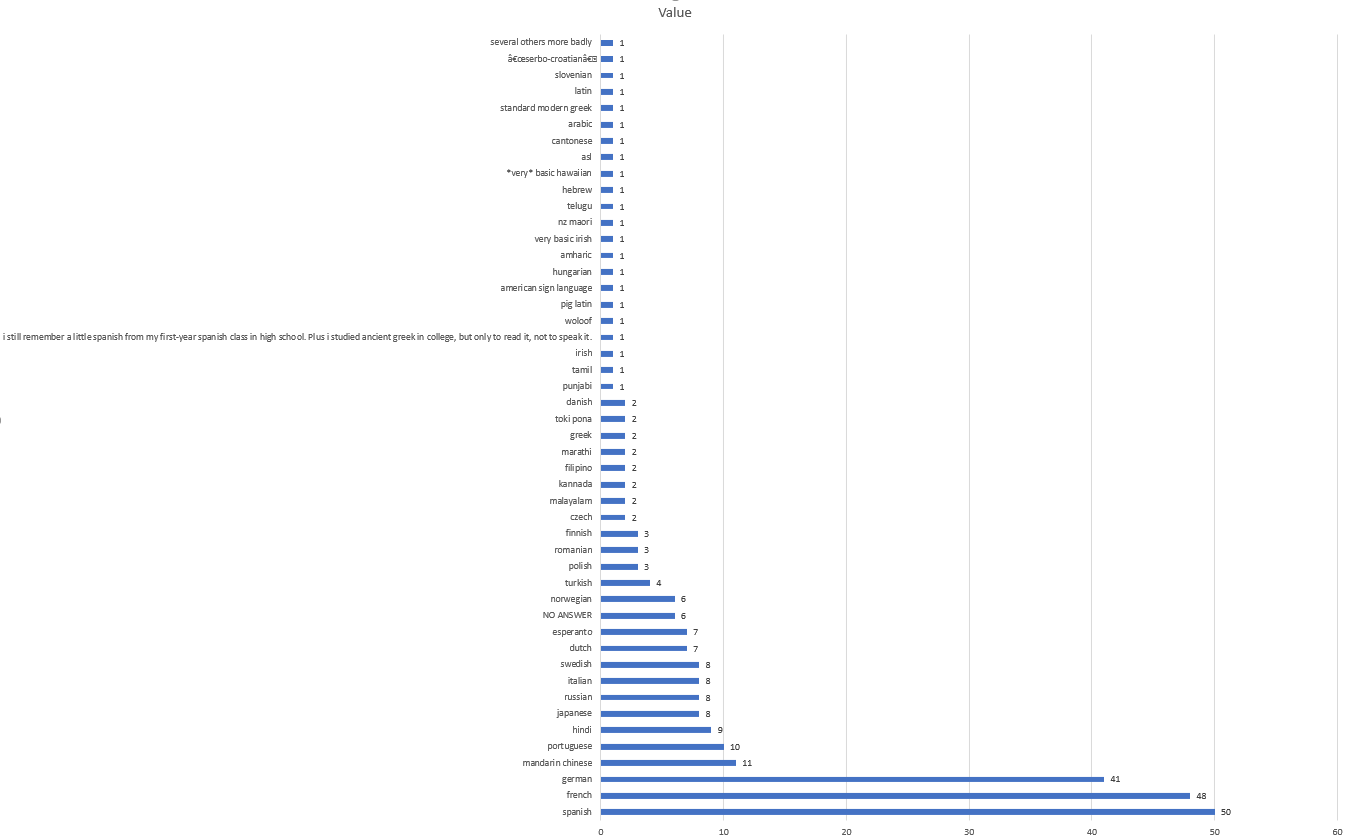
      Also I can't be bothered to edit the "wrong" data out, i.e. typos in languages etc, so those are all in, maybe someone with more compassion than me can do that.

      Kowalski, Analysis

      First of all, I'm going to less graphs this year because it's fucking hard to aggregate things like ethnicity when you get responses ranging from black to a literal link of someone's You23AndMe results. Yes. I mean props to you for that but like, uh, FUCK, what am I going to do now? YOU ARE ALL MAKING THIS WAY TO FUCKING HARD. ლ(ಠ_ಠ ლ)

      This propagates to basically all responses and next year I'm probably going to captain a way straighter course with less options, because I can't fucking MAKE FANCY GRAPHS WHEN YOU GIVE ME TOO MANY INDIVIDUAL RESPONSESFUCKINGKILLME

      Personal Shit

      Geography

      Not much has changed, the US still dominates, Canada second, though the British are catching up. I'm sure you'll have your tea party eventually. Though with good ol' Boris in charge I don't know if annexing the yanks is such a good idea. Also, as there are no invidual option here for everyone to FUCK IT UP it's the most sane graph of them all. No fucked colours this year, I promise, it's all scale.

      Fancy Graph #1: Geography

      Age

      Fancy Graph #2: Age by decile For those wanting to repeat this, watch out, as the age by decile and specific age questions were exclusionary. You'll have to combine the results to get the same numbers. I hope. Unless I fucked up. Equal possibility.

      Also whoever entered 28.9, because of you I had to make the age field in my code a double instead of an integer. Fuck you.

      Gender etc.

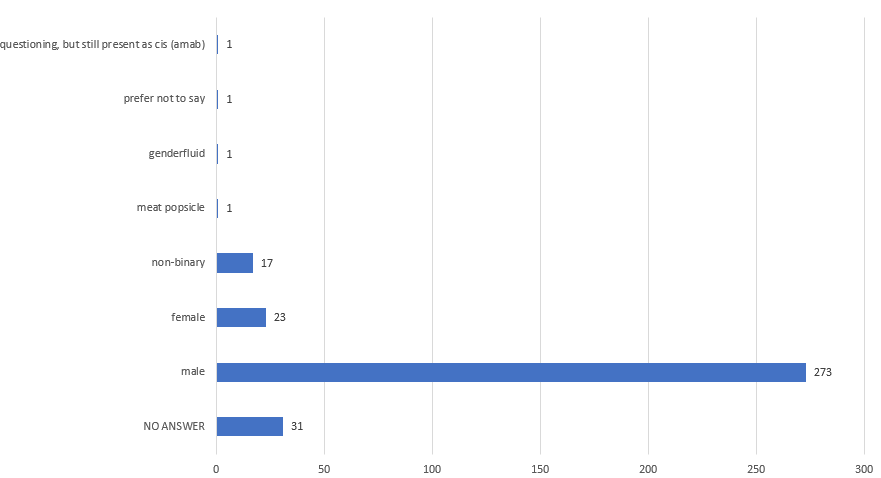
      I honestly thought this was going to be the wildest answer, but y'all are such a minority that it's fairly sane. The real clusterfuck starts after this question. Also whoever wrote prefer not to say, DID YOU NOT READ THE PART ABOUT THE OPTIONAL ANSWERS, [REDACTED] PLEASE [REDACTED] AAAHHHHHHHHHHHHHHHHHH-

      Anyway as I said, fairly standard results.

      Fancy Graph #3: Gender

      Trans? Value
      NO ANSWER 13
      no 312
      yes 23

      Yeah I'm not gonna make a graph for a yes/no question, if that's bigoted you may scream at me in the comments.

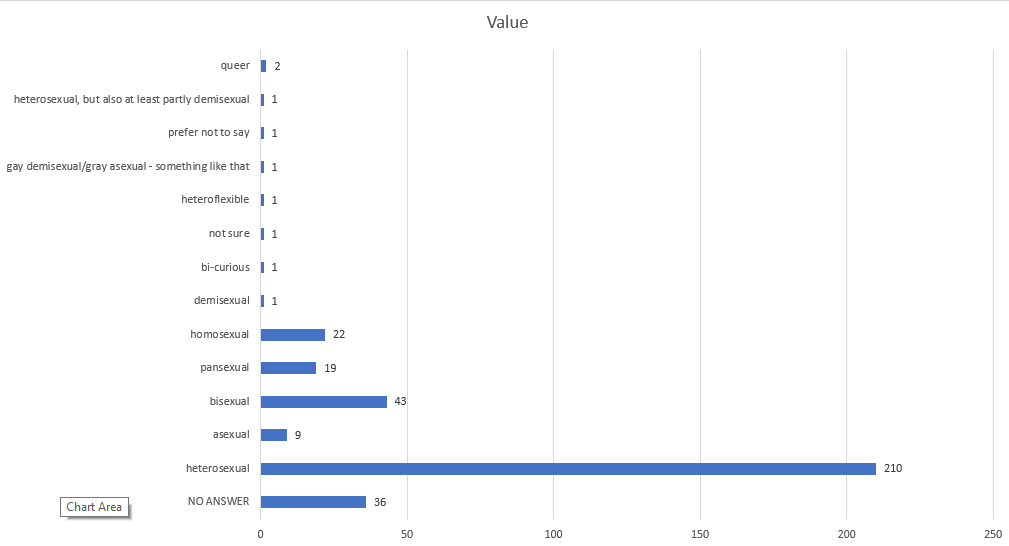
      Sexuality

      I MADE THE SCREENSHOT BUT I FORGOT TO ADD IT FUCK FUCK FUCK FUCK

      Kinsey

      Also forgot about you. Average is 1,37, idk what else to do.

      Ethnicity

      This was a mistake. 124 wrote white. 23 wrote caucasian. One person wrote causcasion. One person wrote that it's illegal to ask this question in their country. Someone wrote I bleed red white and blue.

      THIS WAS A MISTAKE.

      Kill me. Safe to say, that Tildes is, as someone put it perfectly: white af. Yes this was also a reply. KILL ME.

      Language

      Fancy Graph #3,5: LanguageThis was added later, and I'm really not updating the others.

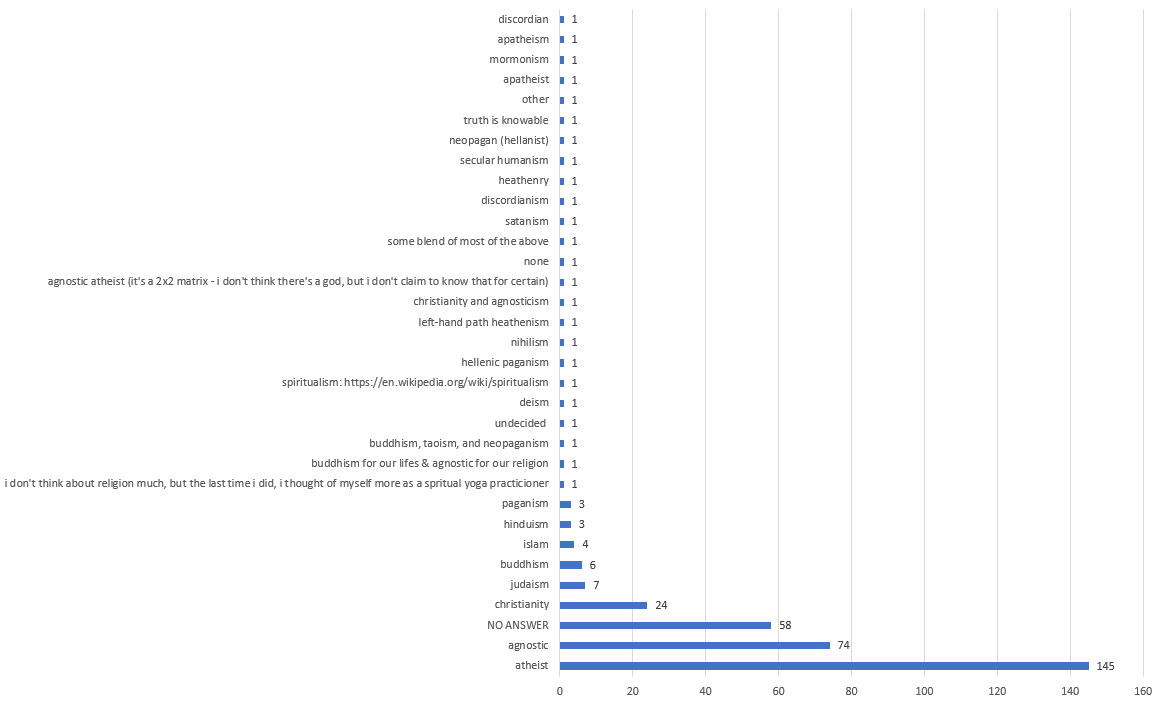
      Religion

      I'm just gonna let the graph speak for itself, I don't have it in me to keep the anger up.

      Fancy Graph #4: Religion

      Politics, Education, Work

      This is where the fun begins. No, honestly not really.

      Politics

      If I average out our Sapply values, we get this compass result. Yeah we're all communists. So whoever said in their dislike the alt right people on this platform, I really don't know what you mean. If anything we need more to achieve PEAK CENTRISM. In all honesty, the people saying that this sub is a leftist echo chamber (there were a few), you may have a point.

      When we get to the magical field of how everyone identifies themselves politically, well, let's just sayah, there's the rage again I'M NOT GONNA REPEAT THIS NEXT YEAR, GREAT FUCKING IDEA. Whoever entered confused, I FUCKING AGREE. SINCE WHEN IS PINK A FUCKING POLITICAL AFFLIATION? We do have a pirate though.Nice

      You may wade through the rest OF [REDACTED] YOURSELF in the published data.

      Education

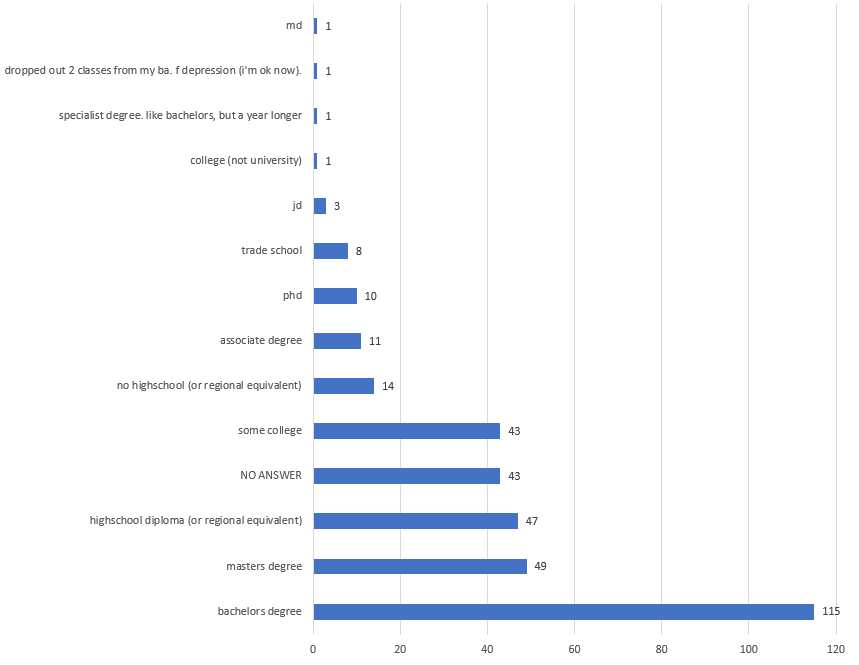
      Tildes is an educated lot, contrary to popular my belief after making this census. A good chunk of people have a Bachelors, Masters, PhD. Still only one MD though, so if you have a medical emergency take it up with... checks notes Ah fuck I can't reveal anything. ...Take up with them. JK please call your local emergency line when you need help

      Fancy Graph #5: Education

      Work

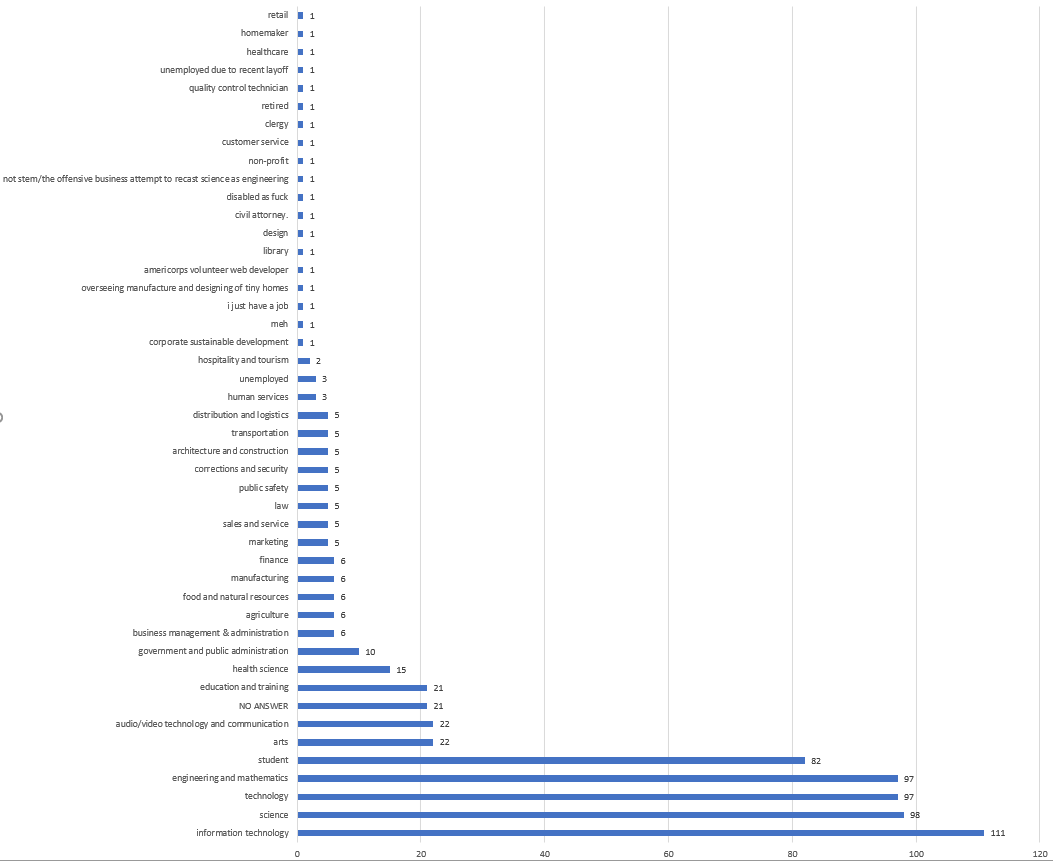
      Actually fairly sensible results, except a few, like that one person that entered not STEM, thanks for not giving me any useful information. You have the ability TO NOT ENTER SOMETHING. THIS GOES FOR THE PERSON WHO ENTERED meh AS FUCKING WELL, [REDACTED].

      Fancy Graph #6: Work

      Technology

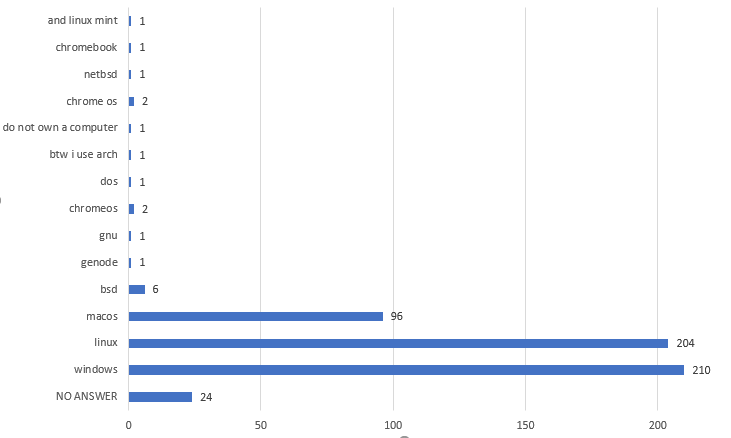
      Fancy Graph #7: Computer Operating Systems

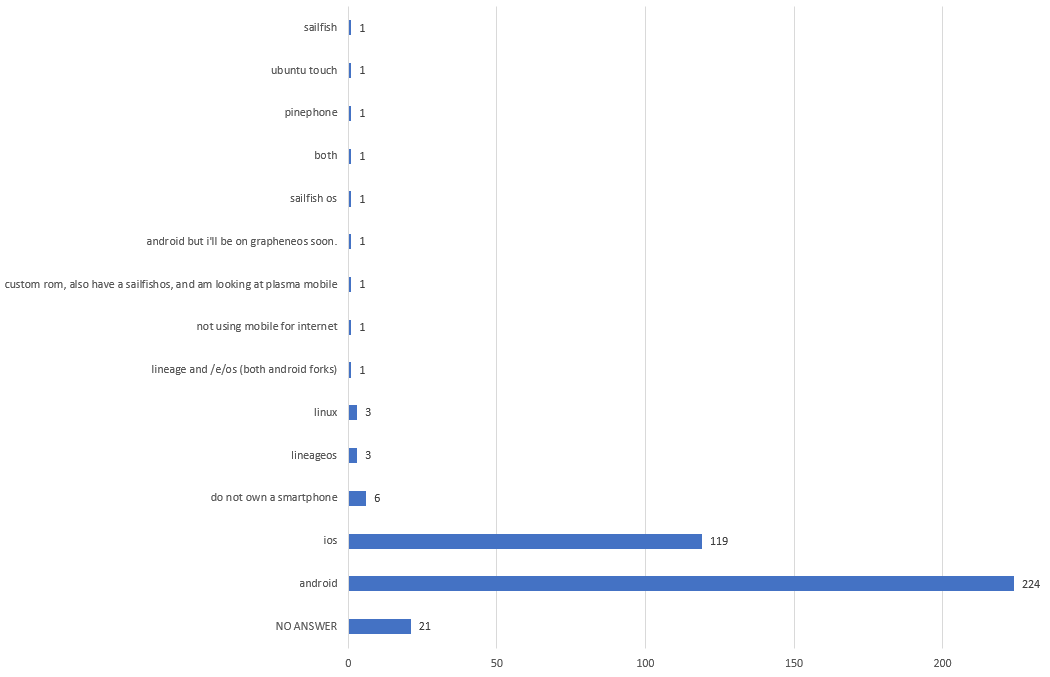
      Fancy Graph #8: Mobile Operating Systems

      Basically just like religions. You all have to many options, since we're all communists now according to average, and options are bad, you MAY ONLY USE WINDOWS VISTA FROM THIS POINT ON, OR THE GESTAPO WILL PAY YOU A VISIT fuck, wrong mass murderers

      About Tildes

      Have Acc? Value
      NO ANSWER 7
      yes 312
      no 29

      For consistency, and it didn't fit into the picture in a nice way.

      Fancy Graph #9: Various Tildes Statistics

      Most people migrated off reddit, followed by Hackernews. The rest is various random shit, include like 5 different ways of "I don't know", but the one person replying Gab surprised me. Didn't think people would hop on Tildes off Gab, since Gab is basically extreme rightwing Twitter and Tildes is like, the antithesis to that. Leftist userbase, longform discussion.

      The long replies

      Once again, can't graph the shit outta this, so here's the collection of them. One reply per line. Had to format some replies to fit this format, I know someone did bullet points, apologies.

      What do you like about Tildes?

      What do you dislike about Tildes?

      What would you change about Tildes?

      Final notes

      To keep my sanity in check, although when I read this post, that probably didn't work out too well, I kept some notes.

      1. Someone suggested to ban all Europeans off the platform. You now have the stats, so I'm going to let you guess from where they are. Fucking hilarious.

      2. Someone very cordial managed to write an entire blog post into one of the final freeform boxes. I appreciate the feedback and I'm sure Deimos does as well, but why did you have to make so many empty lines? TBH it's more on Jotform for not removing linebreaks when giving you the CSV, it breaks the entire format.

      3. We should have a prize for that person who fit a textbook into the box for ethnicity, also amazing, you mad fucking lad (or lass, but statistics are on my side, lol)

      In closing, most answers were good and interesting, except for the part where I let you run wild with the politics question, holy fuck, but that's on me. To the people that reduced my IQ by a few points, well I took the piss outta you already, so I hope you have a great day. Everyone else, I hope you [REDACTED] on a few [REDACTED]. Wait, I think I mixed something up here.As you may have guessed, don't take this too seriously

      As always, see you all next year, same time?Unless I get banned, which seems like a good possibility when I proofread all this, so much angerI need to get laid, or drunkActually how high does this go?

      Cheers, I'm gonna go C͉̠̰͚͚͓ͪ̿̋̏̚O͓̯͕̙͕͎͈̫̦͐̊́Ṅ͕̮̣̺̖̣̖̈ͥͦ͊̽͒͠S̶̵̹̜͔͖͗͂̋̔̈̒͊̚Ú̷͔͍͇̪̥͍ͭͭ̔ͨ̄̇̅̕M̵͈̮͉̹͈͕̻̎̓E̛̯̝̭͉̼̍̎̐̋̑̎ ̷̵̮͔̬̙̠̣̬͉ͭ͒S̨͙̼̟̻̜̈̄͋̄̇ͨ͛́͟͞Ò̡̧͙̩̓̄͂̓͗́M̹̰̲̆̌E̴̡̲̟ͯ ̹͇̲̩͍ͨͨ͒̑͊̌͒͆̕͡F̵͊̊̾ͭ҉̘̲̝͎̥͔̠̺̙O̧̡̱̠̙ͤ͒ͪO̬̯̪͉͙̩̅͂̀̏ͫ̄̓͂D͎͓͍͔͙̰͕̒̒͒̓̃̍͂ͭ̀͢
      Grzmot

      60 votes
    16. I've beaten Final Fantasy VII Remake. How to approach the Postgame and Hard mode?

      I beat Final Fantasy VII Remake last week. Those last chapters were exhausting, and amazing, and now that I've gotten some rest I'm thinking about going back and doing some postgame content and...

      I beat Final Fantasy VII Remake last week. Those last chapters were exhausting, and amazing, and now that I've gotten some rest I'm thinking about going back and doing some postgame content and Hard mode.

      Any tips on where to begin? I tried picking Chapter 9 to go to the Colosseum and get a couple upgrades I missed for Aerith, but quickly died to some easy mobs within the first 15 minutes of the chapter.

      So I'm thinking I need to do some grinding first, probably on Normal, before attempting Hard? My characters are around Level 40.

      How did you go about the postgame content? Did you replay the chapters in chronological order, or prioritize specific goals? What worked well for you (read: made the postgame enjoyable and not frustrating), and what would you have done differently?

      10 votes
    17. Does anyone here feel like talking about how social media sites are probably used for way too many different purposes at once right now?

      In this thread, @viridian said this: Twitter, in my limited usage, has a completely different problem. It actively encourages you, by rule of the 280 character limit, to strip away all nuance and...

      In this thread, @viridian said this:

      Twitter, in my limited usage, has a completely different problem. It actively encourages you, by rule of the 280 character limit, to strip away all nuance and conversational tone. You can avoid this of course, but the UI ensures that you then suffer the consequences of having to

      split up your posts into multiple tweets, which is bad by design in every single way for the user. Replies become distributed to different tweets, and thus inaccessible without a series of 2*(# of tweets) clicks. Everything about the design is just begging you to

      box in the entirety of your thoughts to 280 character blocks, which I think is the single largest issue the platform has when it comes to encouraging thoughtful engagement. Twitter actives fights nuance and explanation, and so the platforms users follow the bad behavior

      patterns Twitter encourages.

      Completely agree, it is a bit of a feedback loop. You do have to say though that even the fact it's no longer at the original 140 characters is a concession to the fact that the kind of discourse that now happens on there rather than what it was intended for. I imagine designing something to handle both types of usage well while maintaining the platform's identity can't be easy.

      (Okay, this one was said by @culturedleftfoot.)

      It's certainly not an easy problem to solve, it may even be impossible. That said though, maybe a 280 character mass social media platform is just destined to be a net negative for society.

      And it reminded me of this comment I wrote a while ago:

      To be fair it the term 'social media' is pretty useless when it comes to describing a site's purpose. In twitter, for example, you have celebrities rambling about random aspects of their lives, politicians delivering serious to obviously canned responses to serious or made-up problems, anime artists sharing their work, YouTubers sharing sneak peeks for future videos or shilling out, all in the same platform, which is disponible in 33 languages across every continent except Sub-Saharan Africa. (which was started specifically as a SMS & microblogging site, hence the word limit). Not many 'social media platforms' actually have their intended purpose be their sole purpose, which can backfire intensely. Social media platforms might have decided to recommend people with similar opinions to you as an unintended consequence in order to find people with similar hobbies to you, rather than to create an echo chamber of radicals and stifle communication between different political beliefs.

      (Not that the fact that's a real possibility excuses them from not doing anything to combat it once they realized that was one of the side effects of their decision for most or all of my lifetime.)

      One of the IMO most underrated problems with the state of social media today is that social media platforms are used in far too many ways for any one site to be designed around.

      YouTube for example is used as a meme-consumption feed, source of education, video-game feed, ASMR feed, news feed, music feed, child cartoon feed and more.

      And since YouTube was designed mostly for video sharing, things like the comment section were of secondary importance and areas like educational or political content are greatly harmed by that since the YouTube comment section is basically impervious to serious discussion. The algorithm also appears to be basically universal for all these vastly different types of content. This also hurts educational and political channels (unless they somehow accommodate to that, usually by lying ala PragerU) but also animation channels.

      Another example would be Facebook which originally (supposedly?) started off as a platform for connecting with people, apparently limited to universities initially. Now it's used for sharing memes, news, personal life updates and more, things which are fundamentally quite different from one another and probably shouldn't be under the same site, since the things important when it comes to spreading a news article are wildly different from those when spreading a meme (format?). (Or management, obviously.)

      IMO, decentralizing social media along these lines into say news sharing platforms, meme-sharing platforms, image-sharing platforms, educational platforms, social platforms (where you go to make friends, which is what social media billed itself as early on IIRC) is IMO one of the more interesting but underlooked options and in some senses is looked on into with places like Instagram and pinterest (although obviously if these sites aren't regulated to provide privacy it's all smoke and mirrors and given this requires government action I don't blame people for ignoring this all that much).

      So does anyone else have any more thoughts?

      23 votes
    18. Complete an emotional inventory of your music library/experiences

      This is not so much an ask thread as it is a task one. The idea is simple: for any/all of the categories below, identify music from your library or experiences that fits the bill, and explain a...

      This is not so much an ask thread as it is a task one. The idea is simple: for any/all of the categories below, identify music from your library or experiences that fits the bill, and explain a bit about why.

      You can choose any from the list, or do all if you like, but please do NOT just list items with no explanation! Your thoughts are the exciting parts of this exercise, not just the music itself, so please share!

      For the purposes of this inventory, "music" can refer to a specific lyric, a song, an album, an artist, or even a concert or event -- really anything that you think fits the bill. If you want to go into multiples per category, that's fine too -- just remember to explain them!


      Inventory Items

      Tell me about music that:

      • Is an instant mood lift
      • Is emotionally devastating
      • You've cried to
      • Reminds you of someone you love
      • Reminds you of someone you used to love
      • Brings you back to a specific memorable moment/time in your life
      • Helps you relax
      • Amps you up
      • Makes you feel safe
      • Could put you to sleep (in a good way)
      • Makes you feel like you're on an adventure
      • Reminds you that there is beauty in this world
      • Impresses you
      • Makes you smile
      • Makes you laugh

      You don't have to do all of them -- only the ones you feel strongly about or that have interesting stories behind them. Also, feel free to add on new categories in the comments that people can also respond to.

      21 votes
    19. Thoughts

      I don’t even know where to start. I realize it’s not meant to be a coherent piece of text, but rather a (fortunately short) stream of related thoughts. I could talk about when an ambulance took me...

      I don’t even know where to start. I realize it’s not meant to be a coherent piece of text, but rather a (fortunately short) stream of related thoughts.

      I could talk about when an ambulance took me to the hospital because I was so drunk I couldn’t even move.

      I could talk about how with other friends I bullied people for no justifiable reason.

      I could talk about how I can’t stop watching porn, and consequently how my sexual tastes diverged from the normal, making me guilty of engaging in and craving illegal content.

      I could talk about how I wasted literally years trying to finish a bachelor degree, to the point where I am now lying to my family and friends about exams.

      I could talk about the many other stupid things I did, some of which while being recorded by people who aren’t even friends any more and who could easily ruin my life by sending them out (not that they have a reason to do so, but nothing can change the fact that I am powerless).

      I could talk about how I wish suicide was an option, but since it’s not, the best alternative is sleeping while enjoying dreams. Too bad you can’t sleep forever.

      The list could probably go on.

      I can’t seem to spend a day without dwelling on at least one of these (and other) burdens; be it a memory, a negative feeling, an evil thought, an action, or a combination thereof.

      When I think about the past, I feel overwhelmed by nothing but regret. When I think about the present, I’m filled with guilt. When I think about the future, I feel fear (of life, of ageing, of death).

      No one can object to the intrinsic meaninglessness of life, unless you take into account religion (which I do not) or subjective purpose (which I could consider, but it’s impossible to consistently focus on that when you are reminded everyday of the underlying nonsense of life while fantasizing about suicide).

      I often ask myself If I’m being truly honest with myself or if I’m semi-unconsciously sabotaging my existence just because playing the role of the victim is admittedly easier than fighting for your life.

      I am ultimately confused by the reason why I am the way I am: is it because of my past (wrongdoing)? Is it because I suffer from a mental disease? Is it because I suffer from a physical disease? Is it because that’s simply how (evil) I am? I have so many questions and so little answers.

      22 votes
    20. Help me think about the next step in my life

      Hello, I am a late 20s person from Europe who works part-time at a low-skilled job and is nearing completion of a masters in Financial Mathematics (FM). I also have an undergraduate degree in...

      Hello, I am a late 20s person from Europe who works part-time at a low-skilled job and is nearing completion of a masters in Financial Mathematics (FM). I also have an undergraduate degree in Economics and a post-graduate degree in Finance.

      Previously I’ve worked full-time as an IT consultant, in R&D at an asset management company and in operational risk at an investment bank. I stopped working full-time in early 2018 due to mental health issues such as depression, anxiety disorder and possible Asperger’s. But even before then it was obvious my health was deteriorating and I actually got fired from my second job partially due to these problems. Since then I’ve been slowly working (or at least trying to) on my health, which has improved substantially but not as much as I would like. So in early 2018, with way too much time in my hands, I decided to get the part-time job to partially offset my expenses and also decided to go back to school to study FM.

      I went back to school for multiple reasons. I was tired of doing work that was not very technical or quantitative. While working on my health I realized that I don’t do well with work that is subjective, unstructured or involves little interaction (for example doing a lot of reading, specially when I have no clear goal). I did a little programming at previous jobs and more during the masters. So, I can say with some confidence that I enjoyed it. But going back to the FM masters: it is very technical, I was fascinated and curious about it plus it has an excellent track record with regards to employment prospects. I also considered “going back” and doing an undergraduate degree in computer science but decided that it was just too long (minimum 3 years).

      So with this “introduction” out of the way let’s get to the heart of this post. I don’t know what to do after I finish my masters. Of course I could just apply for jobs related with what I am studying. However, I think I really want to try working in the technical side of IT. I will admit I don’t know much about the different aspects and careers in IT but I find it interesting. Every time I was doing non-technical work I just wanted to understand and do the work of my technical colleagues. I think it both better suits my personality and aligns well with my long term goals of increased freedom and flexibility (IT generally pays well and you can do a lot of work remotely). I have this idea of maybe becoming a freelancer but I can understand that is not realistic in the short-term. So, working in IT inside a company is probably my best bet at this time. Regardless, another objective of mine is to be able to work less than 40h per week. I think it would be great for me, specially health-wise.

      I have to say I got more excited about my ideas when I saw this post here on Tildes: https://tildes.net/~comp/quj/would_any_tilderino_be_interested_in_tutoring_me_in_programming. I am willing to put in the work and it would be awesome to have some tutoring. Another point I took from that post is that IT is a very big field and I honestly don’t know specifically what I want to do inside that space. However, I do know I don’t like dealing with UI or graphical/design aspects.

      I guess I will finish by asking direct questions to help people structure their answers around (but if you want to talk about something else I wrote, be free to do so):

      • First of all, what technical areas within IT do you think would suit me? If it’s not much of a hassle, please provide a brief description of what people actually do in those areas.
      • Is it realistic to start working as a technical IT freelancer and learn as I go? Or are the odds very slim?
      • Alternatively, if I decide to take the "safer" and more probable route of nailing a technical IT job, what should I do to put myself in a better position to attain that goal?

      Thank you =)

      10 votes
    21. If you're a parent, what is it like?

      If I see myself in someone's child here then I'm deleting this thread, no questions asked /s You should probably say/indicate your and your children's age and sex (can be plural, obviously.) You...

      If I see myself in someone's child here then I'm deleting this thread, no questions asked /s

      You should probably say/indicate your and your children's age and sex (can be plural, obviously.)

      You can follow the Q&A format below but you don't have to.

      A few questions that come to (my very uninitiated) mind are:

      How much time do you spend on them?

      If you aren't their biological parent:

      (i.e you're @aphoenix not hetero and a parent didn't want to go through fkin birthing people an adoptive parent, for example)

      • Where did you (uhh) find them?
      • If it was an orphanage, what was it like there? (Can you even find children elsewhere if they don't have parents?)
      • How many children were there to choose from?
      • What led you to choose the child you picked in specific instead of someone else? (Dear God, is this an ethical question to ask?)

      How do you parent them?

      • Do you follow what they're doing on the Internet or how much they use it? How much?

      • Do you encourage them to have a good diet? How much?

      • Do you encourage them to do more chores? How much?

      • When you do this, how cooperative are they? If they aren't, what do you do to convince them?

      How do you and your partner split the time spent taking care of them?

      What was the most unexpected thing about parenting to you?

      More personal questions below. (You can avoid these, I probably would too tbh)

      If you had a particular preference/expectation for what you wanted/expected your child to be and got something else, what did you do?

      How did birth(-ing?) go? What was it like?

      What was being/seeing your partner be pregnant like?

      Is there anything you regret doing when parenting them?

      Why did you have them?

      30 votes
    22. A comprehensive, deep dive into Tetris: The Grand Master (TGM) design, the hidden Japanese Tetris version you will never legally play

      'sup. As promised, here's a text discussing the minutae of Tetris the Grandmaster, its sequels, and the game mechanics of Tetris in general. If you want more, there's some market analysis, drama...

      'sup.

      As promised, here's a text discussing the minutae of Tetris the Grandmaster, its sequels, and the game mechanics of Tetris in general. If you want more, there's some market analysis, drama and politics in the comment.

      Tetris the Grand Master is probably the most beautifully designed game I know. I hope you will share my passion for this when your are finished with this post.

      Since Tetris is a "pure" videogame where pretty graphics and/or enticing plot is irrelevant to the game, this will focus a lot on the game mechanics.

      Also: this is based on a draft script for a video I wanted to make for a while now. Presumably this thing would flow better with some illustrations at the same time. I tried to include some, but of course it's not the same as someone narrative over image.

      Also: weird language ? Missing words ? Misplaced punctuation ? This probably comes from me, writing in English as a second language. Picture this article with a vaguely French accent if it helps (although I'm not actually French).

      I am aware of Tetris Effect. I am happy if people find TE a transformative transcendental synesthetic experience, but for this matter I much prefer Rez and particularly its Area X.

      So: make yourself comfortable, get a hot beverage of your choice, perhaps enable the reader mode in your browser and prepare for a 4k-ish words long read.


      Tetris, the arcade game

      Tetris. The little game from the Soviet Union, the killer app of the Gameboy, and until Minecraft happened the most sold computer game of all time.

      Despite its tremendous success, the general perception is that this title has not evolved since its initial release in 1984. We would effectively be playing the same game plus-or-minus some gimmicks and/or yearly graphical updates.

      This is of course false. The evolution of Tetris game mechanics is a story for another time, but the skinny version is that there's two main branch to the Tetris tree: Nintendo, and Sega. What I want to talk about now is a representative of the Sega branch.

      Did you know ? Sega means "Service Game". The company we know today as a publisher with a blue mascot originally sold arcade games. And even today, Sega has a strong presence in the arcade world.

      Tetris the Grandmaster is an arcade game, made by Arika, a company made by ex-Capcom employee whose more notable works at the time include Street Fighter Ex.
      Arcade game design is a delicate juggling act between two parties:

      • the game operator: wants money, and for single player game that could mean a short and/or difficult game.
      • the player: wants fun. If the game is too difficult and/or unfair and/or incomprehensible, he or she will move to the next game

      With this definition, vanilla Tetris is a pretty good arcade game:

      As you play the game, the game ramps up in speed and consequently its difficulty. But it never feels unfair: you may complain having bad luck and getting a crappy piece distribution (more on that later), you are still responsible for that terrible stack you just made.

      However, there's a finite limit to the speed of the game. Past a certain point, you end up in a kill-screen where it is impossible to play. The piece just falls and lock immediately, with you being powerless, unable to do anything.

      How lock delay extend the base game

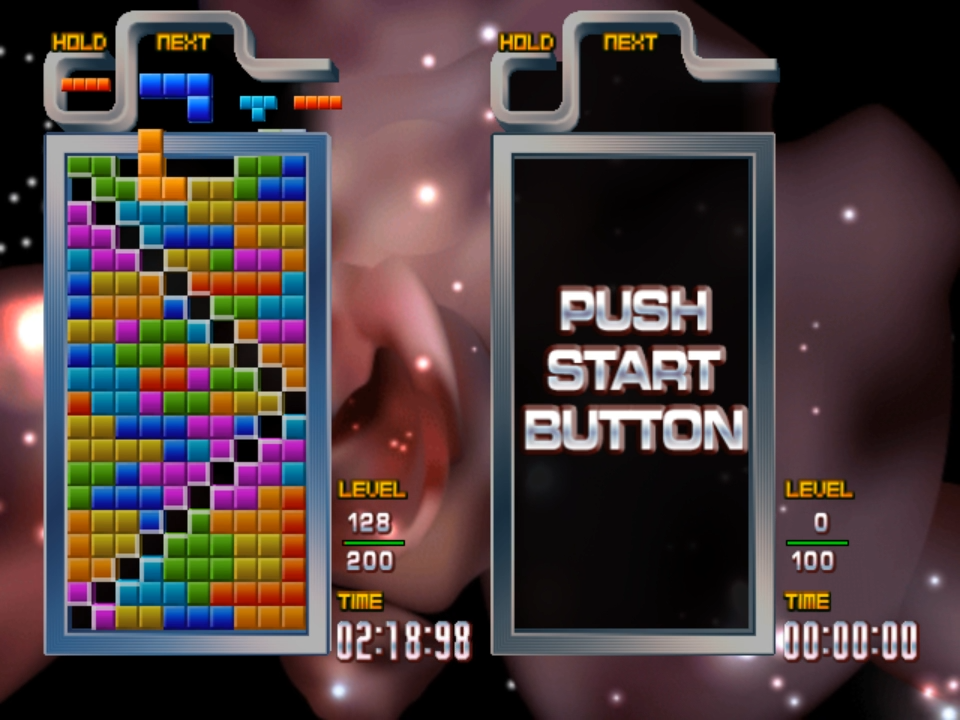
      Video: Godlike high gravity NES Tetris game from JdMfX_, Godlike high TGM game from 777

      What is remarkable with Tetris the Grandmaster is not only it has found a way to extend the base game past this seemingly hardcoded limit, but it also focus nearly all of its design toward this idea of speed. Speed is the focus of the game, and if you don't believe this, there's a giant chronometer at the bottom of the screen acting as a constant reminder.

      So, how do you survive to the kill screen?

      You could try to make the piece move faster (which they did) but this is not enough. At some point, the piece will still spawn on the ground and immediately lock.

      Enter the Lock Delay.

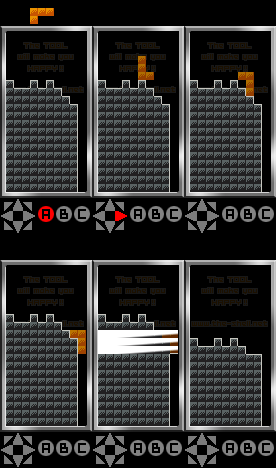
      Illustration: lock delay

      Lock delay is the mechanic in which if a piece falls into the ground or the stack, it will not immediately lock but can react to play inputs and "slide" for a few frames before locking into the stack.

      This has deep, deep consequences.

      Obviously, you can make the game faster than anything we've seen before. All the while still have a viable game. At maximum speed, or "20G" as it is known in the jargon, the piece directly spawns on the stack without floating at any point in the air.

      for the pedant: historically, Sega Tetris was the one of the first game to feature lock delay; and the mechanics was already there in some other falling blocks game such as Puyo Puyo.

      At high speed, and especially at 20G speed, the piece movement becomes severely limited. Having the game viable at 20G completely re-contextualize the game, its moment-to-moment tactics and its general strategy. Not only you have to think about a given piece placement, but more than ever you have to take the next piece into account. Some sub-optimal piece placement or "bridges" have to be made in order to make the whole game continue.

      Illustrations: possible piece placement at 2G, at 20G, at 20G with a bridge

      And thus: while the core gameplay stays the same, the game becomes more demanding both physically and mentally. You have to react faster and input your command quickly and confidently; and at the same time you have to constantly think about your stack, the area where work is needed and how you can accommodate unwanted pieces. You can even manually control the pace of the game by cancelling the lock delay (done very naturally by pressing down.)

      Lock delay is probably the most important game element added to Tetris, but it's not the only thing in which TGM also innovates. Several other additional mechanics exists, and they have this common idea of a "speed enabler". Let's review them:

      "Speed enablers" game mechanics

      DAS

      I mentioned earlier that the way you move the pieces was faster. This seems like a straightforward thing to do at first sight but there's some subtleties hidden in it.

      So: when you hold left or right, the piece moves automatically (in the jargon it's called DAS - Delayed Auto-Shift). It's a nice and natural movement akin to letting a key down in your keyboard, but there's actually two parameters to take into account.
      First, how fast the auto movement is triggered, and second, then how fast the repeat itself is. In TGM, both happens at a brisk space (16 frames before auto-movement, and a movement of 1 case per frame). This is essential for 20G play. And, in the context of 20G, the DAS enable a family of movement techniques called autosynchrothat bring additional depth to the game.

      manual synchro also exists, but requires significantly more skill, as it requires a 1-frame combination. Yup, just like in fighting games and their 1-frame links!

      Wallkicks

      There is another mechanic that involve automatic movement, called wallkick. A wallkick happen when you try to rotate a piece near a blocked cell, such as the stack or a wall. Normally, if the rotation mask overlap a blocked cell, the rotation will fail. However with wallkicks, the piece can automatically move so that the rotation can still happen. In modern standard Tetris, the rule of how the piece move is quite complicated (to my eyes) but enable advanced placement such as the infamous T-Spin Triple. In TGM however, it's dead simple: try to move one case toe the right or one case to the left in that order, and if the piece fits, it gets moved.

      Illustration: wallkick

      So yes: at first sight those wallkicks are concessions given to player that make the game easier. However, some advanced movement techniques takes advantage of wallkicks. The goal of course is to move a piece faster, leading to tiny but compounding time saves.^†

      in the jargon, optimal piece movement is called finesse

      IRS

      Continuing on the theme of rotation, let's now talk about the Initial Rotation System or IRS. So in most game, when a piece is locked, the next one immediately enters the playfield.
      This is not the case with TGM: there's a tiny interval in which nothing happens (except perhaps a line clear animation). .

      of course there's a jargon term for this: it's called ARE††
      †† it's not an acronym, it literally means "that thing" in Japanese (あれ)

      This interval have a dual purpose (Mark Brown would be happy): first, it serves as a buffer to charge the DAS. But it is not limited to rotation: you can also charge a rotation.

      And that is what IRS exactly is: press a rotation button during this time and then the piece will spawn already rotated .

      IRS usefulness is not only limited to make the game smoother to play: it solves a problem inherent to Sega Tetris. All game in that lineage have most piece spawning with a pointy end toward the ground. This can be problematic in high gravity, and especially in 20G. If you IRS such pieces, you can then confidently slide them to the side without worry of them being stuck somewhere.

      Illustration: trapped without IRS, saved with IRS

      why not having them spawn flat-side down ? I think this is partly for historical reason (establish a clear lineage with Sega Tetris), but also because this this extra-difficulty is coherent with an arcade game design.

      And yes, of course, IRS is also a time saving measure, helping to shave some milliseconds here and there.

      TGM history-based randomizer

      Let's talk luck. Earlier on, I half-jokingly said that "luck" as a hallmark of a good game of Tetris. Well it is a bit more profound than that.
      Any competitive Smash player can tell you this: consistency is king in a competitive game. That's why random event affecting the core gameplay are frown upon, and that's why tripping in Smash Brawl was so negatively received.
      You can probably see where I'm getting at: there's one giant thing in Tetris that's by definition random: the way the piece sequence is generated. And yes, TGM has a optimized random generator, and in fact most Tetris game have one.

      An analysis of the history of the different random generator is a story for another time, but here's the gist of it:

      In a purely random sequence of pieces, a sufficiently long series of S and Z tetraminos is bound to appear. Such sequences is mathematically proven to lead in a game over. Of course, this doesn't happen in practice. Especially in TGM, there's a finite number of piece given and thus the change of that happening is infinitesimally small.
      However this does gives us insight about the piece distribution: flood (too much of a piece) and drought (not enough of a piece) is not fun. In other word, waiting for that g!%d!3mn long bar piece sucks.

      So how does TGM counteracts this ? It implements a history system that prevent recently given piece to be distributed again. This is a flood prevention measure and make the game much more consistent while still having an element of unpredictability. And being unpredictable is not necessarily a bad thing, particularly in an arcade context where you still want the player to finish the game eventually. Fun trivia: modern standard Tetris nowadays implement an extremely predictable randomizer, which is mathematically proven to be infinitely playable at low gravity††.

      historically TGM is not the first game to implement a history system, there was already a rudimentary one in NES Tetris
      †† this is less of a problem in recent years due to the focus on multiplayer, enabling stuff like openers, but this is a story for another time

      Consistency in randomness is not directly tied to the notion of speed, but being confident in that you will not screwed by the piece distribution definitely helps in the elaboration of reliable strategies.

      The graphics helps too

      Illustration: An actual screenshot of TGM

      So far I've describe how the game is mechanically inclined toward speed, but aesthetically there's also some elements that are helps during high speed games.

      First, look at what the stack and notice how the active piece contrasts with the rest of the stack. There's a clarity of graphics that comes not only by the fact that the locked pieces have a darker hue, but also because of the of this white border that surrounds the stack. The goal is to have an instantly readable playfield.

      Continuing on this trend, each piece type is color coded so you can instantly read what you're getting by using your peripheral vision, leaving the focus clear on the stack. You can then more easily confirm the placement of your current piece, which is further helped by a very noticeable flash.

      The next-piece window is also aligned so that the piece previewed is placed directly above where it will spawn. This unconsciously helps the tactical decision of where to put your piece. Speaking of unconscious effect, the whole series have this auditory gimmick in which each pieces have its own jingle. From what I know, nobody use this consciously, even the one that can tackle the invisible challenge (more on the invisible challenge later).

      Scoring, grading, and speedrunning

      So we've seen the mechanics and the aesthetics of speed within TGM.

      But what would would be an arcade game without a good I piece measuring contest ?

      TGM has three metrics exposed to the player: Score-grades, level and time.

      Time is a straightforward metric, and is the main point of comparison for players having reached the Gm grade. Finishing the game under 13 minutes is ok, under 12 min is pretty good, under 10min is exceptionally good, and approaching 9min is godlike.

      Score, as in most videogame is a measure of how "good" you are at the game, but takes here a subtly different meaning. The exact detail of the scoring system is not super interesting to see, but its implication is. Let me explain:

      here : Score = (roundUp((Level + Lines)/4) + Soft) × Lines × Combo × Bravo ; Combo = Previous Combo value + (2×Lines) -2

      The optimal strategy with this scoring system is to clear as much line as the same time as possible. In order words, Tetris, triples and even doublesmakes a lot of points, whereas Singles proportionally don't score as much points.

      Tetris: four line cleared at the same time; triple: three lines cleared at the same time; double: two lines cleared at the same ; single: one line cleared

      This has an interesting side effect, as it incentivize to have a clean stack. A clean stack is a stack without holes. If there's holes in your stack, and particularly in they are all over the place, you tend clean them by performing singles. Sidenote: in TGM1, grade is directly correlated with score, except for the titular last grade, which is gatekeeped by some time requirements.

      So in TGM, the score still describe how "well" you play, but you may have noticed that there's no notion of time at all. I would argue that scoring here doesn't reflect how "well" you play but rather how "clean" you play. Keep that in mind for later.

      To be perfectly pedant there's the level factor in the equation that would incentivise you to play fast to reach high-yielding level as fast as possible. But please don't ruin my narrative.

      I mentioned just before that the last grade had some time requirements. Now, this is a perfectly reasonable requirement for a game that is focused on speed but, and I guess you are used to me saying that, there's some subtleties to it.

      Let's say the only requirement to get the last grade would be to reach X amount of point in Y amount of time, and reaching the last level. A viable strategy would be then to play as clean as possible so that you reach the point threshold, and then you just have to survive. This would mean that in that last part can play as sloppy as you want, you will still reach the Gm grade. That's, of course, not ideal as it doesn't push the player to play at its maximum (you can cheese the last part).

      What TGM did is neat and two-fold: First, it takes the "level" metric, which was until then a measure of how fast the game is, and turned it into a progression gauge. So you know that at level 100 you are at the beginning of the game, 500 is midgame and 900 is the last push. The gravity is still tied to the level, so at level 0 it's quite slow and at 300 it's significantly faster. But the thing doesn't have to be linear or monotonic, in fact there's a speedbump at level 200 (people told me it's for dramatic effect), and maximum speed is reached at level 500 (to let the new 20G gameplay shine.)

      Now here's the catch: you can progress faster in the game by clearing lines. Indeed, the way you gain level is that you increase the counter by one each time you land a piece, but more interestingly you get a bonus level for each line cleared.

      This ties everything together: if you want to play fast you have to play well, and if you play well the game will get faster.

      This positive feedback loop is in fact a system with dynamic difficulty curve: as good players will be presented with a more appropriate challenge faster, as more novice player will get challenged at their pace.

      So there you have it: even the scoring system is meant to go fast. Isn't that beautiful ?

      The sequels

      There were two sequels to TGM.

      The first one, known as TAP within the community because of the subtitle of the final version of the game ("The Absolute Plus"), builds on the building block of the first. There's now a dedicated 20G mode with a brutal speedcurve to it (it is, after all, named "Death" mode). For the main game (now called "Master" mode), there's a much appreciated addition of an instant drop. This significantly speeds up the pre-20G game. The point system is now decoupled from the grade, and a secondary but hidden point system is used to calculate the player grade. The detail of which is complex, but the take-away effect is that consistency of play is now taken into account.

      Video: a a TAP Gm game recorded during a livestream

      The second sequel is known in the community as Ti (again with the subtitle: Terror instinct). It had implements some gameplay elements mandated by the Tetris Company: three pieces preview, a "hold" function, and floorkicks (i.e. piece can always rotate on the ground even if it collides with it). As a happy accident, this enabled TGM to go the even higher, borderline absurd, speed. I want you to look at the sheer insanity of the Death Mode's replacement: Shirase. And then look toward the end of the run where pieces turns into brackets (a nod to the real original Electronica60 version), nullifying the convenience of both color-coded pieces as well at the white-border. It's glorious.

      Video: Cleared Shirase game by KevinDDR, the best Western TGM player.

      Now, on the Master mode side, there's two major changes: there's a revamp of the progression/level system, where now the speedcurve itself becomes dynamic, and a further focus on consistency. You not only have to be consistent within a game, but also across games. Indeed, there's now an account system that is tied to an examination system. It inspects your performance and randomly challenges you with an special exam game in order to reach the grade it thinks you deserve.
      The last grade is of course locked behind an exam, and is only reachable through that mean.

      Additional challenges

      Sprinkled around the main game are some additional challenges that are a bit adjacent to the main game.

      Illustration: A secret grade pattern build by ohshisaure

      There's a ">" pattern you can built within the game. Doing so will award you a "secret grade" depending on how complete your chevron is. This is a nod to TGM predecessor (Sega Tetris), where bored players in the arcades invented this challenge and became popular. This is totally optional to the game, but really challenge your creativity, a bit like the golden and silver block in The New Tetris.

      Video: KevinDDR and crew performance at AGDQ2015

      And then there's the infamous "invisible" challenge first appearing in TAP. It is in fact a mandatory requirement to get the Gm grade. If, and only if, you played well enough in the main game, you are then presented with the invisible challenge during the credit roll, in which you have to survive during 60 grueling seconds.
      I don't know the whys of this challenge, but I assume this is an extrapolation coming from the following observation: when playing the game, most players are in fact not directly looking at the stack (to convince you, look at this eye-tracked demonstration).
      Looking at the stack only serves as some sort a placement confirmation, and so there's somewhere a mental model of the playfield. The invisible challenge thus forces the player to exclusively rely on this pre-existing mental model.
      Fun trivia: the credit order is randomized so that you can rely on the name to estimate how much time is left.

      Conclusion

      So that's it for this gameplay analysis.

      Hopefully you'll understand now why some people play one or several of those games 15, 20 or 22 years after their releases. All games are still played and there's no "superior version" as each version has slightly different priorities on the theme of "speedy Tetris": Ti has raw speed, TGM is careful and methodical, and TAP is a happy medium between the two.

      As a game designer, what general lessons can we learn from TGM ? I'm just a random dude on the internet, but let me suggest one:

      "Brevity". I keep thinking back to a textual Let's Play I've read about the second addons of Neverwinter Nights 2 (Mask of the Betrayer) . During a story recap just before the game climax, Lt. Danger offers an analysis of the expansion and writes (highlight from me):

      Instead let's focus in on what makes Mask good - and I think the answer ultimately boils down to 'brevity.'
      [...]
      Obsidian knew what they wanted to do with Mask and wrote it accordingly. Too often in games I find some puzzle, some encounter, that could have come from anywhere; the most egregious example is Bioware's reliance on the Towers of Hanoi puzzle (which thankfully has come to an end). There's too much that has barely anything to do with the premise or purpose of the story (if they bothered to have one at all). In Mask, though, I struggle to find wasted space. I've mentioned it before, but it bears repeating: there are no irrelevant sidequests. Every quest and every NPC ties back to the core themes in some way.

      If, looking back at your game, you can say "it's a game about X, hence Y", you may be on to something.

      That's why remakes and sequels that "go back to their roots" are generally perceived as positive. It's an change to remove cruft and focus on the core of the game. Take Zelda Breath of the Wild for instance. Zelda 1 was a game about adventure, exploration and mystery. Hence: very few handholding, an open world, and no limits to exploration.

      Of course, super-concise game shouldn't be the ultimate guiding principle of any given game. Case in point: I recently finished Yakuza 0. This is an excellent, excellent game, yet in terms of gameplay and pacing, it is all over the place: one moment you are in a crime drama, and five minutes later you're managing a cabaret club, and 10 minutes later you're in a karaoke booth singing baka mitai Judgement with a biker costume at the end.

      But brevity sure can sure made your game more elegant and enjoyable.

      20 votes
    23. A brief look at programming paradigms

      Overview If you've spent any significant amount of time programming, then you've probably heard discussions about imperative, functional, and declarative programming. These discussions are often...

      Overview

      If you've spent any significant amount of time programming, then you've probably heard discussions about imperative, functional, and declarative programming. These discussions are often mired in technical knowledge and require a fair amount of intuition when trying to grasp the differences between the examples placed in front of us. These different programming styles, usually called programming "paradigms", are discussed as if they exist within a vacuum with complete and total isolation from one another. This only furthers the confusion and frustration among newer programmers especially, which runs counter to the goal of instructing them.

      In this post I'll be taking a look at the oft-neglected intersections where these paradigms meet with the hope that the differences between them will be better understood by reframing our existing knowledge of programming basics.

      Note: I'll be using PHP for my code examples and will try to provide comments when necessary to point out language quirks.


      Understanding Fundamentals is Imperative

      Let's start by first reviewing the most basic, fundamental programming paradigm: imperative programming. The term is a bit strange, but the important thing to understand about it is that imperative programming refers to writing software as a series of instructions where you tell the computer how to solve a specific task. For example, if we need to add together a bunch of numbers inside of an array, we might write code that looks like this:

      $numbers = [ 8, 31, 5, 4, 20, 78, 52, 18, 96, 27 ];
      $sum = 0;
      foreach($numbers as $number) {
          $sum += $number;
      }
      

      This is a pretty typical example that you've probably encountered in some form or another at some point in your programming studies or career--iterate over an array one element at a time from the first element to the last and add the current element to some accumulating variable that starts at 0. The kind of loop you use may differ, but the general format of the solution looks the same. This is very similar to the way the computer itself performs the task, so the code here is just a relatively human-friendly version of the actual steps the computer performs. This is the essence of imperative programming, the basic building blocks of everything you learn early on.


      Abstract Concepts

      As the software we write gets larger and more complex, we then tend to rely on "abstractions" to simplify our code and make it easier to understand, reuse, and maintain. For example, if we've written a program that adds arrays of numbers together, then we probably aren't doing that in only one place. Maybe we've written a tool that generates reports on large data sets, such as calculating the total number of sales for a particular quarter, gross profit, net profit, remaining inventory, and any number of other important business-related metrics. Summing numbers could be so common that you use it in 30 different places, so to avoid having to maintain 30 separate instances of our number adding code from above, we define a function:

      function sum($numbers) {
          $sum = 0;
          foreach($numbers as $number) {
              $sum += $number;
          }
      
          return $sum;
      }
      

      We do this so frequently in our code that it becomes second nature. We attach so many names and terms to it, too: DRY, abstraction layers, code reuse, separation of concerns, etc. But one thing experienced programmers learn is to write their functions and object and interface methods in such a way that anyone who uses them doesn't need to care about the underlying implementation details, and instead only need to worry about the method name, expected arguments (if any), expected return type (if any), and expected behavior. In other words, they don't need to understand how the function or method completes the intended action, they only need to declare what action they want performed.


      A Declaration of Understanding

      Anyone who has looked into the concept of the declarative programming paradigm should find those last words familiar: "they don't need to understand how the function or method completes the intended action, they only need to declare what action they want performed". This is the oft-touted explanation of what declarative programming is, the difference between detailing "how" and declaring "what", and I believe that it's this great similarity that causes imperative and declarative programming to become heavily entwined in a programmer's mind and makes it difficult to understand. Take this common example that authors tend to use to try to detail the difference between declarative and imperative programming:

      // imperative
      function sum($numbers) {
          $sum = 0;
          foreach($numbers as $number) {
              $sum += 0;
          }
      
          return $sum;
      }
      
      // declarative
      function sum($numbers) {
          return array_reduce($numbers, fn($x, $y) => $x + $y, 0);
      }
      

      The authors will go on to state that in the imperative example, you tell the computer how to sum the numbers, whereas in the declarative example you don't tell the computer how to do it since you don't know anything about the reduce implementation, but intuitively it still feels as if you're telling the computer how to perform its task--you're still defining a function and deciding what its underlying implementation details are, i.e. the steps it needs to take to perform the task, even if its details are abstracted away behind function or method calls that could have varying implementation details of their own. So how the hell is this any different from defining functions like we do in imperative programming?

      The answer is simple: it isn't. We've used so many names and terms to describe functions and methods in our ordinary imperative programming, but the truth is that a well-defined function or method serves as a declarative interface to an imperative implementation. Put differently, declarative programming is defining and utilizing simple interfaces that describe what you want accomplished while the underlying implementation details are inevitably written using imperative code.


      Functional Differences

      Now we can finally tackle one of the biggest trends in programming right now: the functional programming paradigm. But to understand this paradigm, it's important to understand what a "function" is... from a mathematical perspective.

      Yes, I know, math tends to be a enthusiasm sink for many, but don't worry, we're not actually going to be doing math. We only need to understand how math treats functions. Specifically, math functions usually look something like f(x) = {insert expression here}, which is loosely equivalent to the following code:

      function f($x) {
          return {insert expression here};
      }
      

      The important thing to note about functions in math is that you can run them a theoretically infinite number of times on the same input x and still get the same return result. Unlike in a lot of the programs we can write, math functions don't produce side effects. Files aren't written to or destroyed, database entries aren't deleted, some global counter somewhere isn't incremented, and your x doesn't suddenly change. The idea behind functional programming is to embody some of that nature of mathematical functions because they're predictable and always reproducible, and therefore simple to test as well. For example, take the following:

      // not functional
      function increment(&$x) { // pass by reference--$x will be modified outside of this function!
          $x++;
      }
      
      $x = 1;
      increment($x);
      increment($x);
      increment($x);
      
      // functional
      function increment($x) { // pass by value--$x will NOT be modified outside of this function!
          return $x + 1;
      }
      
      $x = 1;
      $y = increment($x);
      $y = increment($x);
      $y = increment($x);
      

      Note that the first example will change the value of $x on each call, meaning each subsequent call of increment($x) produces a different result. Meanwhile the second example doesn't change $x and so the return value of increment($x) is always the same. This may seem like a silly example, but in larger, more complex software this can be significant. So now that we have an understanding of functions from a mathematical perspective, we have everything we need to actually understand what functional programming is.

      Functional programming is a subset of declarative programming. Just like in declarative programming, you use simple interfaces to tell the program what you want to do rather than how to do it. But unlike declarative programming as a whole, functional programming imposes some additional restrictions on what you should and shouldn't do:

      • You should encapsulate behavior in pure functions, which always give a consistent output for a given input and don't have side effects.

      • You should write functions in such a way that you can compose them together, allowing you to combine and chain behavior to produce new functions or use the output of one as the input for another.

      • You should avoid side effects as much as possible.

      • You should avoid mutable state (e.g. changing the values in a variable).

      • You should avoid sharing state between components.

      These restrictions would require an entirely separate post on their own to properly cover and have been covered so many times in so many ways by others elsewhere that it would be superfluous for me to try to add anything more. It's important to note, however, that these restrictions are imposed because they provide some key benefits. By avoiding side effects and by avoiding mutable and shared states, the code you write becomes more predictable and tracing the behavior of an algorithm becomes far simpler. By writing pure, composable functions, you create reusable building blocks that can be strung together in virtually any configuration with predictable results. This makes writing, reading, maintaining, and debugging code easier and less error-prone.

      That said, I feel that it's important to note that in the real world when writing practical software that users can interact with, it's simply not possible to completely avoid side effects or mutable state. The very act of creating and updating database entries is itself an act of mutating state, which runs contrary to functional programming principles and is essential for many important software projects. But even if you can't adhere strictly to functional programming principles, it's possible to benefit significantly from being aware of them and integrating them into your own software development strategies.

      Let's consider a more practical example to illustrate this. Imagine that you've built a social media website and you're trying to test a push notification system that will be triggered when your user receives a new message. Now imagine your code and unit tests look something like this:

      function sendNotification(&$message) { // pass by reference--$message will be modified outside of this function!
          $notification_system = new NotificationSystem();
          if(!$message['sent_push_notification']) {
              $notification_system->sendPushNotification($message);
              $message['sent_push_notification'] = true;
          }
      }
      
      function testSendNotification() {
          $message = [
              'user_id'=>'{some_id}',
              'contents'=>'Hi!',
              'sent_push_notification'=>false
          ];
      
          sendNotification($message);
          sendNotification($message);
      }
      

      At a quick glance you probably wouldn't be aware of why the second message didn't send, but the fact that our sendNotification() function mutates the state of the data provided to it is the culprit. This is code that doesn't adhere to functional programming principles since the data provided to it is mutated. As a result, running the function multiple times on the same variable doesn't result in the same behavior as the first call. If we wanted to work around this without adhering to functional programming principles then we would need to manually set $message['sent_push_notification'] = false; between function calls, which makes our unit tests potentially more error-prone. Alternatively we can make a simple change to adhere better to those functional principles:

      function sendNotification($message) { // pass by value--$message will NOT be modified outside of this function!
          $notification_system = new NotificationSystem();
          if(!$message['sent_push_notification']) {
              $notification_system->sendPushNotification($message);
              $message['sent_push_notification'] = true;
          }
      
          return $message;
      }
      
      function testSendNotification() {
          $message = [
              'user_id'=>'{some_id}',
              'contents'=>'Hi!',
              'sent_push_notification'=>false
          ];
      
          sendNotification($message);
          sendNotification($message);
      }
      

      Now both notifications will be sent out, which is what we would intuitively expect. You should also notice that the above is also a blend of imperative, declarative, and functional programming. Our function definitions have imperative code, our sendNotification() function adheres to the functional programming principle of avoiding mutable state (well, mostly), and our NotificationSystem object provides a declarative interface for sending a push notification for a message.


      Final Thoughts

      By viewing these three paradigms not as completely separate concepts but as layers on top of one another, where functional programming is a type of declarative programming which is implemented using imperative programming, we can stop being confused by their similarities and instead find clarification in them. By understanding that imperative programming is the backbone of everything, that declarative programming is just simplifying that backbone with simple interfaces, and that functional programming is simply adding some additional guidelines and restrictions to the way you write code to make it more consistent, reusable, and predictable, we can start to see that we're not choosing one programming paradigm over another, but instead choosing how much consideration we place on the design of the programs we write. Except in purely functional languages, functional programming isn't some alien concept distinct from imperative or declarative programming, but is instead a natural evolution of the two.

      There are a lot of details I've glossed over here. Each of these programming paradigms is far too detailed to include a proper analysis in an already lengthy post that tries to separate them from each other and clarify their differences. Blog articles exist in a thousand different places that can do each one far more justice than I can, and programming languages exist that completely cut imperative programming out of the picture. But for your average programmer slinging JavaScript, C, Rust, PHP, or what have you, I hope that this serves as a crucial starting pointing to understanding just what in the hell these functional programming enthusiasts are on about.

      25 votes
    24. Covid testing rant

      I'm in line at a free covid testing site. It is a CVS minuteclinic. I have to use the normal drivethrough, and self administer the nasal swab. What the hell is that bullshit? My wife went to a...

      I'm in line at a free covid testing site. It is a CVS minuteclinic. I have to use the normal drivethrough, and self administer the nasal swab.

      What the hell is that bullshit? My wife went to a 'real' test site where a professional swabbed and she described it as a pap smear on the back of her eye.

      So I'm going to a CVS so they can print a barcode, give me, an unqualified layperson a long qtip and a test tube to do my own test and drop in a collection box. Which they will likely ship to an actual lab.

      And for all of this 'work', they get to bill my insurance for hundreds or more, which will likely mean rate hikes later.

      Our healthcare system is a sham, and this is just further proof. Given I have to do it myself anyway, the government should just mail me a kit which I then drop off.

      It would not shock me in the slightest if they actually just drop the tests in a dumpster and just send a 'negative' a few days later.

      Edit: 40 min later, through line and swabbed. Yes, they just have Quest diagnostics empty the dropbox. 0 reason CVS should be involved.

      17 votes
    25. Looking for albums that are both beautiful and melancholic

      This is hard to describe, but I'm looking for albums that I can kind of wallow in a bit emotionally, but that are also beautiful musically, aesthetically, or lyrically. Because it's difficult to...

      This is hard to describe, but I'm looking for albums that I can kind of wallow in a bit emotionally, but that are also beautiful musically, aesthetically, or lyrically.

      Because it's difficult to put into words, here's an example of a song that kind of has the vibe I'm going for: Snail Mail's "Deep Sea". It's sad but not too sad, and I find the arrangement and melody to be resonant and, well, beautiful. I want something that feels like this, but across a whole album (note that the "feel" doesn't apply to the genre of the song so much as it does my emotional response to it).

      I'm open to any suggestions. Bandcamp preferred, but not required.


      UPDATE: A huge thank you to the community for all your recommendations! I have a lot of wallowing to look forward to.

      22 votes
    26. Do you own a VR headset?

      I recently got my significant other into Eurotruck Simulator 2 and was given the go-ahead to purchase a VR headset so that we can better experience the various sim games out there. Unfortunately,...

      I recently got my significant other into Eurotruck Simulator 2 and was given the go-ahead to purchase a VR headset so that we can better experience the various sim games out there. Unfortunately, the complete Valve Index package is back-ordered about 8 weeks so it will be a while before I can take the plunge and buy one.

      Was just curious though if anyone here also has a VR headset and what their experience has been with it. I had a 1st generation Oculus Rift a long time ago but ended up selling it since I felt the software wasn't there (2016) and I could really only play the seated experiences with a 360 controller so I felt I was behind the curve even on my 1st purchase.

      Some prompts to help spur discussion, but feel free to share what you would like to share:

      • How often do you play on your headset?
      • What games/experiences would you recommend?
      • What games/experiences do you not recommend?
      • What headset do you own/have you tried any others?
      • Are there any accessories or peripherals that are worth checking out?
      13 votes
    27. Tell me about your experience with martial arts

      As life slowly returns to normal in the UK, I've felt the need to look after my fitness more. I lacked discipline throughout lockdown to workout at home and keep my fitness. As a result I've got a...

      As life slowly returns to normal in the UK, I've felt the need to look after my fitness more. I lacked discipline throughout lockdown to workout at home and keep my fitness. As a result I've got a nice COVID-gut, and my endurance and strength are shot. I swam regularly before quarantine hit, at least 4 times a week, and I'm keen to get back into that. But I'm also looking at picking up a martial art, for a more intense workout and fitness, as well as just to pick up a new skill. However I have no idea where to begin with martial arts, so I figured I'd start a thread for some inspiration, and go from there.

      So are any tilderen martial artists? If so, tell me about it!
      What do you practice?
      How long have you done it?
      How does it benefit you?
      Do you attend classes or practice solo?
      Would you recommend your martial art to a beginner?

      16 votes
    28. 4K screen on 15" laptop - worth it?

      Pricing up my next Thinkpad (I'm a lifer for Thinkpads I think now) and I keep hovering over the 4K screen option. I'm looking at a 15.6" screen. The FHD 14" screen I currently have is lovely and...

      Pricing up my next Thinkpad (I'm a lifer for Thinkpads I think now) and I keep hovering over the 4K screen option. I'm looking at a 15.6" screen. The FHD 14" screen I currently have is lovely and sharp with a decent colour gamut, and I don't think I can see pixels, even now when the machine is literally on my lap. I'd guess the screen is maybe 35cm from my eyes at the moment.

      I don't really game, I do edit photos, video (HD, not 4K) and do a little 3D work with Blender/FreeCAD/etc. I usually run Debian/Gnome, occasionally dropping into Windows because my 3D printer's preferred slicing software is Windows only (grrrr).

      The other bonus to 4K is HDR400 and twice as many nits of brightness but again, I'm not sure that's worth an extra £250. I'd probably turn the brightness down anyway. The HDR is potentially interesting but as I don't watch TV/movies on this machine and my camera doesn't output HDR, that's likely not very useful despite sounding good. I could buy quite a lot more compute power and ram with that money instead..

      I would go and look at one in person but I have no idea where the nearest 4K Thinkpad is, in person, and even if I did, I don't really want to go into shops right now.

      Any thoughts, experiences, advice, etc would be much appreciated.

      9 votes
    29. A friendly reminder: If you own a bicycle, you must own a helmet

      I shivered at the thought of being severely brain-damaged after being hit by a car while cycling about a month ago. I am now extremely humbled by the fragility of the human body. The vehicle that...

      I shivered at the thought of being severely brain-damaged after being hit by a car while cycling about a month ago. I am now extremely humbled by the fragility of the human body. The vehicle that hit me was going really slow--a hard requirement of the lane. An apt cyclist can easily achieve 30 MPH (48km/h). That's enough to do a lot of damage itself. Now imagine a shock with a vehicle coming in the opposite direction at a mere 20 MPH (32km/h) (that’s not what happened to me BTW. I have no recollection of the accident, and no wish to get in touch with the driver. I don’t resent him at all, in fact he was extremely caring and wanted to ride with me in the ambulance but my mom was already occupying the only spot).

      I'm terrible at physics but you guys and girls are probably not, so you make the calculations. To sum up, without a helmet a ridiculously "benign" accident at low speeds can literally impair you for life.

      After the crash, my helmet went into pieces. I wish someone had got it so I can visualize the extent of my luck. It was an old helmet that should have been replaced at least 2 years ago. It cost me about 30 bucks and probably saved my life or cognition.

      So, cyclists: own a helmet and use it whenever you're on the bike even if there are no cars around. A skilled cyclist can still crash all by himself/herself. And a car could appear from nowhere.

      Some people get brain damage by falling in the bathroom. Why would you be safer waltzing around on top of a metal frame?

      41 votes
    30. What are your thoughts on piracy?

      I was inspired to make this thread after seeing the very interesting side-conversation going on here. Guiding questions: Do you pirate media? If so, why? if not, why not? When, if ever, do you...

      I was inspired to make this thread after seeing the very interesting side-conversation going on here.

      Guiding questions:

      • Do you pirate media? If so, why? if not, why not?
      • When, if ever, do you feel pirating something is ethical?
      • Do you have a "code" that you follow for when it's right/not right to pirate something?
      • In what ways is piracy damaging, and in what ways is it beneficial?
      • If you used to pirate certain things and then stopped, what stopped you?
      • If you used to pay for access to certain things and then went back to pirating them, why did you move back?

      This is a very broad and deep topic with a lot of different avenues to explore (different types of media, different regions, archives, pre-release content, law, etc.), so I'm interested in seeing what Tildes thinks.

      47 votes
    31. Life has gotten a lot more stressful for me lately

      I find it difficult to reach out to people, especially so publicly, but this shit is getting out of hand, and I need to let it out. Tonight I couldn't sleep because I've lost some sensitivity in...

      I find it difficult to reach out to people, especially so publicly, but this shit is getting out of hand, and I need to let it out.

      Tonight I couldn't sleep because I've lost some sensitivity in my left arm. You know how you get the numbness in your arm in the morning when you sleep on it at night? Except I haven't: it just started to go off slowly, fully functional but clearly numb in places. Tonight's different because in addition to my arm, like the last time, several other parts of my body express the same symptom: my right foot and my right shoulder. It's one of the most terrifying things I've experienced in a long time.

      I think stress is finally getting to me.

      I'm pretty sure it's stress because I'm an otherwise-healthy young male with no history of chronic disease – or susceptability to common ones, even – with a stable diet and lifestyle. I haven't had significant changes in my routines or preferences for a long time, except for the fact that I started walking more. I haven't been outside the city, let alone the country, for almost a year.

      The only major thing that's changed is my living situation.

      I've been trying to make it as an independent creator – writer, developer, designer, modder – for a year now, maybe two. I've been working on several projects publicly and a lot more privately: mostly writing, some development, my website included. It hasn't been arduous but has been very long without much result to speak of. I haven't been marketing myself a whole lot, and frankly, there isn't much to show aside from a lot of peripheral talk (like the production logs of the website or Mythos).

      I live alone in a small studio owned by my parents. They also afford me a small weekly fund of about $27, for just about $110/mo.. Even in Russia, where I live, that isn't a lot of money – you get to buy just about enough food for a month, and that's it – but I get it for existing, so I don't complain. On the surface, it's a stable and excellent arrangement that I should be nothing but grateful for.

      Last week, I made an error in telling my parents it might be a good idea to sell the studio and use the funds to move to a bigger city and let myself live off them while I develop my non-career career path (they've made it clear with anything but a written statement this studio is meant to be for me, and the ownership is but a formality to avoid paying more taxes). My mother lashed out at me: how stupid of an idea it was to rent when I have a perfectly-good apartment, and where would I end up when I eventually spend everything down to the last dime... I don't remember the rest of it 'cause I tuned it out, for the sake of my emotional stability at the time.

      I haven't told them about what I'm trying to accomplish here: they think I'm looking for a site designer position. I haven't told them a lot of things: about my depression, about my anxiety, about what I like, what I want, what I need... I wouldn't want them to know 'cause I already feel trapped in their influence on my life. They've been helicopter-parenting my whole life, and every time I tried to gain that much autonomy and freedom, I've been met with resistance, and blame, and "what will people think of you", and even fake tears. There's no dialogue to be had, and the energy it takes to make any kind of meaningful progress is the energy I don't have.

      So, I've been trying quietly to make it on my own.

      I've been using depression-induced mood swings to maintain some degree of order in my life, but recently it's become impossible. My apartment is a mess, and I keep up only what I immediately need; even that takes a lot. I had a brief few days of victory recently when I push through sleeping later and later until I started waking up very early, when I feel most energetic and positive – and even that eventually washed away. It's a good day when I'm able to get one thing done. The rest of them I weather out as best I can, including spending much more on comfort food (and gaining proportional weight) than I should. It also usually involves a lot of gaming and mindless watching of Internet videos, for what seems to me obvious reasons.

      I've been through periods like these before, but they've never felt quite so hopeless. I need to make money to get the freedom I need, which I can't do because I barely have the energy, which is because I can barely afford to live through the week with the vices that keep me steady, which I need because I don't have the freedom I need...

      I'm not lazy. I can work long days. I have been working long days on projects that promised some degree of "more freedom". Back when I thought Intergrid would be my saving grace, I'd work studiously to make it happen by a set deadline. Earlier still, I'd work for $80/mo. on a website redesign that didn't go through. (It was for a friend, and what may be a quarter of rent for you had been almost double my monthly allowance, and it was perfectly enough 'cause I was enjoying the work.) I don't waste my days on senseless entertainment if I can help it: I have several projects I'm working on when I can, that I enjoy doing and would do for free if I had a financial base otherwise.

      So why not find a job?

      The jobs I did hold previously – a couple of days each – gave me no hope for finding something locally. I live in a semi-rural region of Russia where modern job opportunities aren't very present. People here work hard physically but not intellectually. (First-world problems, I know, but at this stage I can't afford to waste what little energy I have.) Jobs elsewhere? I don't think I'd cut it. For all my experimentation and trying things out and showing bits and pieces here and there, I don't have a portfolio worth a damn, and the last time I tried making one felt like grinding my teeth on a metal rail. That $80/mo. job I had, I had because I mentioned to a friend that I could take that thing he wanted to do for him, and he said "Yeah, okay, you've been talking a lot about web design so far, handle it for me". I don't think someone who doesn't know me would be that trusting.

      So it feels like doing something I enjoy – which doesn't take away what little energy I have – is the only way for me, at least at the moment. Make enough to be able to move out to most places in Russia and not have to worry about food and the roof over my shoulder.

      What I'm going to try is stick to a schedule. I prefer to take my time, work out the kinks and iron out the bugs before publishing something. Given the circumstances, however, it may be time to employ some mental tools. I've heard advice before about publishing a story, or a sketch, or an episode of the podcast every month, or ever week, as long as it's on rails. Good story? Bad story? It goes out. I have a few stories I want to tell, but I've been keeping 'em "unlisted" for a long time now, hoping to work it all out beforehand. Maybe rough as they are, I'm better off with them seeing the light of day. Like I said: I'm not lazy. I just need to find a way to make it work.

      20 votes
    32. The Road to the Tildes 2020 Census: Pandemic Boogaloo Part 2: The Boogalooing

      Note: If you think I'm going to make this title longer with each consecutive topic... You're god damn right. Hello everyone. After the last topic I posted I garnered some feedback and adjusted the...

      Note: If you think I'm going to make this title longer with each consecutive topic... You're god damn right.

      Hello everyone. After the last topic I posted I garnered some feedback and adjusted the planned 2020 form accordingly. Updates include things like the gender text-box so really everyone is included no matter how diverse, unless your gender longer than maximum limit of JotForms text box fields.

      You also have the option to enter your age by decile instead of a precise number. One user had a problem with this last year, so I added the option to make your age more general. As always, none of the fields are going to be mandatory!

      I've also changed the political question to the political compass instead of the 8values quiz. I don't know if it's going to be any more precise, but at least it will allow us to create a better visual representation so the results are not going to be all text. Also, all hail r/politicalcompassmemes. There's also a text box to enter how you identify yourself if whatever movement you subscribe to has a name. It would be very interesting to correlate responses to the data from the compass and country, as political convictions are of course very relative, e.g. American leftwing = European rightwing.

      Here's a picture of the form in it's current formI'm a literary genius

      Another important update would be the following: There's been yearning in the last topic about releasing the data of the census so that fellow Tilderinosnosnos can create their own fancy graphics. I generally do not have a problem with that, and if it were released, it would be the aggregated responses to single questions. For an explanation, see this comment by @hungariantoast, you lovely person.

      Releasing data in this form is not any different than creating graphs from it and releasing it this way, just in a more general, more easily machine-readable format. I think this is acceptable, and it would allow more opportunity for data visualization by the community, and as stated, I wouldn't be releasing more identifiable information this way.

      If there are any concrete additions you'd like to see, like for example suggestions on how to make the title of the next topic even longer (that's the most important part), now's the time to bring 'em out.

      33 votes
    33. How are schools preparing in your country?

      Primarily non-US, as there's been a lot of discussion for various places in the States. In my country (Croatia, EU), nobody knows anything, including the government, and the school year starts in...

      Primarily non-US, as there's been a lot of discussion for various places in the States.

      In my country (Croatia, EU), nobody knows anything, including the government, and the school year starts in three weeks. With the govt change this summer, and the new ministers enjoying their summer vacations, they only created a "task force" last week, which only met today for a few hours and concluded "there are challenges ahead". The minister in charge "thinks" schools will start normally, and "thinks" masks won't be required, with no straight answers or plans.

      Teacher associations, individuals, parent groups have been calling for development of some kind of strategy for weeks (as a tourism-powered 2nd wave hit us), but there doesn't seem to be any sense of urgency on the part of govt.

      This leaves parents (we'e gor one kid in primary school, other in kindergarten) in total fog, there's no way to prepare. Our family is better placed to handle this due to grandparents around to help and flexible schedule (self employed), but the online school from this spring was a disaster and I don't see a chance of the fall doing any better.

      Even with preparations it would be hard, right now looks like it's going to be a disaster.

      How is your country (not) coping with these challenges?

      (edited to clarify the school year start)

      7 votes
    34. How do I talk to my girlfriend about her past sexual assault?

      I've been in a relationship with my current girlfriend for almost a year now, and things seem rough right now because of an issue we're having. My girlfriend is upset with me because she thinks I...

      I've been in a relationship with my current girlfriend for almost a year now, and things seem rough right now because of an issue we're having.

      My girlfriend is upset with me because she thinks I don't care about her past trauma. She's told me, very roughly, what she's gone through, and I told her that whenever she's ready to talk about it, I absolutely will. But according to her, the last time she tried to initiate talking about it, I told her that I had no idea what to say. And this upset her and stonewalled the discussion.

      I don't doubt that happened. My problem is, is that if she were to try again, I might just very well do the same thing. I have zero idea on how to handle something of this severity. How do I ask her to talk about it? Is that something I should be asking? What does someone even say when given this information? I am not equipped whatsoever to deal with information of this magnitude and I'm at a loss. How do I let her know that I really do care about her, and am 100% willing to listen to what she has to say? I worry I'm too far in the doghouse to even make use of any of this advice, but any help is immensely appreciated

      Edit in case anyone was interested: We talked and we're okay :). She told me what she went through and I didn't handle it nearly as bad as I worried I was going to. Thanks everyone for your kind words and helpful advice.

      17 votes
    35. The Road to the Tildes 2020 Census: Pandemic Boogaloo

      Hello everyone! Some of you may remember last years census. I did say I wanted to repeat it, and have decided to push the date forward, as last year a few people said that doing it in December at...

      Hello everyone!

      Some of you may remember last years census. I did say I wanted to repeat it, and have decided to push the date forward, as last year a few people said that doing it in December at the end of the year probably wasn't the smartest choice, due to well, christmas and new year's eve and I totally agree. Wish I would've seen that earlier, but I guess I'm dumb lol. Summer may give us better stats because more people are on vacation any maybe check in more regularily. Or maybe there's also less people around because everyone's on vacation. Who fucking knows, I don't know. I don't know anything.

      Anyway, just like last time, I'd like to organize a preliminary discussion about the census and what questions we should ask this community. As a reminder, this was the 2019 census.

      Areas that I'd like to improve: Politics, mainly. The 8values test I think is good, but maybe there's something better out there. We could do it with the political compass and go full quadrant and r/politicalcompassmemes, but of course that's also not going to be very accurate. I honestly don't even know if there's a good solution to this problem.

      Other than that, are there other questions you'd like to ask the community? Let's discuss!I hope someone replies or this is gonna be emberassing.

      41 votes
    36. How to design a database?

      I'm working on an application that allows a user to view playlists belonging to a particular radio show and stream/download/favourite the tracks in them. It has 4 core entities: User, Show,...

      I'm working on an application that allows a user to view playlists belonging to a particular radio show and stream/download/favourite the tracks in them. It has 4 core entities: User, Show, Playlist and Track.

      • Each show has multiple playlists (one-to-many)
      • Each playlist has multiple tracks (one-to-many)

      To be able to reference a playlist belonging to a particular show. I gave those playlists the same uuid as the show they belong to. A few questions though.

      1. Is this the right/best way to associate data?
      2. As a track could potentially belong to multiple playlists, I can't take the same approach as I do for (show/playlist) How would be best to handle this? Ideally I would like to have a single "Track" table containing all tracks for all playlists.

      For any experienced database designers out there, how would you structure this data? What would you consider in designing the schema and why? If I did go with 4 tables only, presumably there would be performance implications given the potential amount of data in any one of those tables, particularly tracks. If that is the case, how best to structure this kind of thing with performance in mind? Thanks in advance for any help :)

      For reference, in case it's of importance, I'm using sqlite3.

      5 votes
    37. What is a great book to learn high-school level physics?

      That's a requirement for a test I'm going to take. I tend to learn better with well designed, reasonably comprehensive books that don't treat me like a dumbass (not as a genius either!). Please...

      That's a requirement for a test I'm going to take. I tend to learn better with well designed, reasonably comprehensive books that don't treat me like a dumbass (not as a genius either!).

      Please notice that I'm not asking for websites, interactive platforms, videos, or whatever, but about books, preferably ones that I can study on my Kindle (so PDFs are not ideal). I know all the major websites but I just can't follow them.

      I can pay very small amounts but I'm pretty much unemployed in a third world country so free is always better.

      If there are requirements to understand such books, kindly inform!

      I finished school more than 20 years ago and I was not a good student. But I'm kind of a decent learner now that I have a diagnostics (ADHD).

      Thanks a bunch!

      EDIT: guys, I am actually a beginner in the sense that I literally know little to nothing about the subject! I'm also not a math wizard. Advanced suggestions are appreciated but also entirely useless. This is also for a test, so, beyond a very brief introduction, general understandings on the Neil DeGrasse Tyson level is also of little use for me. I don't need to understand the beauty of the cosmos, I need to pass a test. Thanks!

      10 votes
    38. I am a Mozilla employee, AMAA

      Hi everybody, happy Friday! I am Aaron Klotz, a Staff Software Engineer on the GeckoView team at Mozilla Corporation. I have worked at Mozilla since the fall of 2012 and have worked on three...

      Hi everybody, happy Friday! I am Aaron Klotz, a Staff Software Engineer on the GeckoView team at Mozilla Corporation.

      I have worked at Mozilla since the fall of 2012 and have worked on three different teams across that time: Performance, Platform Integration & Security Hardening, and finally GeckoView.

      Given the recent news about layoffs, I thought it might be cathartic to do an AMA to share my experiences at Mozilla and try to set the record straight the best that I can. I would not dare try this in other forums, but since the Tildes community is capable of civil discussion, I'll do it here! I provided some proof a long time ago when I first joined Tildes, and I'd like to think that many people in this community are willing to vouch for me at this point, but if you want more, I can add it.

      Obviously I cannot discuss issues that are covered by my NDA (but fortunately most issues are not covered), and some details I might want to avoid out of sensitivity for people who were laid off. AMAA!

      EDIT 1: Also to make clear (if it wasn't obvious): These opinions are mine and mine alone, do not reflect the opinion of any Mozilla entity, etc. etc.

      EDIT 2: I'm logging off for the night, but I'll try to follow up throughout the weekend if I have time. Thanks for all the questions! Hopefully I've cleared up some things for you!

      EDIT 3: Okay, I think I've gone through the other questions asked over the weekend, but I'm going to stop now! Thanks for your interest! Now, I've got a mobile browser to help build!

      98 votes
    39. In your opinion, what is the most powerful speech in history?

      Despite not even being his most famous speech, I think that Martin Luther King's final speech "I've Have Been to the Mountaintop" is the most amazing example of public speaking ever. The grand...

      Despite not even being his most famous speech, I think that Martin Luther King's final speech "I've Have Been to the Mountaintop" is the most amazing example of public speaking ever.

      The grand finale of Dr. King's great legacy. A speech given by a man who knew that his days were numbered. A speech given by a man who knew he would not live to see his dream come to fruition. Dr. King discusses the adversity that the Civil Rights movement had already faced and how these challenges were overcome through non violent methods. He challenges America and it's citizens to live up to the ideals of the country.

      Somewhere I read of the freedom of assembly. Somewhere I read of the freedom of speech. Somewhere I read of the freedom of press. Somewhere I read that the greatness of America is the right to protest for rights. And so just as I said, we aren't going to let dogs or water hoses turn us around. We aren't going to let any injunction turn us around. We are going on.

      The speech ends with Dr. King foreshadowing the possibility of his death, an event which would occur the very next day when MLK was assassinated at his motel in Memphis, Tennessee.

      Well, I don't know what will happen now. We've got some difficult days ahead. But it really doesn't matter with me now, because I've been to the mountaintop. And I don't mind. Like anybody, I would like to live – a long life; longevity has its place. But I'm not concerned about that now. I just want to do God's will. And He's allowed me to go up to the mountain. And I've looked over. And I've seen the Promised Land. I may not get there with you. But I want you to know tonight, that we, as a people, will get to the Promised Land. So I'm happy, tonight. I'm not worried about anything. I'm not fearing any man. Mine eyes have seen the glory of the coming of the Lord.

      So that's my vote. What do you view as the greatest speech in history and why?

      24 votes
    40. How it feels like to think about my own death about once a day

      For the past 20 years, I thought about my own demise about once a day. Bipolar depression can do that to you. I was always prone to bouts of melancholia. Someone once wrote that the problem with...

      For the past 20 years, I thought about my own demise about once a day. Bipolar depression can do that to you. I was always prone to bouts of melancholia. Someone once wrote that the problem with melancholia is that it kinda feels good. It's addictive. Abandoning all hope is equivalent to abandoning all failure. You're suddenly in power. Eventually came the desire to die. My girlfriend lived in a high apartment and the thought of jumping from the window became a secret obsession. Every time I felt any kind of insecurity, during fights big and small, the window was always there, a reminder of a perfect solution. That's how some call suicide: a perfect solution. Something that cannot be rectified. The ultimate fantasy.

      This girlfriend eventually dumped me, and then came another. She was going to another state and I had difficulties relocating. She was a doctor, I was a freelance professional. Two very distinct economic situations. When the move proved impossible, I took a box of pills and threw myself in the pool. Happily, I soon realized that breathing was grossly underestimated, and quickly swam to the surface. That day I decided to live.

      This doesn't mean death is not a part of every single one of my days. It's like an addiction for the brain, an automatic response of the unpleasant kind. Lost a job or a relationship? Your brain suggests suicide. Is your Playstation 4 no working? Maybe you should not be living at all. Unemployed? Don't waste time and resources on a futile pursuit! For every single minor frustration that might ruin your day, I may be fighting with the thought of throwing myself in front of a train.

      I could, of course, talk to people, but how many people do you know that are able to deal with the fact that their friend/relative/partner/coworker can envision their own death multiple times a day, and for the most mundane reasons?

      No, I am not gonna kill myself, this is not a suicide watch. Living is awesome. I like eating, fucking and watching TV shows. I also think a lot about suicide. And it sucks.

      26 votes
    41. What TLDs do you view the most positively?

      I'm thinking of registering a new domain to host a personal blog and a few other pages that is somewhat separate from my current personal portfolio page, as the blog will likely not be directly...

      I'm thinking of registering a new domain to host a personal blog and a few other pages that is somewhat separate from my current personal portfolio page, as the blog will likely not be directly relevant to my work. But since this is a more personal project, I want to branch out in terms of TLDs - I've previously used exclusively .com endings as they lead to the least confusion and are the most accepted.

      I'm a little overwhelmed by the number of options these days, so I wanted to take a little straw poll to see which ones people think are the best. The name itself will be my initials "gpxl", and the endings I am considering are

      • .info
      • .xyz
      • .fyi
      • .computer
      • .me

      But I'm curious to see what others think. I would go with .xyz but I feel like then my domain name becomes an unintelligble string of letters - gpxl.xyz, so I'm wondering what others think and what arguments exist for choosing one over another.

      P.S. If anyone has recommendations for registars I'm open to those too. Currently using google domains but open to switching.

      18 votes
    42. I had to put my best friend to sleep today

      Olly never liked people very much. He was rescued at ~9 months old wandering around the streets in my hometown. Because of this, and perhaps his past, he had an aversion to lots of commotion,...

      Olly never liked people very much. He was rescued at ~9 months old wandering around the streets in my hometown. Because of this, and perhaps his past, he had an aversion to lots of commotion, people he didn't know, or unexpected noise. But between all of that, he came to trust me, and placed his faith in me—his twelve year old owner. He grew up with me, as I went through high school, then university, a few jobs, and more.

      My furry companion, who at night would sleep on my bed, curled up, paws covering his eyes (but only after licking my hand with his raspy tongue for minutes on end) and during the day would wander outside—safety assured, away from any main roads, with lots of high grass to wander through—or lounge under the sun in the front yard.

      He always had to be the boss—have things his way. A large, well-built 6.5kg ginger-tabby who was neutered much later than you'd normally neuter a kitten. This bossiness extended to the neighbourhood competition. He didn't like other cats much, either. This would lead to an occasional, emotionally painful (for both of us) trip to the vets to treat a scratch, or bite. A 20 minute drive in a cat box, as he meowed and sobbed his head off—telling us in no uncertain terms, "let me out!".

      And do you think he'd ever let you pick him up? Not a chance. Everything has to be on his terms! But in between his assertiveness, he shared his love for me, bumping his head into mine, gently touching my face with his paw on occasion, being a part of my life as I was a part of his.

      Unfortunately, none of us can escape the forever ticking of time. 13 good years pass. For the past week though, he started becoming more introverted, would sleep more—and eat less. Taking this kind of cat to the vet is a judgement call that you don't make lightly. Do you cause stress and anxiety, making him trust you less for weeks on end, make him spend more time outside, away from your watchful eye? Or do you visit the vet less frequently, but still proactively, if you know something is definitely wrong?

      I made the latter decision last night, taking him to afterhours. The triage indicated a heart murmur, and a blood panel indicated parameters that might be indicative of mild renal dysfunction—to be followed up at the proper vet tomorrow. So he was sent home, with some precautionary injections, and an appetite and hydration boost.

      Sadly, I never got that opportunity to take him for a follow up. He slept with me that night, but his condition deteriorated rapidly this morning. I rushed him to the proper vet, watching him helplessly tremble and vocalise his scaredness. I can't help but cry as I type this. The staff told me it was time. I knew it, and in some ways, I think he did too. I'm glad I got to give him the opportunity to fade away peacefully.

      I don't have many frames of reference to compare this part of my life to, but it seems to me this is the most pain I've ever felt over a single event. You might be able to get another cat, but you definitely can't get another Olly. A part of my heart is forever gone. I'm a believer that the pain doesn't really go away, you probably just learn to cope with it more, to focus on the years of good, and not the hours of bad. I really hope I can do that, because he was my best friend.

      I love you, buddy. I hope you're at rest now, and I'll miss you always. 🧡

      29 votes